Antoniterkirche
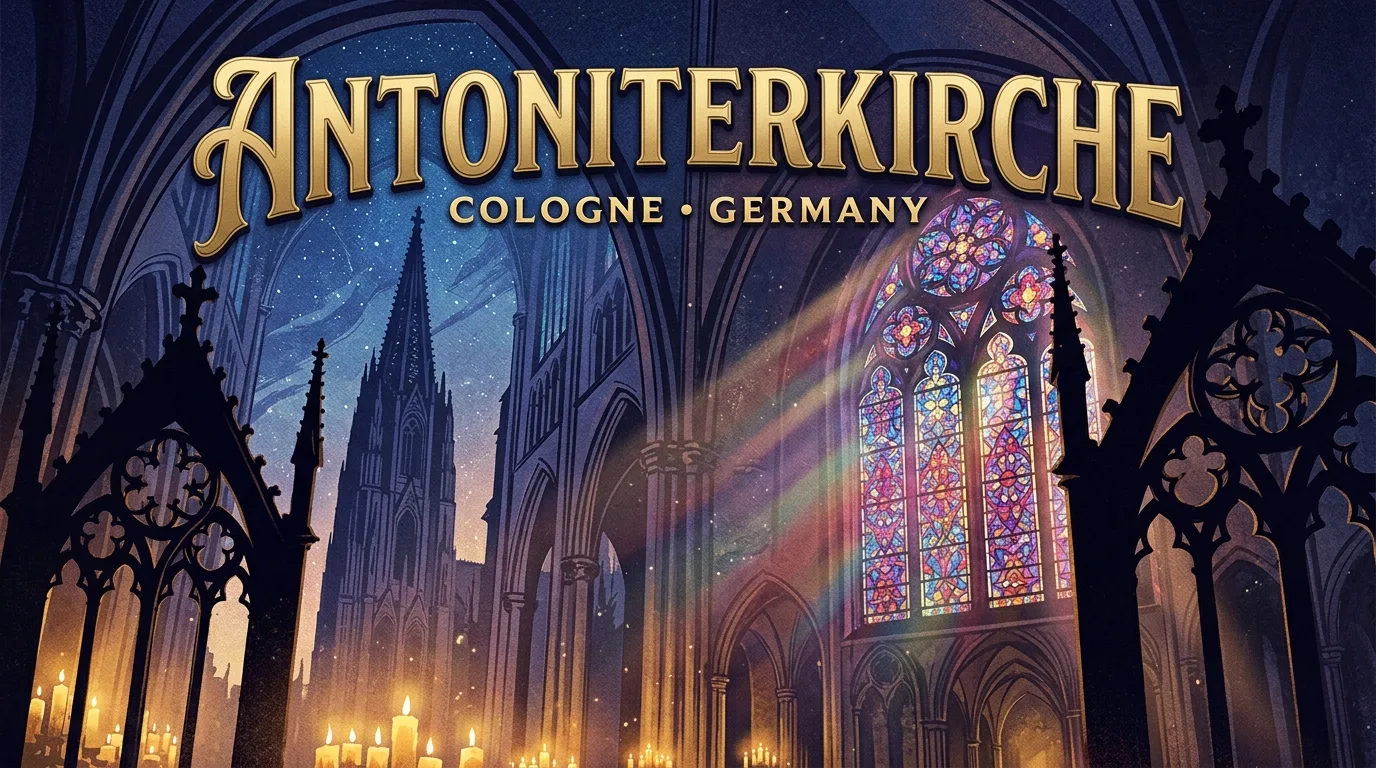
In the middle of the bustling Schildergasse, one of Europe's busiest shopping streets, an unexpected Gothic structure from the 14th century rises above the shopfronts: Antoniterkirche. Amid storefronts, pedestrian crowds and the constant hum of retail life, Antoniterkirche opens up a space of quiet that has carried history for more than six hundred years. Originally built as the monastery church of the Order of Saint Anthony, the building today ranks among Cologne's most significant Protestant churches and is, after Cologne Cathedral, the second most visited church in the city. Stepping through the unassuming façade at Schildergasse 57, visitors encounter a striking contrast: outside, the hectic pace of a modern inner city; inside, Gothic vaulting, medieval architecture, and in Ernst Barlach's sculpture "Der Schwebende" one of the most moving works of art commemorating the victims of the World Wars. Antoniterkirche is therefore far more than a place of worship - it is a memorial, an art space, and an urban refuge all at once.
History of Antoniterkirche
The origins of Antoniterkirche date back to the middle of the 14th century. Between roughly 1350 and 1378, the Order of Saint Anthony - a hospital order originally founded in France and dedicated to caring for the sick, particularly those suffering from the condition known as "St. Anthony's fire" - built its Cologne monastery church on this site. The order commissioned a three-aisled Gothic hall church with a polygonal choir, an unusual design for Cologne in that the building was deliberately given no tall tower, only a slender roof rider (Dachreiter) above the ridge. For centuries the building served as the center of the Antonite convent, until the upheavals of the French Revolution and the subsequent French occupation of Cologne ended monastic life there in 1794. The monastery was secularized and its property transferred to the state.
A decisive turn in the church's history came in 1802, when the French administration offered Cologne's Protestant congregation, which until then had relied on private houses for worship, a choice among several former monastery churches. The congregation chose Antoniterkirche, which, after renovations suited to Reformed liturgy, was solemnly reopened on Whitsunday 1805. It thereby became the first Protestant church in a city that remained overwhelmingly Catholic - a historical distinction it still carries today. During the Second World War, an air raid in 1942 severely damaged the church, destroying large parts of its roof structure and interior. Reconstruction lasted from 1946 to 1952 under architect Georg Eberlein, who preserved the Gothic fabric of the building while also creating space for a new artistic centerpiece that would make the church famous far beyond Cologne.
Highlights of Antoniterkirche
The undisputed centerpiece of Antoniterkirche is the bronze sculpture "Der Schwebende" ("The Floating One") by sculptor Ernst Barlach. Barlach created the figure in 1927, originally as a war memorial for the cathedral in Güstrow, Mecklenburg - an androgynous, cloaked angel with closed eyes and arms crossed over its chest, appearing to hover weightlessly in space. The figure's face bears the features of the artist Käthe Kollwitz, a close friend of Barlach's throughout his life. The National Socialists denounced the work as "degenerate art," had it removed from the church in Güstrow in 1937, and melted it down. Only because a plaster cast survived could the sculpture be recreated in bronze after the war. One of these recastings found its place in the rebuilt Antoniterkirche in 1952, where it has since hovered in the nave above a memorial plaque set into the floor. The plaque bears the dates of the First World War as well as the years 1933 to 1945, turning the figure into one of the most powerful memorials against war and tyranny anywhere in Germany.
Beyond "Der Schwebende," further works by Barlach are displayed within the church and adjoining spaces, making Antoniterkirche an informal venue for modern religious art in the heart of Cologne. Architecturally, the church impresses with its restrained, light-filled Gothic hall structure: slender clustered piers carry the vaulting, large windows admit ample daylight even on overcast days, and the polygonal choir provides a calm, meditative conclusion to the space. Visitors would do well to simply take in the atmosphere itself: amid the retail bustle of Schildergasse, the silence inside Antoniterkirche feels almost meditative, and many visitors deliberately seek it out as a counterpoint to the noise outside.
Opening Hours, Tickets & How to Get to Antoniterkirche
Antoniterkirche is located in the heart of Cologne's city center at Schildergasse 57, 50667 Köln, just a short walk from Neumarkt and the Hohe Straße shopping district. Visiting the church is free of charge - no admission fee is charged, since it functions as an active place of worship rather than a museum in the classic sense. Visitors can generally enter the church Tuesday to Friday from 11 a.m. to 6 p.m., Saturday from 11 a.m. to 5 p.m., and Sunday from 11 a.m. to 5:30 p.m.; the church is closed on Mondays. As an active parish church, opening hours may vary on public holidays, during services, or during special events, so it is advisable to check the current times on the official website of Antoniter City Kirche before visiting. Regular worship services take place on Sundays at 10 a.m., complemented by short, roughly ten-minute midday devotions on weekdays, which offer office workers and tourists passing through the shopping street a quiet pause.
Getting to Antoniterkirche is remarkably easy thanks to its central location: the church sits directly on the Schildergasse pedestrian zone and is reachable in under five minutes on foot from the Neumarkt stop, served by numerous light-rail lines. The church is also an easy walk from Cologne's main train station and from Cologne Cathedral. Parking is available in several multi-story car parks around Neumarkt and Cäcilienstraße, since Schildergasse itself is closed to motor traffic as a pedestrian zone.
Attractions Near Antoniterkirche
Its location right on Schildergasse makes Antoniterkirche an ideal starting point for exploring Cologne's city center. Schildergasse itself is one of the highest-grossing shopping streets in Germany, lined with department stores, boutiques, and cafés perfect for a leisurely stroll. Just a few minutes' walk away lies Neumarkt, one of the city's largest squares, which regularly hosts markets, events, and seasonal attractions and also serves as a major hub of Cologne's light-rail network. Heading toward the Rhine, a walk of roughly ten to fifteen minutes brings visitors to Cologne Cathedral with its iconic twin spires, a UNESCO World Heritage Site and the city's best-known landmark. Along the way, visitors pass the WDR broadcasting buildings as well as other historic churches in Cologne's old town, such as St. Aposteln and the Minoritenkirche. Travelers with extra time after visiting Antoniterkirche can also head to the Schnütgen Museum or the Kolumba Museum, both known for their collections of medieval and contemporary art, which pair thematically well with the atmosphere of Antoniterkirche.
Where to stay in Cologne, Germany
Compare current hotel prices and find the right place to stay.