Alter Markt
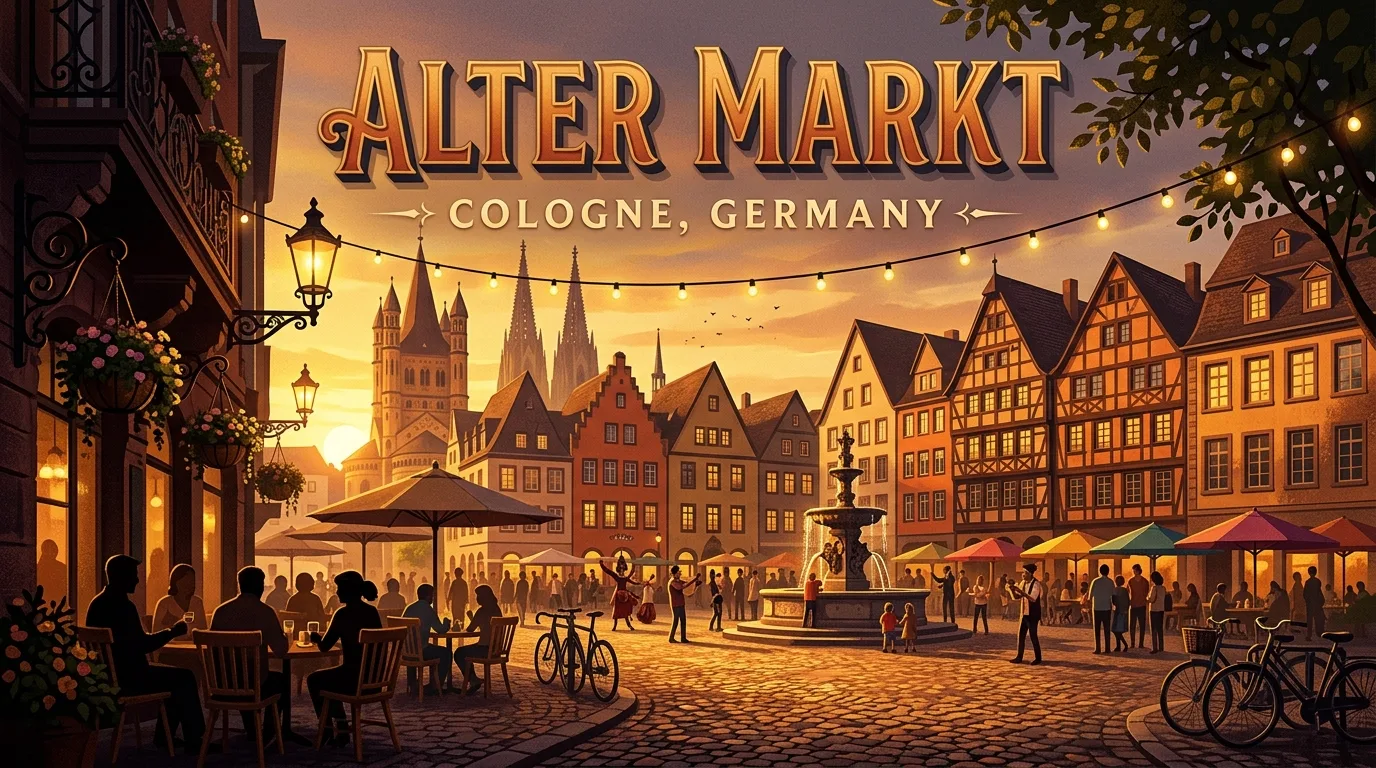
Alter Markt is one of the oldest and most historically rich squares in Cologne's old town, lying just a few steps from the Rhine and the Historic Town Hall. Framed by colorful gabled houses, traditional brewery pubs, and lively restaurants, the square has served as a meeting point for locals and visitors alike for centuries. During Carnival season in particular, Alter Markt transforms into one of the liveliest hubs in the city, as costumed revelers fill the narrow surrounding lanes and the air fills with music and singing. Yet the square is well worth a visit outside the famous fifth season too: the blend of medieval history, baroque architecture, and buzzing everyday life makes Alter Markt a place where Cologne's eventful past can be experienced firsthand. Anyone wandering through the narrow streets of the old town will almost inevitably stumble upon this spacious, sun-drenched square, shaped by outdoor dining in summer and the glow of its Christmas market in winter.
History of Alter Markt
The history of Alter Markt stretches back to Roman times: archaeological investigations have shown that during the Roman era, an arm of the Rhine ran through the area of Alter Markt and Heumarkt, its riverbed now lying roughly 13 meters beneath today's surface. As an independent marketplace, Alter Markt is first documented in the year 922, making it one of the oldest recorded gathering places in the city. During the Middle Ages, the area surrounding the square became the preferred residential district for Cologne's upper class and wealthy patrician families, who built their townhouses here. After 1024, the Archbishop of Cologne even established a mint in the immediate vicinity of the square, a sign of the considerable economic importance this location held in high medieval Cologne. Over the centuries, Alter Markt served as a central trading place, especially for vegetables, fruit, and other goods, while the surrounding gabled houses grew into one of the most picturesque townscapes in all of Cologne. One of the oldest surviving buildings, the so-called Gaffelhaus at number 20-22, dates back in its core structure to as early as 1213. The darkest chapter in the square's history came during the Second World War: air raids in May 1942 and again in June 1943 almost completely destroyed the historic gabled houses surrounding Alter Markt. After the war, reconstruction deliberately followed a historicizing style, so that the square today once again displays the characteristic, uniform row of gabled facades reminiscent of the pre-war era, even though the actual building fabric is modern.
Highlights of Alter Markt
At the center of the square stands the Jan-von-Werth Fountain, erected in 1884 at a considerable cost of 20,000 marks at the time. The fountain tells the well-known Cologne love legend of Jan von Werth, a simple cavalry groom who fell in love with the washerwoman Griet, only to be initially rejected by her. Years later, when he returned as a highly decorated general, Griet is said to have regretted her refusal, a story that still stands today as a symbol of the saying that it is never too late to try your luck. Just steps from the fountain sits the curious figure known as the Platzjabbeck, a grimacing stone face sticking out its tongue from one of the house facades, typical of Cologne's quirky local humor and fondly regarded by locals as the square's unofficial guardian spirit. Alter Markt directly borders the Historic Town Hall with its striking Renaissance tower, one of the city's most significant secular buildings, architecturally bridging the Gothic town hall loggia and a representative tower structure. Just a few meters away stands the imposing Gürzenich, Cologne's traditional festival hall, used since the 15th century for balls, concerts, and above all the lavish Carnival sessions. Numerous typical Cologne brewery taverns line the square, where the local top-fermented beer Kölsch is traditionally served in slender glasses known as Stangen. In summer, the entire square turns into one continuous open-air dining area, while during the Christmas season, the charmingly designed market known as Heinzels Wintermärchen with its handcrafted stalls creates a festive atmosphere. The true highlight of the year, however, remains the Cologne Carnival season, traditionally kicked off on November 11th, during which Alter Markt becomes one of the central stages for the city's exuberant celebrations.
Opening Hours, Tickets & How to Get to Alter Markt
Since Alter Markt is a public city square rather than a ticketed attraction, visiting is free of charge and possible at any time, the square is accessible 24 hours a day, 365 days a year. Only the surrounding restaurants, brewery pubs, and cafes follow regular restaurant hours, with many establishments opening in the late morning and serving guests well into the late evening. Getting to Alter Markt is remarkably simple, as it sits right in the heart of Cologne's old town. By public transport, the best way to reach the square is via the Heumarkt light rail stop, served by several tram lines and located just a few minutes' walk away; alternatively, the Dom/Hauptbahnhof stop is a good option, from which it takes roughly ten to fifteen minutes on foot through the picturesque old town lanes to reach the square. From Cologne's main railway station, which is also the central hub for long-distance and ICE train connections, Alter Markt is an easy twelve-minute walk away. Drivers should keep in mind that the entire old town is largely traffic-calmed or designated as a pedestrian zone, making arrival by private car impractical. It is therefore advisable to use one of the nearby parking garages, for example along the Rhine riverside or near Heumarkt, from which the square can be reached on foot within a few minutes. Arriving by bicycle is also a popular and increasingly common option thanks to the excellent network of cycling paths along the Rhine.
Attractions Near Alter Markt
The central location of Alter Markt in the heart of historic Cologne makes it an ideal starting point for discovering further old town attractions on foot. Just a few steps away lies Fischmarkt, a smaller but equally atmospheric square directly on the Rhine riverbank, charming visitors with its colorful half-timbered houses and its immediate proximity to the Romanesque church of Groß St. Martin. Heading east, visitors quickly reach Heumarkt, one of Cologne's largest squares, home to the equestrian monument of Friedrich Wilhelm III and numerous traditional brewery taverns. The world-famous Cologne Cathedral, with its striking Gothic towers, is also just a short ten-minute walk away and should not be missed on any visit to the old town. The Rhine promenade offers a wonderful place for a stroll, with views of the Hohenzollern Bridge and the modern architecture of the Rheinauhafen harbor district across the river. Culture enthusiasts will also enjoy a visit to the nearby Museum Ludwig or the Chocolate Museum at Rheinauhafen, both within comfortable walking distance of the square.
Where to stay in Cologne, Germany
Compare current hotel prices and find the right place to stay.