Wilhelm-Marx-Haus
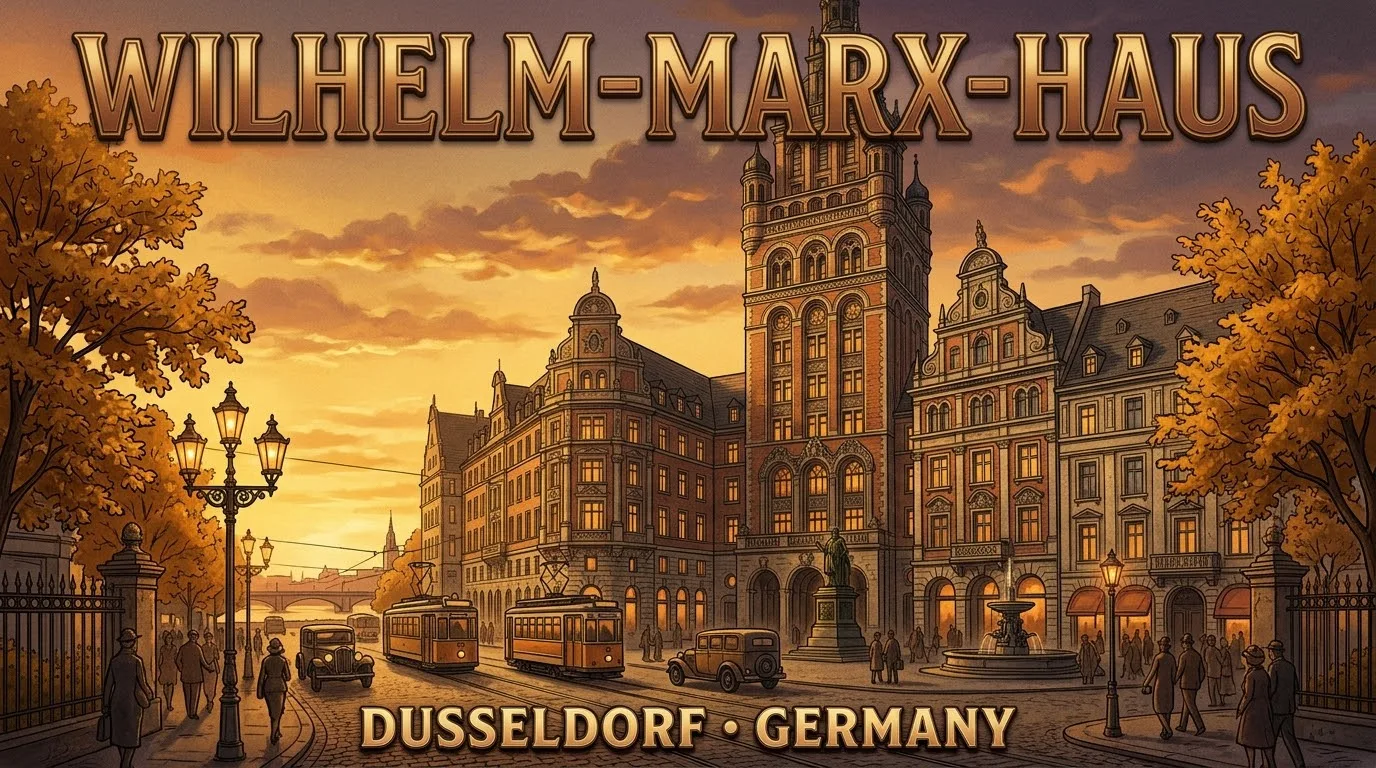
Rising above the heart of Düsseldorf's Altstadt, just steps from the Rhine promenade, the Wilhelm-Marx-Haus stands as one of the most striking examples of 1920s German high-rise architecture. With its bold brick facade, stepped crown and an unusual height of 57 meters for its era, the building was counted among the tallest reinforced concrete structures in Europe upon completion. Today the Wilhelm-Marx-Haus is not only a protected architectural monument but also a living part of the city center, home to shops, cafés and a small theatre on its ground floor. For anyone interested in the history of early European skyscrapers, in the brick expressionist style, or simply in how Düsseldorf transformed itself in the early twentieth century, this building offers far more than its everyday role as an office and retail block might suggest.
History of Wilhelm-Marx-Haus
The origins of the Wilhelm-Marx-Haus lie in a period of profound change for Düsseldorf. In the early 1920s the city sought to present itself as a modern metropolis and an economic powerhouse of the Rhineland, and the driving force behind this ambition was the mayor at the time, Wilhelm Marx, after whom the building was later named. Constructing a true high-rise was intended as a statement, underlining Düsseldorf's claim to economic and urban significance at a moment when German cities were only beginning to experiment with tall buildings. The design was entrusted to Wilhelm Kreis, a renowned architect who taught at the Kunstakademie Düsseldorf and ranked among the most influential German builders of his generation. Constructed between 1922 and 1924 on what is now Heinrich-Heine-Allee, the building combined a strict, vertically articulated brick facade with a stepped-back upper section, drawing clear inspiration from contemporary American skyscrapers while developing its own distinctive expressionist vocabulary rooted in German brick architecture. With twelve to thirteen stories and a height of 57 meters, the Wilhelm-Marx-Haus was at one point regarded as one of the tallest reinforced concrete buildings in Europe and was widely seen, far beyond Düsseldorf itself, as a symbol of the modern city. Inside, the elaborately designed entrance hall impressed visitors with its natural stone cladding, from which a carved stone tiger figure survives to this day and remains a favorite photo subject. During the Second World War, Düsseldorf suffered extensive bombing, and the Wilhelm-Marx-Haus was not spared: the upper floors sustained significant damage, which was repaired in a simplified form during the postwar years, resulting in the loss of part of the original stepped roofline. Despite these alterations, the core structure of the building survived intact, and in 1984 the Wilhelm-Marx-Haus was officially placed under heritage protection in recognition of its architectural and urban-historical importance. Over the following decades the building housed, among other tenants, the Rhenish-Westphalian Stock Exchange of Düsseldorf, before gradually evolving into a mixed-use commercial property with banks, offices and retail units. A comprehensive renovation in the 1990s restored historical elements and modernized the building's technical infrastructure without compromising the character of its facade.
Highlights of Wilhelm-Marx-Haus
The most striking feature of the Wilhelm-Marx-Haus is undoubtedly its facade: deep reddish-brown bricks, combined with vertical window bands and a slightly recessed upper section, create an almost cathedral-like effect typical of the brick expressionism of the Weimar era. In the late afternoon light in particular, the facade takes on a warm, almost shimmering quality that attracts photographers and architecture enthusiasts alike. Visitors entering the building should take time to admire the historic entrance hall, where natural stone cladding, decorative ceiling elements and the aforementioned stone tiger figure convey a sense of the representative ambitions the building once embodied. This tiger figure, an unusual detail for a 1920s commercial building, has over the decades become something of an unofficial emblem of the structure and is fondly regarded by many Düsseldorf residents as a charming curiosity. Another highlight is the Wilhelm-Marx-Haus's inner courtyard, which functions as a covered passage linking several entrances and today hosts cafés, small shops and seasonal market stalls. This passage connects Heinrich-Heine-Allee with the surrounding alleys of the Altstadt and is used by many visitors simply as a pleasant, covered shortcut through the city center, quite apart from its architectural interest. The ground floor also houses the Junges Theater in der Altstadt, known as JuTA, a stage dedicated to contemporary drama that lends the historic building an active cultural life. Architecture enthusiasts should also pay attention to the roofline: despite wartime damage and the simplified postwar reconstruction, traces of the originally stepped, crown-like silhouette can still be made out and compared with historical photographs and illustrations from the 1920s. The building's location directly above and beside the Heinrich-Heine-Allee subway station is also technically remarkable: the entire structure rests on an elaborate foundation of several hundred concrete piles, an extraordinary feat of engineering for its time that made it possible to erect such a tall building on the soft, water-saturated ground near the Rhine. Together, these elements make the Wilhelm-Marx-Haus convincing both as an architectural monument and as a functioning part of modern city life.
Opening Hours, Tickets & How to Get to Wilhelm-Marx-Haus
The Wilhelm-Marx-Haus is primarily a privately used office and commercial building rather than a conventional museum, so there are no fixed opening hours and no admission fee for the building as a whole. The facade and the exterior area along Heinrich-Heine-Allee can be viewed freely and at no cost at any time, making it an easy stop during a walk through the Altstadt. The shopping passage in the inner courtyard, with its cafés and small retailers, generally follows typical Düsseldorf business hours and is usually accessible from Monday to Saturday during the daytime, though individual businesses may vary. The JuTA theatre on the ground floor publishes its own performance schedule and ticket prices for its productions, which should be booked separately from any general visit to the building. The Wilhelm-Marx-Haus enjoys an exceptionally convenient location for visitors: the Heinrich-Heine-Allee subway station sits directly beneath the building and is served by several Düsseldorf light-rail lines, making it one of the most central stops in the Altstadt. Visitors arriving by car will find several paid parking garages nearby, for instance near Schadowplatz or close to Carlsplatz, since the Altstadt itself is largely a pedestrian zone. From the Rhine promenade and Burgplatz, the building is only a few minutes' walk away, so it fits easily into a broader stroll through the old town. Since it remains an actively used commercial building, it is best visited during daytime hours when the passage and surrounding shops are open, while the illuminated facade in the evening offers an additional, more purely architectural appeal.
Attractions Near Wilhelm-Marx-Haus
The central location of the Wilhelm-Marx-Haus in Düsseldorf's Altstadt makes it an ideal starting point for exploring further historical and cultural sights. Just a few minutes' walk away lies the Rhine promenade, offering sweeping views across the river toward the striking Rheinturm tower and the modern architecture of the Medienhafen district. Equally close is Düsseldorf's Rathaus on the Marktplatz, whose Renaissance architecture provides an appealing contrast to the modernist language of the Wilhelm-Marx-Haus. Fans of church architecture will find the Basilica of St. Lambertus, one of the city's oldest churches, within easy walking distance, instantly recognizable by its distinctively twisted spire. The Altstadt itself, often nicknamed "the longest bar in the world," offers numerous narrow lanes around the Wilhelm-Marx-Haus lined with traditional breweries serving the local Altbier. A short walk further brings visitors to Carlsplatz with its lively market, while the elegant Königsallee, affectionately known as the "Kö," with its boutiques and accompanying canal, is also reachable on foot. The Düsseldorf Schauspielhaus and several smaller galleries and museums in the city center lie within comfortable reach as well, making it easy to combine a visit to the Wilhelm-Marx-Haus with a more extensive tour of Düsseldorf's historic heart.
Where to stay in Dusseldorf, Germany
Compare current hotel prices and find the right place to stay.