Tritonbrunnen
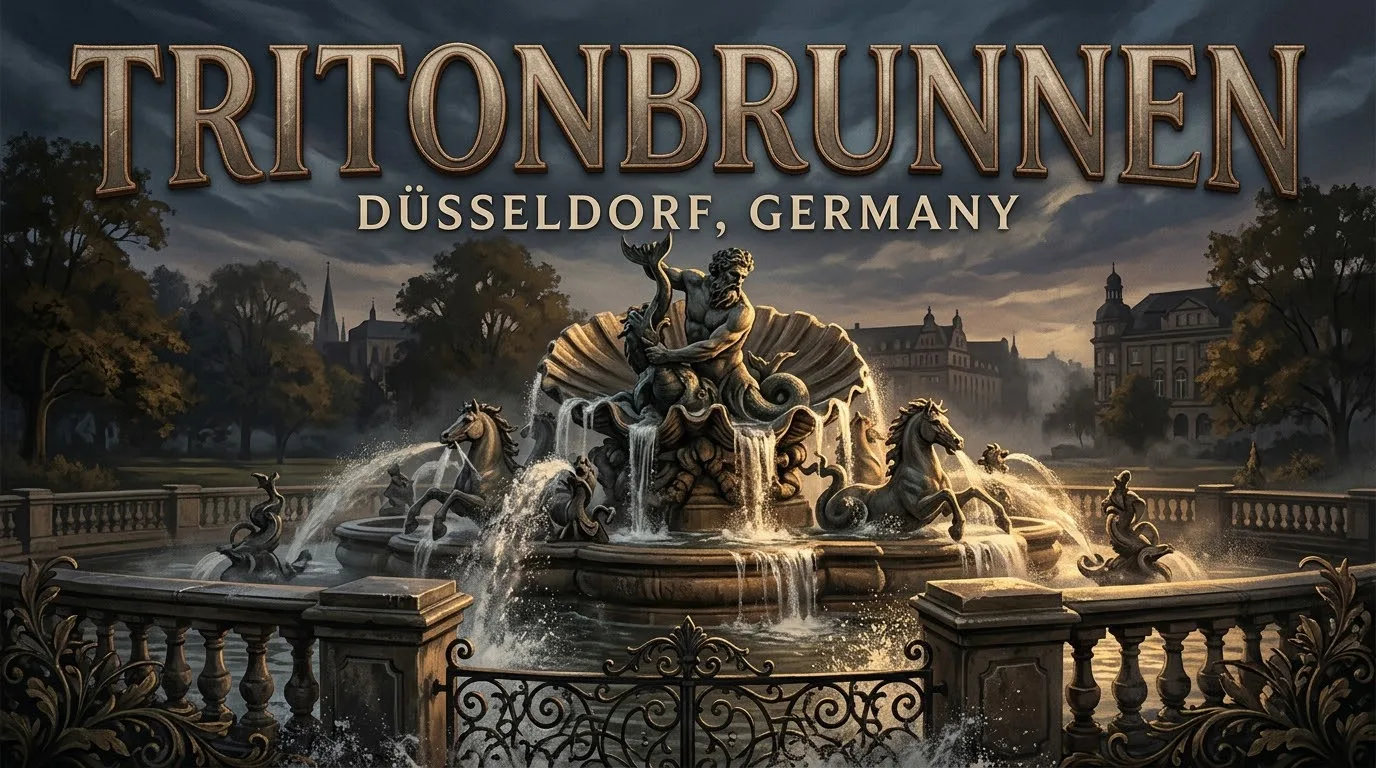
At the northern end of the world-famous Königsallee, where the so-called Stadtgraben moat reaches its elegant conclusion, stands a work of pale limestone architecture and bronze sculpture that continues to invite even seasoned Düsseldorf residents to pause and look: the Tritonbrunnen. The fountain forms the grand visual climax of the water-filled moat that runs alongside the full length of the Königsallee, one of Germany's most famous promenades. At the center of this elaborate composition, the Greek sea god Triton wrestles with an enormous fish while two small water-children play around him, a motif that impressively combines mythology, waterworks engineering, and civic grandeur. Anyone entering the "Kö," as locals affectionately call the Königsallee, from the north has the Tritonbrunnen directly in view, experiencing one of the most beautiful architectural transitions in the entire city center.
History of Tritonbrunnen
The Tritonbrunnen was built between 1898 and 1902 to designs by Düsseldorf sculptor Friedrich Coubillier, creating one of the city's most architecturally ambitious fountain structures around the turn of the century. Its construction coincided with a period when the Königsallee had already risen to become one of Düsseldorf's most prestigious addresses, and the city placed great importance on giving its central promenades a representative, metropolitan design. Coubillier conceived the fountain as a stone, bridge-like balustrade that visually closes off the northern end of the Stadtgraben while being adorned with decorative vases and numerous putti. The pale French Euville limestone chosen as the building material still gives the fountain its characteristic warm coloring today. At the center of the structure stands the bronze figure of Triton, who in Greek mythology is the son of the sea god Poseidon and ruler of the waves. Coubillier's depiction shows Triton locked in combat with an oversized, water-spouting fish, armed with a spear and a knife, while two naked water-children, known as putti, wrestle alongside him. The artistic quality of the work proved so influential that it inspired fellow sculptor Joseph Hammerschmidt to create the equally famous "Jröne Jong" statue as early as 1899. Since 1994, the entire ensemble of the Königsallee, the Stadtgraben, and its accompanying garden landscaping has been protected as a historic monument, further underscoring the outstanding significance of the Tritonbrunnen within the city's history.
Highlights of Tritonbrunnen
The particular appeal of the Tritonbrunnen lies in the interplay of architecture, sculpture, and water. The stone balustrade, with its sweeping lines and richly decorated vases, resembles a small bridge and creates a harmonious transition between the water of the Stadtgraben and the adjoining street level of the Königsallee. At the center, the dramatic bronze group immediately catches the eye: Triton, depicted as muscular and powerful, subdues a giant fish with spear and knife, water streaming from its mouth into the basin below, a lively, almost theatrical scene that is especially striking in sunlight, when the shimmering water comes fully alive. The two putti clinging combatively to the fish add further dynamism and a touch of childlike playfulness amid the mythological struggle. Its position right at the northern end of the Königsallee makes the fountain a popular photo subject, as the elegant commercial architecture of the "Kö" and the plane-tree-lined promenade along the Stadtgraben often frame the scene in the background. In the evening especially, once the surrounding lighting comes on, the pale limestone takes on a warm, almost golden glow. Architecture and art enthusiasts will also find it rewarding to examine the intricate details of the balustrade, which remain in remarkably good condition despite being well over 120 years old.
Opening Hours, Tickets & How to Get to Tritonbrunnen
The Tritonbrunnen stands freely accessible in the public space at the northern end of the Königsallee, so there are no fixed opening hours and no admission fee; the fountain can be visited free of charge at any time. During the warmer months the water feature typically runs continuously, while in very cold winter months it is occasionally switched off briefly for technical reasons; the stone architecture and bronze figures remain unaffected and can be admired year-round. The Königsallee lies centrally within Düsseldorf's city center and is excellently served by public transport: the Steinstraße/Königsallee stop is served by several tram and bus lines and lies just a few minutes' walk from the fountain. The main railway station is also directly connected to the Königsallee by underground within a few minutes, or alternatively the walk from the station takes about 15 to 20 minutes. Drivers will find several paid parking garages along the Königsallee and in adjoining side streets, since traffic on the avenue itself is restricted. The Tritonbrunnen is also conveniently reached by bicycle via the city center's well-developed cycle paths.
Attractions Near Tritonbrunnen
The Tritonbrunnen marks the starting point of the famous walk along the Königsallee, both sides of which are lined with elegant shops, boutiques, and cafés, making it one of Europe's best-known shopping streets. Just a few minutes south, visitors will find the "Jröne Jong" statue, inspired by the success of the Tritonbrunnen and likewise standing along the Stadtgraben. Following the Königsallee further toward the Altstadt leads, after a short walk, to the Marktplatz with its Jan-Wellem-Reiterstandbild as well as to Burgplatz with the Schlossturm, the Stadterhebungsmonument, and the Radschlägerbrunnen. The Hofgarten, Germany's oldest public park, is also within comfortable walking distance and offers a green retreat after a stroll along the Kö. Culture enthusiasts can additionally make a short detour to the nearby Schauspielhaus theatre or to the Kunstsammlung Nordrhein-Westfalen art museum at Grabbeplatz. For a break, the numerous cafés and restaurants along the Königsallee offer both international cuisine and traditional Rhenish dishes.
It is also worth noting the urban-planning context in which the Tritonbrunnen was created: the Königsallee itself was laid out in the first half of the 19th century on the remains of the old city fortifications, with the Stadtgraben preserved as a water-filled canal that became a central design element of the promenade. The Tritonbrunnen deliberately serves as the representative counterpart to a similar fountain at the southern end of the avenue, creating a symmetrical, self-contained overall composition for the entire promenade. This thoughtful design explains why the Königsallee is still regarded as one of the finest examples of metropolitan urban planning in the Rhineland and is regularly discussed in scholarly publications on Düsseldorf's urban development history. Visitors interested in garden design and historic city planning will therefore find it rewarding not only to admire the fountain itself but also to walk the full length of the Stadtgraben to experience the harmonious interplay of water, architecture, and planting in its entirety.
Where to stay in Dusseldorf, Germany
Compare current hotel prices and find the right place to stay.