Tonhalle Terrace
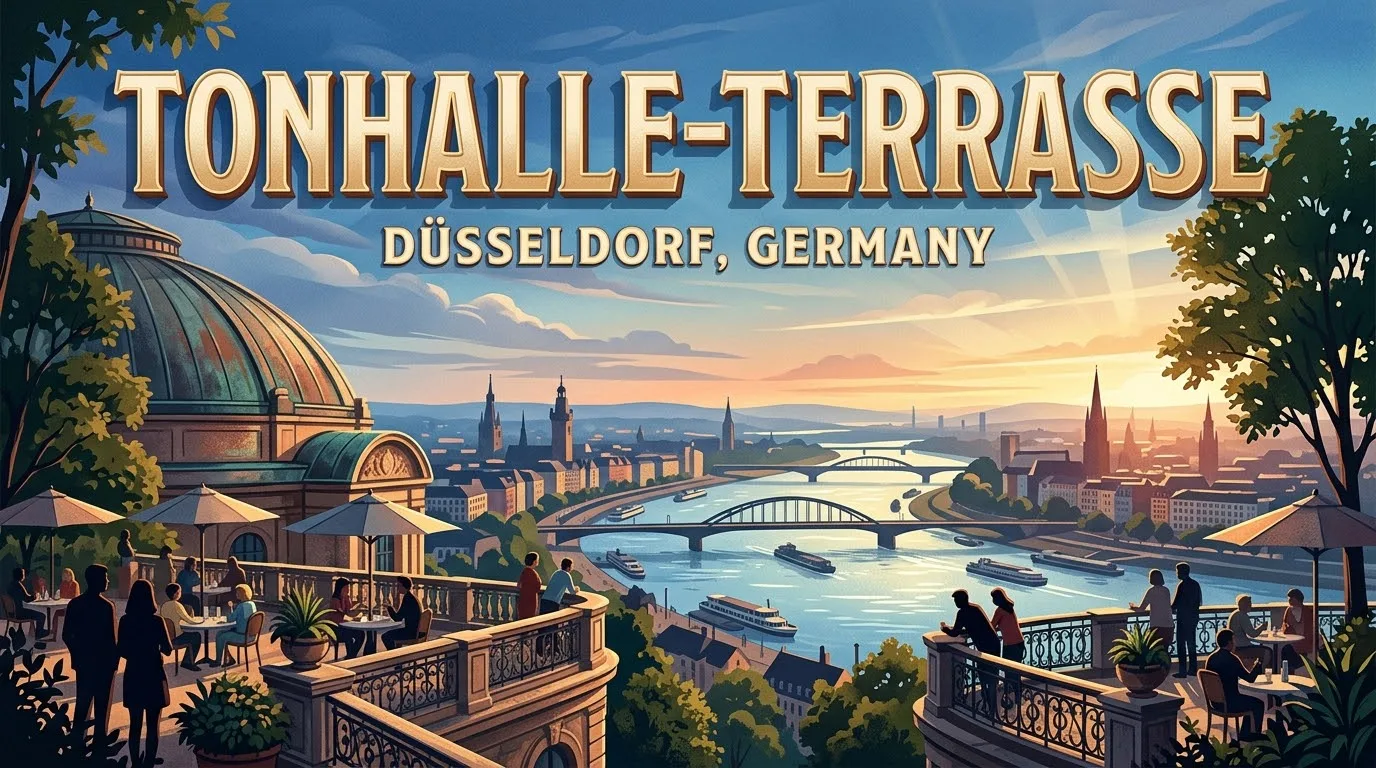
Right on the eastern bank of the Rhine in the Pempelfort district, at the foot of the striking expressionist dome of the Tonhalle, lies one of the quietest and yet most beautiful viewing terraces in Düsseldorf. While crowds of visitors gather just a few hundred metres south at Burgplatz and in the Altstadt, the Tonhalle Terrace on the Joseph-Beuys-Ufer offers a noticeably more relaxed, almost local view of the Rhine. From here, the eye travels across the wide riverbed toward the Theodor-Heuss-Brücke, with its slender, brightly lit structure, while passing cargo ships and excursion boats are reflected in the water. Especially in the evening, as the sun sets behind the opposite bank and the bridge lighting switches on, this spot transforms into one of the most atmospheric photo locations in the city - something of an insider tip, far better known among Düsseldorf locals than among most visitors. The proximity to the Tonhalle itself and the entire Ehrenhof ensemble, including the Museum Kunstpalast, lends the place an additional cultural atmosphere that rounds off a walk along the river into a complete experience.
History of Tonhalle Terrace
The terrace is inseparably linked to the history of the entire Ehrenhof ensemble, built in 1925 and 1926 for the GeSoLei, the "Great Exhibition for Health Care, Social Welfare and Physical Exercise." With around 7.5 million visitors, this exhibition was the largest trade fair event of the entire Weimar Republic and briefly turned Düsseldorf into one of the most closely watched exhibition venues in Europe. This massive wave of construction also produced today's Tonhalle, originally built under the name "Rheinhalle" to designs by architect Wilhelm Kreis and conceived so that it could serve either as a planetarium or as a multipurpose hall. Its location directly on the Rhine was no coincidence: the designers of the Ehrenhof wanted to create a cultural campus that deliberately opened toward the river and connected to the city via a continuous riverside promenade. During the Second World War, the Rheinhalle was heavily damaged, and its reconstruction into today's concert hall took place between 1976 and 1978, followed by a comprehensive renovation in 2005. The riverside terrace itself was repeatedly adapted and expanded over the course of the Ehrenhof's development, yet it has remained consistently true to its original function: a freely accessible public space by the river where culture, nature and city life meet. The Hofgartenrampe bordering it to the south, leading toward the Oberkasseler Brücke, and the Theodor-Heuss-Brücke to the north mark the two fixed points between which the view from the terrace unfolds, a reminder that this stretch of river has always been a central space for traffic and encounter in the city.
Highlights of Tonhalle Terrace
The greatest appeal of the Tonhalle Terrace lies in its calm, almost maritime atmosphere, which differs markedly from the busier viewpoints of the Altstadt. From the wide steps and seating areas along the riverbank, visitors look directly toward the Theodor-Heuss-Brücke, whose clean, modern lines form an appealing contrast with the historic facades of the Ehrenhof in the background. This spot is especially popular among locals as an after-work meeting point: sitting on the steps down to the Rhine with a drink in hand, watching the ships pass by, is for many Düsseldorf residents one of the loveliest rituals of a summer evening. During the golden hour, the low-hanging sun bathes the water's surface in golden and reddish tones, shortly followed by the first lights of the bridge and the Rhine meadows on the opposite bank beginning to shimmer on the river's surface - a spectacle that regularly draws photographers to this spot. The view in the other direction is equally rewarding: along the riverbank, visitors can admire the elegant facade of the Tonhalle, with its copper-clad dome and characteristic expressionist decorative bands, before the view shifts further south toward the Hofgartenrampe and the Oberkasseler Brücke. Architecture enthusiasts also find plenty to appreciate here, since the terrace makes it particularly easy to trace the transition between the historic fabric of the Ehrenhof and the more modern riverbank reinforcements, which have been repeatedly adapted over the decades to meet flood protection requirements. In spring and summer, the blossoming trees along the Joseph-Beuys-Ufer turn the terrace into a shaded retreat, while in autumn the warm light of the low sun bathes the Tonhalle dome in its characteristic weathered copper-green, one of the most frequently photographed details of the entire ensemble. On mild evenings, the square around the fountain in front of the Museum Kunstpalast, just a few steps from the terrace, also turns into a lively gathering spot, making it easy to combine a visit to the terrace with a short walk through the entire Ehrenhof ensemble. Visitors hoping to catch a glimpse of concertgoers will also find a particular charm on performance evenings, when elegantly dressed guests gather along the riverbank before the concert begins.
Opening Hours, Tickets & How to Get to Tonhalle Terrace
The terrace along the Joseph-Beuys-Ufer is a public outdoor space, freely accessible at all times and at no cost, with no fixed opening hours or admission fees. The most rewarding time to experience it is in the evening around sunset, when both the natural light and the illumination of the Theodor-Heuss-Brücke come into their own; on warm summer days, visitors should expect correspondingly larger crowds. The terrace is located in the Pempelfort district, directly at the Ehrenhof between the Tonhalle and the Museum Kunstpalast. By public transport, it is conveniently reached via the "Tonhalle/Ehrenhof" light rail and tram stop, just a short walk from the riverbank. On foot, the terrace can be reached from the Altstadt in about 15 to 20 minutes along the Rhine promenade, a route that itself offers numerous beautiful views of the river along the way. Parking can be found near the Ehrenhof as well as in the surrounding side streets of Pempelfort. The path to the terrace is level and step-free, making the location well suited to families with strollers and visitors with limited mobility.
Attractions Near Tonhalle Terrace
Directly adjoining is the entire Ehrenhof ensemble, including the Museum Kunstpalast, home to one of North Rhine-Westphalia's most significant art collections, as well as the NRW-Forum, which regularly hosts changing exhibitions on contemporary culture and photography. Just a few minutes' walk south, via the Hofgartenrampe, lies the Oberkasseler Brücke, with its famous panoramic view of the Altstadt skyline and the Rheinturm. The expansive Hofgarten, the oldest public park in Germany, also adjoins the area to the south and is ideal for an extended stroll after visiting the terrace. Heading north along the riverbank, the path leads toward the Theodor-Heuss-Brücke and onward to Rheinpark Golzheim with its sweeping green spaces. Visitors wishing to continue into the city centre from the terrace can reach Burgplatz, the Schlossturm, and the historic Altstadt with its traditional breweries in about 20 minutes along the Rhine promenade.
Where to stay in Dusseldorf, Germany
Compare current hotel prices and find the right place to stay.