Tonhalle Düsseldorf
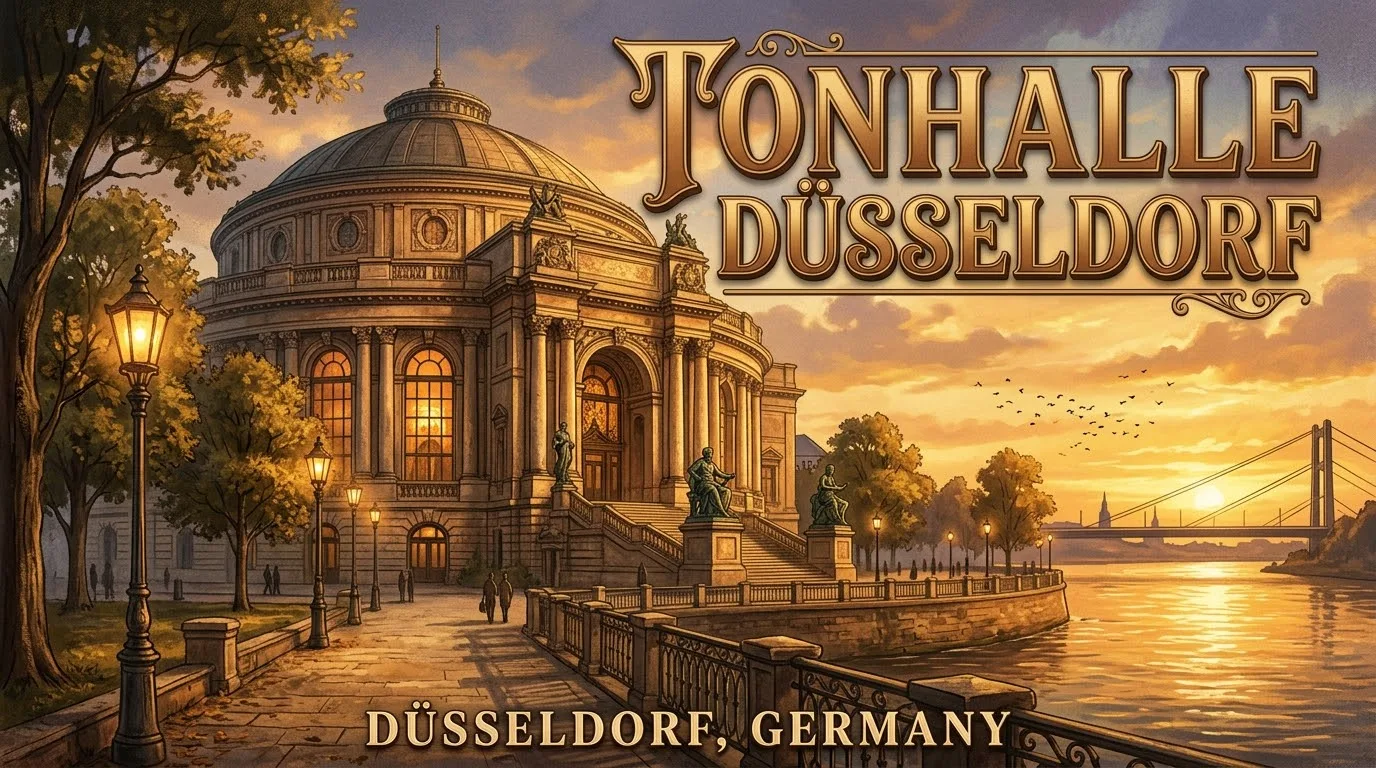
Tonhalle Düsseldorf, with its striking dome, is one of Europe's most unusual concert halls and has been the city's musical calling card for decades. The circular building at the transition between Pempelfort and the Rhine promenade was not originally built as a concert hall at all, but as a monumental multipurpose hall with an integrated planetarium - a dual function still legible today in its unusual dome construction. Today, the Tonhalle is the home venue of the Düsseldorfer Symphoniker and hosts around 300 concerts a year, ranging from classical orchestral music to jazz and world music. For music lovers and architecture enthusiasts alike, a visit to the Tonhalle is among the highlights of any stay in Düsseldorf.
History of Tonhalle Düsseldorf
The Tonhalle was built in 1925/26 to designs by architect Wilhelm Kreis, who was also responsible for numerous other notable buildings in Düsseldorf, including the nearby Wilhelm-Marx-Haus. The building was constructed for the great "GeSoLei" exhibition (on health care, social welfare, and physical exercise) held in Düsseldorf in 1926, which required a representative large hall. Remarkably, the hall was designed from the outset to double as a planetarium - under the massive 38-meter-diameter dome, star projections were shown, making it one of the largest planetarium structures of its time. The expressionist brick architecture, with its scale-like ornamentation at the base of the dome, is considered a characteristic example of the "Backsteinexpressionismus" (brick expressionism) movement of the 1920s. The building was damaged during the Second World War but survived with its basic structure intact. Between 1976 and 1978, the Düsseldorf architecture firm HPP carried out a fundamental conversion into a dedicated concert hall: beneath the reconstructed dome, a nearly hemispherical auditorium was created, which continues to define the building's distinctive acoustics today. A further major renovation in 2005 improved the room acoustics with additional reflector surfaces behind the inner dome, resolving earlier echo problems. Since this conversion, the Tonhalle has established itself as one of Germany's most acoustically demanding concert halls, its unusual round form still prized by architectural historians and musicians alike.
Highlights of Tonhalle Düsseldorf
The architectural centerpiece of the Tonhalle is its massive dome, which appears from the outside as a monumental rotunda and encloses from within an almost spherical concert hall. The main auditorium seats 1,854 and is considered one of Germany's most unusual concert halls because of its round shape and carefully engineered acoustics - musicians and audiences alike describe an unusually immediate, enveloping sound experience. Alongside the main hall, the Tonhalle has a chamber music hall with around 300 seats for more intimate concert formats, as well as a spacious circular foyer that is itself used as a venue for smaller concerts and receptions for 200 to 400 guests. The facade still displays the characteristic expressionist scale ornamentation from the 1920s, giving the Tonhalle its unmistakable silhouette on the riverbank. As the home venue of the Düsseldorfer Symphoniker, the hall regularly hosts symphonic concerts, complemented by guest performances from international orchestras, chamber music evenings, jazz and world music programs, and formats for children and families. In total, the Tonhalle hosts around 300 events a year attended by more than 300,000 visitors - an impressive level of activity for a concert hall of this size. Visitors should be sure to take a look at the foyer, whose open, circular architecture creates a fluid transition between indoor and outdoor space and, in good weather, provides access to the adjacent open area along the Rhine. The exterior also rewards a slow walk around the building, since the proportions of the dome look different from every angle.
Opening Hours, Tickets & How to Get to Tonhalle Düsseldorf
The Tonhalle is not a traditional museum with daily opening hours but an actively used concert hall - access to the building is generally tied to attending a concert. Tickets for the various concert series are available through the city's box offices as well as online, with prices varying considerably depending on the program and seating category. For visitors interested in the architecture, the Tonhalle occasionally offers public guided tours that also show areas not normally accessible, such as the stage technology or the dome construction; dates are announced on the official website. The grounds and promenade around the building can be visited free of charge at any time. The venue is easily reached by public transport: several tram and bus lines stop in the immediate vicinity, and the Tonhalle is also just a short walk from the Hofgarten and the Altstadt. Parking is available in the surrounding area for drivers, though arriving early is advisable on concert evenings, as parking near the building fills up quickly. Cyclists reaching the Tonhalle will find a continuous, well-maintained bike path running along the Rhine promenade.
Attractions Near Tonhalle Düsseldorf
The Tonhalle sits at the northern edge of the Altstadt, right at the start of the Rhine promenade, placing it close to numerous other attractions. Just a few steps away lies the sprawling Hofgarten, Düsseldorf's oldest public park, home to Schloss Jägerhof and several museums. Walking along the Rhine promenade takes visitors to the Altstadt, with its Rathaus and Marktplatz, in around 15 to 20 minutes. In the other direction lies the Ehrenhof, home to the Museum Kunstpalast and the NRW-Forum, two major cultural institutions that combine well with a concert visit. The Rheinturm and the Medienhafen are also easily reached from the Tonhalle on foot or by bike along the riverside promenade.
Where to stay in Dusseldorf, Germany
Compare current hotel prices and find the right place to stay.