Südpark
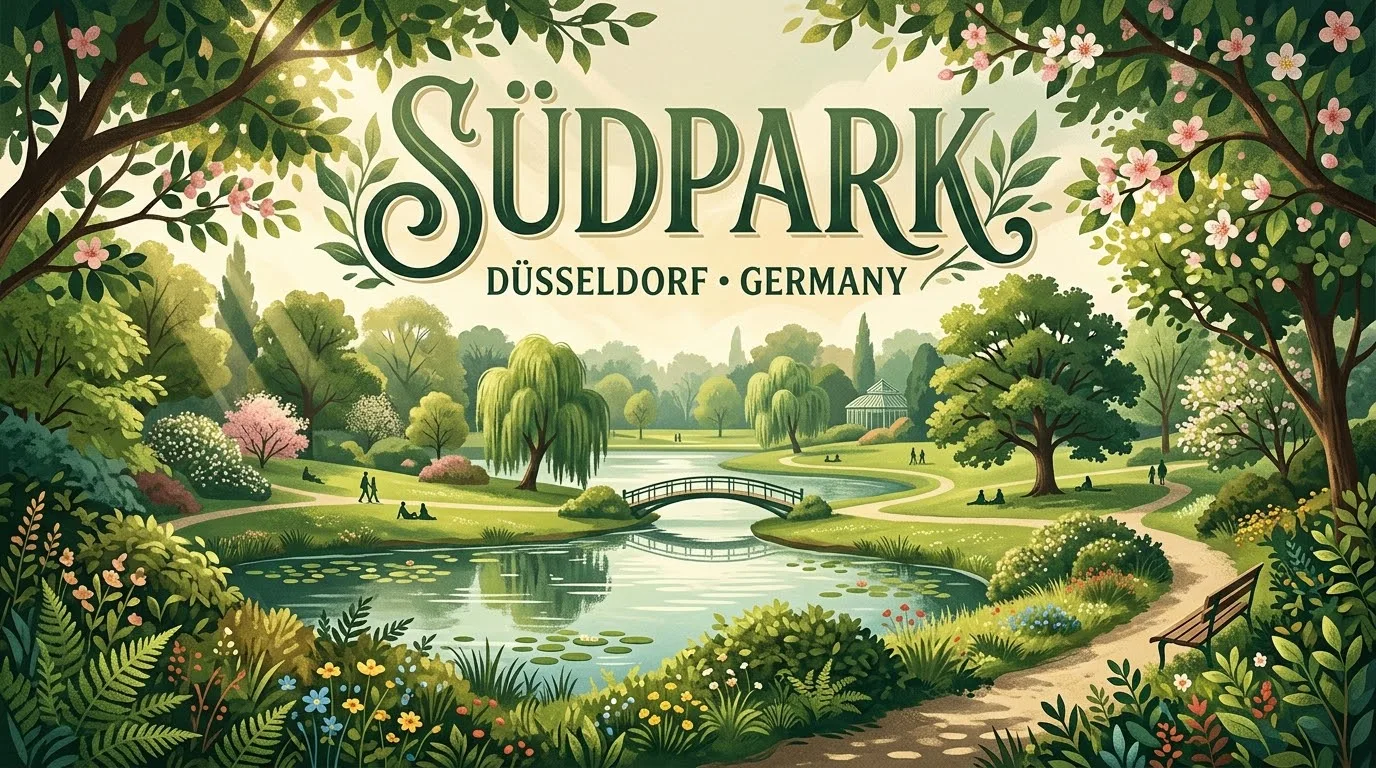
At a generous 70 hectares, Südpark is the largest and most-visited park in the North Rhine-Westphalian state capital of Düsseldorf. It lies southeast of the city centre in the districts of Oberbilk and Wersten, bordered by the railway line to Cologne in the north, Siegburger Straße and Kölner Landstraße in the east, the sunken Bundesautobahn 46 motorway in the south, and the Stoffeler Friedhof cemetery in the west. The park took its present form following designs by the Planungsgruppe Südpark for the 1987 Federal Garden Show (Bundesgartenschau), which expanded the already existing Volksgarten with large new garden areas created on former wasteland. This origin story is still reflected in the park's three distinct zones today: the natural, historic Volksgarten; the thematically arranged "In den Gärten" area; and the Rhine-facing "Vor dem Deich" zone. This combination of established parkland and thoughtfully designed garden-show architecture makes Südpark one of the most varied open spaces in the city, equally cherished by walkers, sports enthusiasts, families, and birdwatchers.
History of Südpark
The oldest part of today's Südpark, the Volksgarten, was planned as early as 1893 as a recreational park for the densely populated southern districts of the city. The city of Düsseldorf acquired roughly 11 hectares of land for this purpose in 1892 from the estate of the noble Arenberg family; since an industrial company had actually purchased the land to expand its factory, the city explicitly wrote the creation of a Volksgarten into the sales contract. Construction began in 1895, and that same year an architectural competition was held for a restaurant building within the park, won by Düsseldorf architect Peter Paul Fuchs. A dark chapter in the park's history dates to the Second World War: from October 1942, the Nazi regime built the roughly one-hectare "Stoffeln" subcamp of a concentration camp on the grounds, whose prisoners were used for forced labour throughout the city; by the time the camp was dissolved in February 1943, 111 of its approximately 600 prisoners had died. After the war, the former industrial site adjoining the Volksgarten to the south fell increasingly into disrepair, deteriorating by the 1960s into an unsightly wasteland of gravel pits, scrapyards, and overgrown allotments. The first ideas for a unified new Südpark, incorporating the Volksgarten, the Stoffeln cemetery, allotment gardens, and a groundwater lake, emerged in 1982. Following Düsseldorf's successful bid to host the 1987 Bundesgartenschau, a large-scale renovation began under plans drawn up by the Planungsgruppe Südpark, with landscape architects including Gerd Aufmkolk, Rose Böke, Wolfgang R. Mueller, and Horst Wagenfeld. Some facilities built specifically for the garden show were later removed once the event ended, though the park's underlying structure was preserved. In 2008, another round of extensive maintenance work took place, as Düsseldorf was competing at the time in the nationwide "Entente Florale Deutschland" competition — with Südpark as a central part of its entry — ultimately winning the award.
Highlights of Südpark
Each of Südpark's three characteristic zones offers its own highlights. In the oldest and, at 27 hectares, largest section — the naturally landscaped Volksgarten — Canada geese now graze regularly on the broad lawns, while a water playground delights children on warm days and grey herons are frequent visitors. To the southeast, the 20-hectare "In den Gärten" area strings together a series of themed gardens intended to inspire visitors' own gardening projects, including a fragrance garden, a rock garden, and small pond landscapes, complemented by the chemical-free VHS-Biogarten run by the city's adult education centre. At the southern end, the 23-hectare "Vor dem Deich" zone offers views reminiscent of Lower Rhine river landscapes: the former gravel pit lake has been supplemented with three artificial lakes and is partly designated as a bird sanctuary, home to originally American species such as muskrat and nutria that have since settled here. The park's facilities also include what is believed to be the world's largest rope circus, a spectacular climbing and balancing course designed by artist Conrad Roland, as well as two water playgrounds, the larger of which near Emmastraße was fully renovated and reopened in 2019. At the park's western edge stands the lovingly restored "Höfchen," a former farmhouse that offers children and adults alike a glimpse into rural life. Art lovers will find an unusually dense collection of sculpture throughout the park: from Klaus Rinke's "Zeitfeld" (1986) at the main entrance on Auf'm Hennekamp, through classical pieces such as the Feuerbach memorial and "Reh mit Kitz" by Johann Robert Korn, to abstract works like Christian Megert's "Wasserharfe" (water harp) or the striking basalt-lava gate by Erwin Heerich at the Werstener Straße entrance — together forming a genuine sculpture trail across the entire grounds.
Opening Hours, Tickets & How to Get to Südpark
As a public green space maintained by the city of Düsseldorf, Südpark is freely accessible year-round, around the clock, with no admission fee. Only individual facilities within the park, such as garden restaurants or occasional events, may have their own opening hours and prices. Public transport connections are excellent: in the north, several S-Bahn and tram lines serve the Volksgarten and Oberbilk stations, while several additional Stadtbahn light-rail lines serve the south and east; the Südpark stop itself is served directly by three Stadtbahn lines. The park is also easily reached by car via the main roads mentioned above, with parking available within walking distance of the various entrances, such as Auf'm Hennekamp or Werstener Straße. The broad main paths are largely flat and well paved, making the park pleasant to explore with a pushchair or wheelchair, though the more naturalistic "Vor dem Deich" areas can become damp in places after heavy rain. Given its size, Südpark is particularly well suited to longer walks or bike rides; visitors wishing to properly explore all three zones should plan for several hours.
Attractions Near Südpark
Directly east of Südpark stands the Mitsubishi-Electric-Halle, known until a few years ago as the Philipshalle, one of Düsseldorf's largest event venues, regularly hosting concerts and shows. At the western edge, the Stoffeler Friedhof cemetery borders the park, its park-like grounds and mature trees also well worth a quiet stroll. Via Kölner Landstraße and the well-developed cycle paths, visitors can reach the district of Bilk, from where the Botanical Garden of Heinrich-Heine-University is also within comfortable cycling distance, making it easy to combine a visit with Südpark for a green day out in southern Düsseldorf. Heading north leads toward the city centre, where the old town, Hofgarten, and Königsallee offer further classic destinations for an onward stroll through the city. Düsseldorf Airport and the Düsseldorf trade fair grounds are also reachable from here within a reasonable time by light rail, making Südpark an attractive recreational destination both for Düsseldorf residents and for trade-fair visitors seeking a green break between appointments.
Where to stay in Dusseldorf, Germany
Compare current hotel prices and find the right place to stay.