St. Suitbertus Basilika
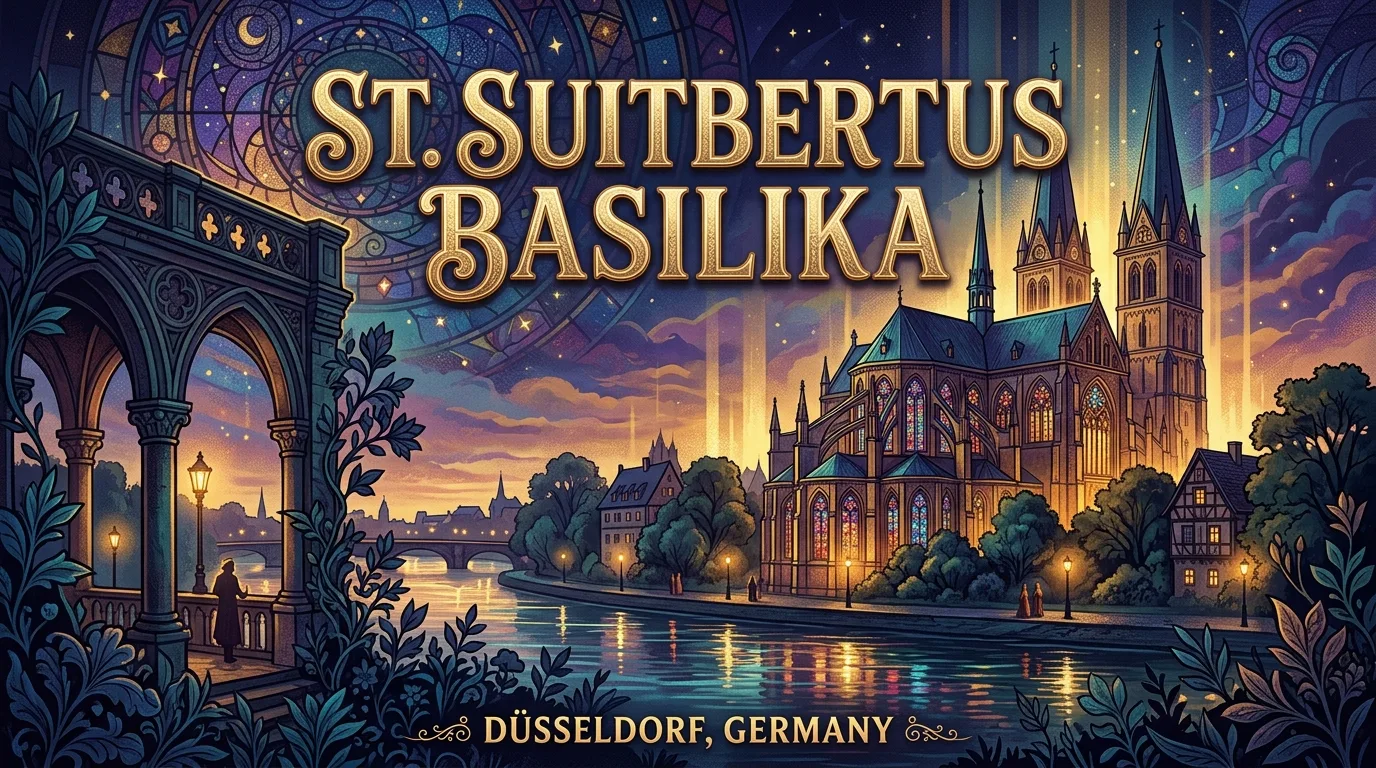
In the idyllic district of Kaiserswerth, located far to the north of Düsseldorf directly on the banks of the Rhine, St. Suitbertus Basilika rises as one of the oldest and most historically significant churches in the entire region. Surrounded by medieval lanes, the ruins of Emperor Barbarossa's imperial palace, and picturesque half-timbered houses, Kaiserswerth still feels today like an independent little town in its own right, one whose spiritual center for more than a thousand years has been the Suitbertus Basilika. Named after the Anglo-Saxon missionary Suitbertus, who founded a monastery on a Rhine island in the early 8th century, the church stands in a remarkably long tradition of Christian evangelization along the Lower Rhine. The fortress-like basilica, built from tufa stone, combines Romanesque and Gothic building phases in an impressive manner and still houses the relics of its namesake patron saint today. For visitors wishing to experience Düsseldorf away from the busy city center, a trip out to Kaiserswerth and its historic basilica ranks among the most rewarding excursions the entire city has to offer.
History of St. Suitbertus Basilika
The history of St. Suitbertus Basilika begins as early as the 8th century, when the Anglo-Saxon missionary Suitbertus established a monastery on what was then a Rhine island at Kaiserswerth, which served as a spiritual starting point for the Christianization of large parts of the Lower Rhine region. Construction of the current church began around the year 1050 on the grounds of this earlier monastery. Architecturally, the basilica reflects two clearly distinguishable eras: while the nave still follows late Romanesque building conventions, the choir, consecrated in 1237, already displays distinctly Gothic forms. A significant event in the church's history was the transfer of the remains of Saints Suitbertus and Willeicus in 1264, which firmly established the basilica as an important pilgrimage site along the Lower Rhine. Between 1870 and 1877, extensive restoration work was carried out, during which the west tower, which had already been demolished in 1243, was faithfully rebuilt. The Second World War left severe marks on the building, with the church tower completely destroyed and later replaced by a smaller steel bell tower erected in 1951. Between 1948 and 1955, the artist Walter Benner designed the new choir windows, while the original 13th-century coloring of the choir was restored around 1990. In 1967, Pope Paul VI finally elevated the church to the rank of a minor basilica, honoring its outstanding significance for the history of Christianity along the Rhine.
Highlights of St. Suitbertus Basilika
St. Suitbertus Basilika presents itself as a flat-roofed, three-aisled pillar basilica built from solid tufa stone, whose fortress-like character still recalls the turbulent times of its origin. At the center of the church's artistic and spiritual significance stands the precious Suitbertus shrine, which holds the relics of the church's patron saint and ranks among the most important medieval reliquary shrines along the Lower Rhine. On the north side of the basilica, an early 13th-century vestibule adjoins the building, which together with the neighboring sacristy forms a rare architectural witness to the medieval monastic complex. Particularly striking is the choir's colorful painting, restored in 1990, which faithfully recreates the original 13th-century color scheme and bathes the interior in a warm, historic light. The choir windows, designed by Walter Benner between 1948 and 1955, provide a deliberate modern counterpoint to the medieval fabric of the building and demonstrate how sensitively the postwar generation approached the church's historic heritage. Musically, the basilica boasts an outstanding organ built by the Hamburg workshop of Rudolf von Beckerath between 1975 and 1976, featuring 39 registers and 2,712 pipes on mechanical slider chests, making it one of the finest-sounding instruments in the entire region. The bell tower houses three bronze bells, the largest of which, the Maria bell cast in 1705 and weighing 750 kilograms, is both the oldest and heaviest, accompanied by the bells named Willeicus and Gertrudis. The entire building complex, embedded within historic Kaiserswerth with its palace ruins and half-timbered houses, conveys an exceptionally cohesive picture of medieval piety along the Rhine.
Opening Hours, Tickets & How to Get to St. Suitbertus Basilika
St. Suitbertus Basilika is generally open daily for quiet visits outside of service times, and admission to the church is free of charge. Since January 1, 2026, the basilica has served as the spiritual center of a newly reorganized, expanded parish that cares for more than 18,000 Catholics across several Düsseldorf districts, so visitors are encouraged to check current service times and any special events before their visit. Guided tours covering the church's eventful building history are regularly offered for groups and interested visitors, with inquiries handled by the parish office in Kaiserswerth. Getting to Kaiserswerth from central Düsseldorf is straightforward: underground line U79 reaches the district in about 30 minutes from the main train station, and several bus lines also serve the historic old town of Kaiserswerth. Visitors arriving by car will find several public parking options near Suitbertus-Stiftsplatz, though heavy excursion traffic should be expected on pleasant weekends, as Kaiserswerth is a popular destination for riverside walks. Arriving by bicycle along the Rhine cycle path is also an attractive option, offering lovely views of the river and passing ships along the way.
Attractions Near St. Suitbertus Basilika
Kaiserswerth itself, with its picturesque old town, is one of the biggest attractions in the immediate vicinity of the basilica. Just a short walk away lie the impressive ruins of the imperial palace, a former imperial fortress from the time of Emperor Frederick Barbarossa, which can today be explored as a romantic ruin right on the Rhine riverbank. Along the narrow, cobblestone lanes stand numerous historic half-timbered houses, cozy cafés, and traditional inns that invite visitors to an extended stroll. The Rhine riverside path, which leads from Kaiserswerth in both directions, offers excellent opportunities for walking or cycling along the river, past boat landings and wide views of the meadows on the opposite bank. History enthusiasts should also take a look at the former Kaiserswerth Deaconess Motherhouse, founded in the 19th century by Theodor Fliedner and regarded as the cradle of modern nursing in Germany - the famous Florence Nightingale herself studied here for a time. Visitors wishing to continue from Kaiserswerth into central Düsseldorf can do so conveniently by underground, going on to visit further highlights such as the Altstadt with St. Lambertus Basilika or the Rheinturm.
Where to stay in Dusseldorf, Germany
Compare current hotel prices and find the right place to stay.