Schlossturm
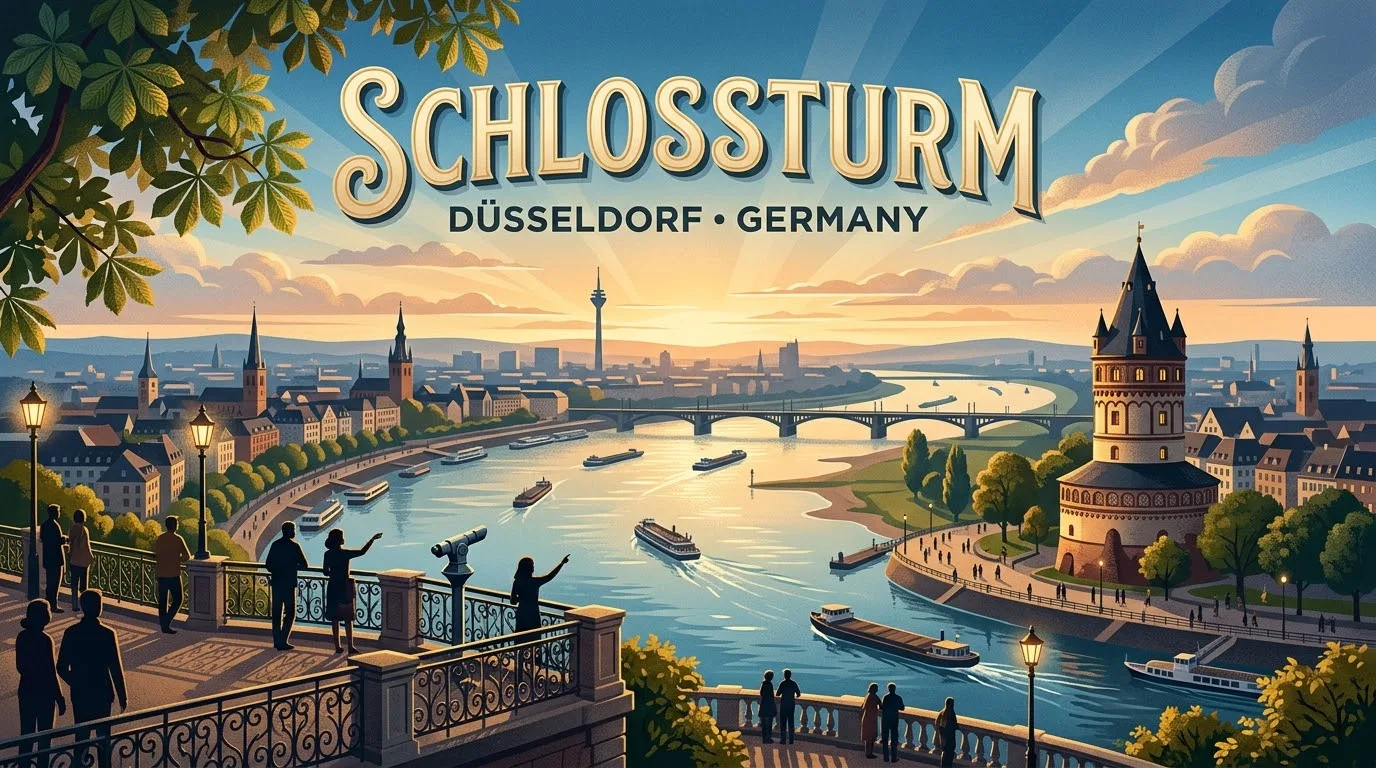
At the northern edge of Burgplatz, right where the Altstadt meets the Rhine, stands the Schlossturm, the last visible remnant of what was once the mighty Düsseldorf city castle. The compact, roughly 33-metre-tall tower appears unassuming at first glance among the surrounding historic buildings, but visitors who climb the narrow staircase inside to its uppermost floor are rewarded with a view unlike any other in the Altstadt. From up here, the entire Burgplatz lies at your feet, with its bustling activity, open-air events and street performers, while the view opens westward across the rooftops of the Altstadt toward the glittering Rhine and the Oberkasseler Brücke. This elevated vantage point, right in the middle of the historic centre yet rising above it, makes the Schlossturm one of Düsseldorf's most underrated viewpoints - considerably smaller and more intimate than the Rheinturm, yet offering an immediate, almost tangible connection to the life unfolding on the square below. The view is at its most beautiful during dusk, when the facades around Burgplatz are bathed in warm light and the first ships with navigation lights begin moving along the Rhine.
History of Schlossturm
The Schlossturm originally formed the northern end of Düsseldorf's city castle, which served for centuries as the residence of the Dukes of Jülich-Berg and formed the core of the medieval town. The lowest three storeys of the tower date back to the 13th century, making them among the oldest surviving structural elements in Düsseldorf. In 1552, Italian master builder Alessandro Pasqualini added a fourth, polygonal storey featuring Tuscan columns, giving the tower the characteristic appearance it still retains today. During the 17th century, the tower served for a time as an archive for the duchies of Jülich and Berg, before architect Friedrich August Stüler added a fifth storey in the Neo-Romanesque style in 1845. A new portal was added in 1883 by Eberhard Westhofen, and in 1909 the upper structure was replaced with a hipped roof. The greatest turning point in the building's history, however, came with the devastating fire of 1872, which destroyed the entire Düsseldorf castle complex except for the tower itself. Ever since, the Schlossturm has stood as a solitary yet dignified witness to this former residence on the banks of the Rhine. In memory of the fire, sculptor Ferdi Walther installed a copper weathervane in the shape of a so-called "Feuerbläser" (fire-blower) on the tower's tip in 1957, a figure that still recalls the dramatic event today. Since 1984, the tower's interior has housed a museum dedicated to Rhine shipping, its exhibition rooms spread across several of the historic floors that visitors pass through on their way to the top. The combination of medieval substance, Renaissance addition and Neo-Romanesque extension makes the Schlossturm an architectural palimpsest, through which the city's turbulent history can be read directly, floor by floor.
Highlights of Schlossturm
The true highlight of a visit lies on the tower's uppermost floor, where generous window openings and a small outdoor area offer an unusually close, almost intimate view of Burgplatz and the Rhine promenade below. Unlike the distant observation platforms of modern high-rises, the bustling life of the square can be followed directly from here: street musicians, groups of tourists, market stalls during special events and the steady flow of strollers along the Rhine promenade all feel almost within reach. At the same time, the view opens westward across the characteristic rooftops of the Altstadt toward the Rhine, passing excursion boats and the elegant silhouette of the Oberkasseler Brücke in the distance. Visitors who come in the late afternoon can watch the light slowly shift over the river, bathing the facades around the square in increasingly warm tones until the first lights of the Altstadt's pubs and street lamps come on in the evening. The tower's compact size keeps the visit pleasantly short and uncomplicated, without the long queues found at some of the city's larger attractions - a reason why the tower is often included as a small but worthwhile detour during short visits or spontaneous walks through the city. Architecture enthusiasts, too, get their money's worth, as the climb reveals the different building styles of each century in direct succession - from medieval masonry to Pasqualini's Renaissance storey - before finally being rewarded at the top with the panorama over the square.
Opening Hours, Tickets & How to Get to Schlossturm
The Schlossturm is generally open to visitors from Tuesday to Sunday during daytime hours, typically remaining closed on Mondays, with possible deviations on public holidays. Admission falls within the typical range of municipal museum pricing in Düsseldorf, making it noticeably more affordable than the city's large observation platforms, and children and teenagers often benefit from reduced rates or free entry. As opening hours and admission fees at municipal institutions can change occasionally, it is advisable to check the City of Düsseldorf's current information before visiting. The tower sits directly on Burgplatz in the heart of the Altstadt, right along the Rhine promenade, making it reachable on foot within just a few minutes from virtually any point in the city centre. By public transport, the "Heinrich-Heine-Allee" subway station is the most convenient option, from where Burgplatz is about a 5 to 10-minute walk away. The main train station is also well connected to the Altstadt by bus or rail within a short time. Parking is available in several car parks at the edge of the Altstadt, as the pedestrian zone around Burgplatz itself is car-free. Due to the narrow, historic spiral staircase inside, the climb to the top floor is not wheelchair accessible, and visitors with limited mobility should take this into account when planning their visit.
Attractions Near Schlossturm
Right in front of the tower stretches Burgplatz itself, one of the liveliest squares in the Altstadt, regularly serving as a stage for open-air concerts, markets and street performances during the summer. From there, the Rhine promenade leads along the river in both directions - south toward the Medienhafen and the Rheinturm, and north toward the Oberkasseler Brücke with its famous panoramic view of the Altstadt skyline. Just a few steps from Burgplatz lies the network of narrow Altstadt lanes with their traditional breweries, part of the so-called "longest bar in the world," while the neighbouring St. Lambertus church, with its distinctively twisted spire, offers another historic eye-catcher nearby. Walking further into the centre from here, visitors reach Kö-Bogen II with its green facade and the adjoining shopping district around the Königsallee within about 10 to 15 minutes. The K20 Kunstsammlung Nordrhein-Westfalen art museum and the Hofgarten park are also within walking distance and combine well with a visit to the Schlossturm as part of a broader Altstadt walking tour.
Where to stay in Dusseldorf, Germany
Compare current hotel prices and find the right place to stay.