Schloss Mickeln
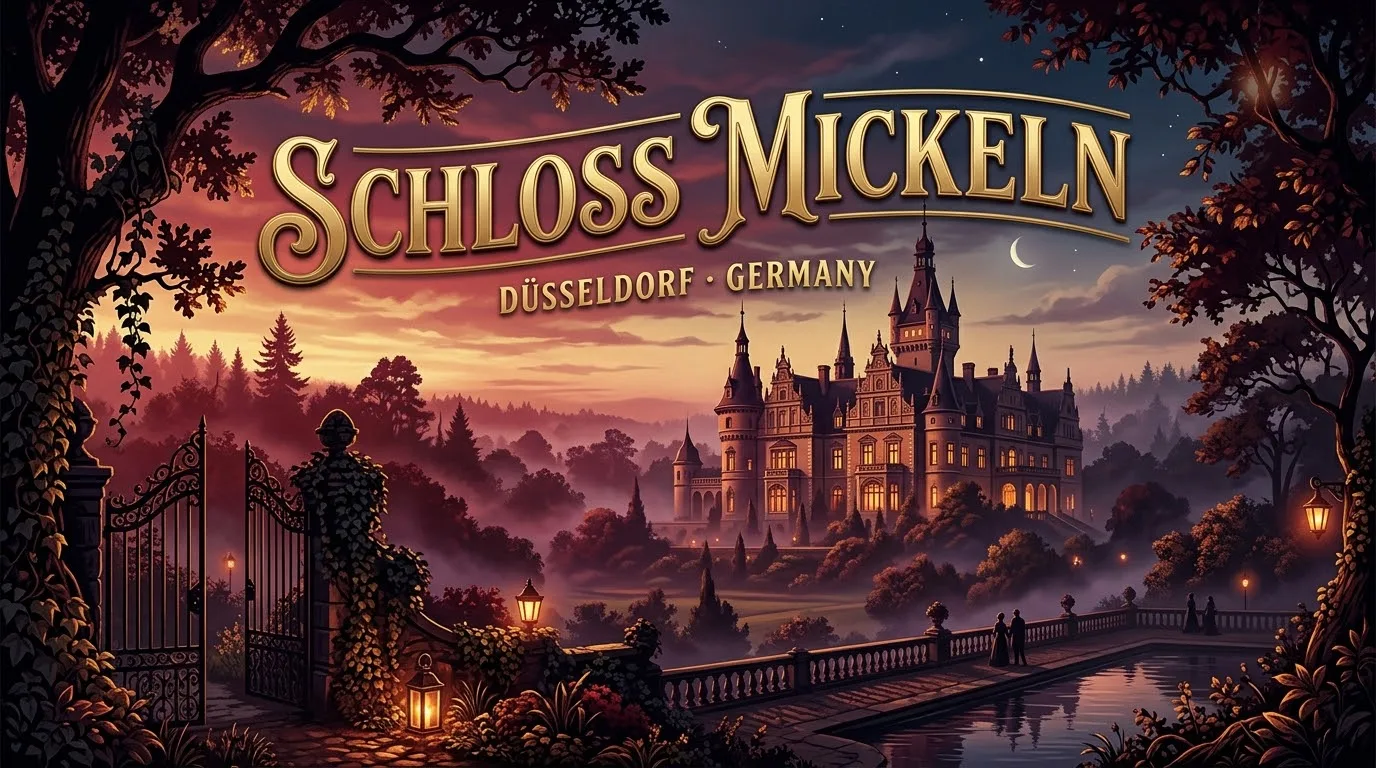
Schloss Mickeln lies in Himmelgeist, a district in the southern part of Düsseldorf, directly on the banks of the Rhine and surrounded by wide meadows and farmland that still preserve the rural character of this part of the city. The small, strictly symmetrical four-sided manor house is among the most architecturally ambitious country houses in the Düsseldorf area, combining Renaissance-inspired Italian villa architecture with the refined bourgeois building tradition of the 19th century. Unlike the well-known Düsseldorf palaces of Benrath, Jägerhof, or Kalkum, Schloss Mickeln is not a classic day-trip destination with free public access; since the year 2000 it has been used by Heinrich Heine University Düsseldorf as a conference center and guesthouse. It is precisely this unusual combination of historic architecture, a well-tended landscape park, and university use that makes Schloss Mickeln a special, somewhat hidden gem on the edge of the city.
History of Schloss Mickeln
The history of the estate dates back to 1210, when the so-called "Haus Mickeln" was first documented on this site, a manor that served for centuries as an agricultural and seigneurial center for the surrounding area. The historic building fell victim to a fire in 1836 and had to be completely rebuilt. Its owner at the time, Prosper Ludwig von Arenberg, commissioned architect Josef Niehaus to rebuild it as a stately summer residence. Niehaus deliberately drew on engravings of Italian villa architecture, in particular designs by the 16th-century Renaissance architect Galeazzo Alessi, creating a building that is unusually strict and classically Italianate for the region. The new Schloss Mickeln was built as an almost perfect square measuring 19.55 meters on each side; all four façades are designed symmetrically except for the north-facing front with its grand staircase, giving the building an almost palatial presence despite its comparatively compact footprint. In 1843, the important Düsseldorf landscape architect Maximilian Friedrich Weyhe, who had already designed the Hofgarten in the city center, laid out the surrounding park in the English landscape style. This close connection to one of the most significant garden architects of the 19th century gives the estate an additional cultural-historical importance that goes beyond the architecture of the main building alone. After passing through various private owners during the 20th century, the estate eventually came into public use and, in June 2000, was put into operation by Heinrich Heine University Düsseldorf as a conference center and guesthouse.
Highlights of Schloss Mickeln
The main building itself impresses above all through its clear, almost mathematical symmetry: the square footprint, just under twenty meters on each side, and the three identically designed façades immediately recall the Italian Renaissance villas that served as its model, while the representative grand staircase on the north side gives the building a clear, outward-facing accent. The surrounding landscape park, laid out in 1843 by Maximilian Friedrich Weyhe, ranks among the most valuable smaller park designs in the Düsseldorf area. The linden-lined approach to the castle creates a stately sense of arrival, while elsewhere in the park several of the original plantings survive to this day, including old plane trees, copper beeches, and two particularly striking cedars of Lebanon, which have since been registered as Düsseldorf natural monuments and count among the oldest and most impressive trees of their kind in the entire region. The location directly on the Rhine, embedded in the wide farmland of Himmelgeist, gives the whole area a distinctive landscape quality that differs sharply from the dense urban fabric of central Düsseldorf. Since being taken over by Heinrich Heine University in 2000, the historic building has been used as a conference center and guesthouse: scholars and researchers from around the world come here for conferences, workshops, and visiting stays, giving the venerable building a lively, internationally oriented use rather than letting it stand as a mere museum piece. This combination of historic architecture, a garden-historically significant park, and modern academic use makes Schloss Mickeln a place that connects past and present in an unusual way.
Opening Hours, Tickets & How to Get to Schloss Mickeln
Schloss Mickeln differs from classic visitor palaces in that its main building is operated as a conference center and guesthouse by Heinrich Heine University Düsseldorf and is therefore not continuously open to the general public free of charge. An interior visit is generally only possible as part of university events, conferences, or by prior arrangement with the university; information on booking conference rooms or guest rooms can be found on the official university website at hhu.de/schlossmickeln. The surrounding park and the immediate grounds of the estate are maintained by the city's parks department, so a walk along the outer grounds and a view of the historic façade are possible even without a booked stay, as long as visitors stay on the publicly accessible paths around the property. Anyone wishing to visit Schloss Mickeln will find Himmelgeist most conveniently reached from central Düsseldorf by car or by bicycle along the Rhine, since public transport connections in this rural district are comparatively limited; occasional bus lines do, however, run between the surrounding districts and Himmelgeist. Limited parking is available in the immediate vicinity of the estate. Since this is not a classic tourist attraction with fixed opening hours, it is advisable to check current information from the university before planning a specific visit, especially if an interior tour or participation in an event is intended.
Attractions Near Schloss Mickeln
Himmelgeist itself is a tranquil, agriculturally shaped village with a historic core, well suited to a quiet stroll away from the bustle of the city. A popular cycling and walking path runs along the Rhine, both north toward central Düsseldorf and south toward the extensive Rheinbogen Himmelgeist-Itter-Hamm nature reserve, an important refuge for numerous bird species. Just a few kilometers away lies Schloss Benrath, one of the most significant pleasure palaces of the Rhineland, which, unlike Schloss Mickeln, operates as a fully public museum with an extensive park and combines well with a visit to Himmelgeist. Heading north along the Rhine promenade, visitors reach Düsseldorf's Altstadt with its many sights after a few kilometers, while to the west, on the opposite bank of the Rhine, the town of Neuss offers its own historic attractions. This location makes Schloss Mickeln a worthwhile stop for anyone exploring the green, rural south of Düsseldorf by bicycle or car.
Where to stay in Dusseldorf, Germany
Compare current hotel prices and find the right place to stay.