Schloss Heltorf
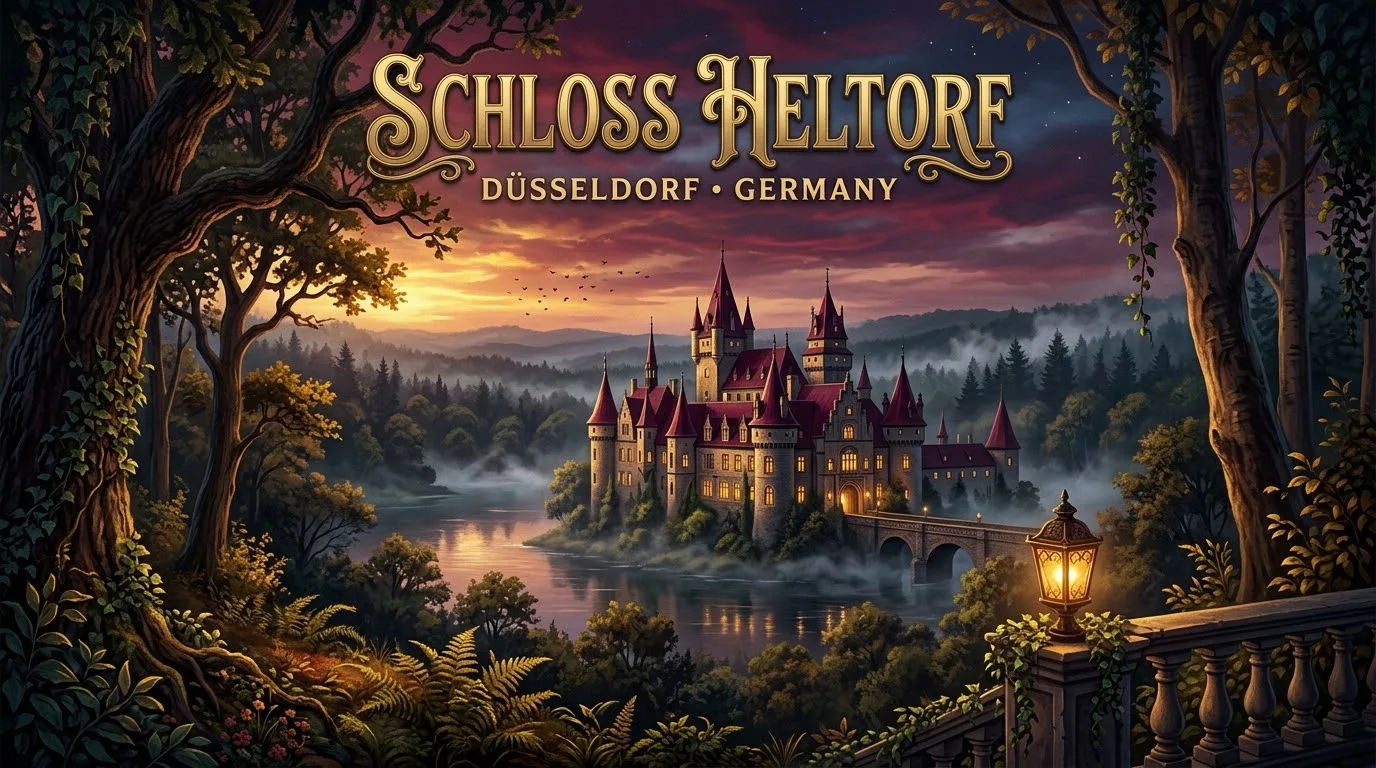
Schloss Heltorf lies in the Düsseldorf district of Angermund, at the very northern edge of the state capital, on the Anger stream and directly on the border with Duisburg. For more than 350 years the moated castle has remained in the possession of the Counts of Spee, who still inhabit and manage the estate today - a continuity achieved by only a handful of Rhenish noble residences. Unlike the city's major visitor palaces such as Benrath or Jägerhof, Schloss Heltorf is not a museum but remains a private family residence to this day; what is open to the public, however, is the extensive landscape park of around 54 hectares, which ranks among the most significant garden-historical sites in the Rhineland. This combination of a private noble residence and a publicly accessible landscape park makes Schloss Heltorf a special destination for anyone interested in history, architecture, and garden design.
History of Schloss Heltorf
The estate's first documented mention dates back to the 11th century, when it was recorded under the name "Hof Helethorpe" as a moated manor used for agriculture and forestry. Among the earliest known owners were the lords of Heldorp; Otto von Heldorp is documented as the owner in 1167. In 1360, the estate passed to the von Lohausen family, who held it for five to six generations, before it passed in 1569, through the marriage of Maria, a daughter of Sibert von Troisdorf, to Wilhelm von Scheid genannt Weschpfennig, into his family. A second decisive marriage in 1649 eventually brought the estate into the orbit of the Spee family: after the death of the parents of the heiress at the time, Schloss Heltorf finally came into the possession of the Counts of Spee in 1662, in whose family it has remained ever since - for more than 350 years. In the early 19th century, the manor house was rebuilt in classical style to designs by the Essen architect Heinrich Theodor Freyse, giving it essentially its present exterior appearance. Inside the castle is a remarkable cycle of frescoes depicting the life of Emperor Frederick Barbarossa, created by important representatives of the Düsseldorf School of Painting such as Stürmer, Mücke, Lessing, and Plüddemann. In 1862, the Cologne architect Vincenz Statz added a neo-Gothic library tower to the building, built specifically to house the family's extensive historic book collection, and it remains a striking architectural feature of the castle to this day.
Highlights of Schloss Heltorf
The centerpiece of Schloss Heltorf is its extensive landscape park of around 54 hectares, whose basic concept was designed as early as 1796 by the French abbé Biarelle and implemented from 1803 by the important Düsseldorf landscape architect Maximilian Weyhe - the same Weyhe who later also designed the Hofgarten in downtown Düsseldorf and the park at Schloss Mickeln. The park is considered one of the earliest and most consistently designed English-style landscape gardens in the Rhineland and impresses with mature trees, sweeping meadows, and carefully composed sightlines toward the castle. The park's rhododendron collection holds particular botanical significance: it ranks among the oldest rhododendron plantings in Germany and blooms in a profusion of color especially in late spring, drawing visitors from across the region. The castle building itself also deserves architectural attention, even though it cannot be visited from the inside: the classical-style rebuilding of the early 19th century, the striking neo-Gothic library tower from 1862, and the picturesque setting on the Anger stream together create a coherent overall picture that vividly connects the estate's different building periods. Inside, though not open to the public, this architecture combines with the aforementioned Barbarossa fresco cycle by the Düsseldorf School of Painting to form one of the most interesting examples of historicist interior design in the Rhineland. For visitors exploring the park, this creates two distinct layers of interest: the botanical and horticultural design on one hand, and centuries of evolving noble architecture on the other, which can be appreciated well from the edges of the park.
Opening Hours, Tickets & How to Get to Schloss Heltorf
Schloss Heltorf itself, as the inhabited family residence of the Counts of Spee, is not open to the public; a tour of the interior is not normally possible. The surrounding landscape park, however, traditionally opens its gates to the public from April to October on weekends and public holidays, allowing visitors during this period to explore the expansive green spaces, the mature tree stands, and the famous rhododendron plantings on their own. Outside this seasonal window - that is, during the winter months and on weekdays during the main season - the park remains closed. Since exact opening dates and any admission arrangements can vary slightly from year to year, it is advisable to check current information before a visit, for example through the estate's forestry administration or local tourism offices. Angermund lies in the north of Düsseldorf, close to the border with Duisburg, and is best reached from the city center by car or, for a more scenic approach, by bicycle along the country roads of the northern Düsseldorf area. Public transport connections include regional trains to Angermund station as well as individual bus lines connecting the village center with the wider city area; from there, it is a short walk to the park entrance. Limited parking is available near the park entrance, though visitors should expect higher numbers on open weekends.
Attractions Near Schloss Heltorf
The village center of Angermund itself, with its rural structure and historic parish church, offers a quiet contrast to the expansive castle park and is well suited to an additional stroll. Just a few kilometers to the south lies Altstadt Kaiserswerth with its Kaiserpfalz and St. Suitbertus Basilika, making it easy to combine a trip to Angermund with a visit to this historic Rhine town. Schloss Kalkum, another of Düsseldorf's four major palaces, is also within easy reach and makes a worthwhile additional destination for a day in the green north of the city. For those wishing to extend their trip further, the nearby city border also leads into Duisburg, with its own range of attractions. This location makes Schloss Heltorf a rewarding stop on a day trip through the rural, yet historically significant, northern districts of Düsseldorf.
Where to stay in Dusseldorf, Germany
Compare current hotel prices and find the right place to stay.