Schloss Benrath
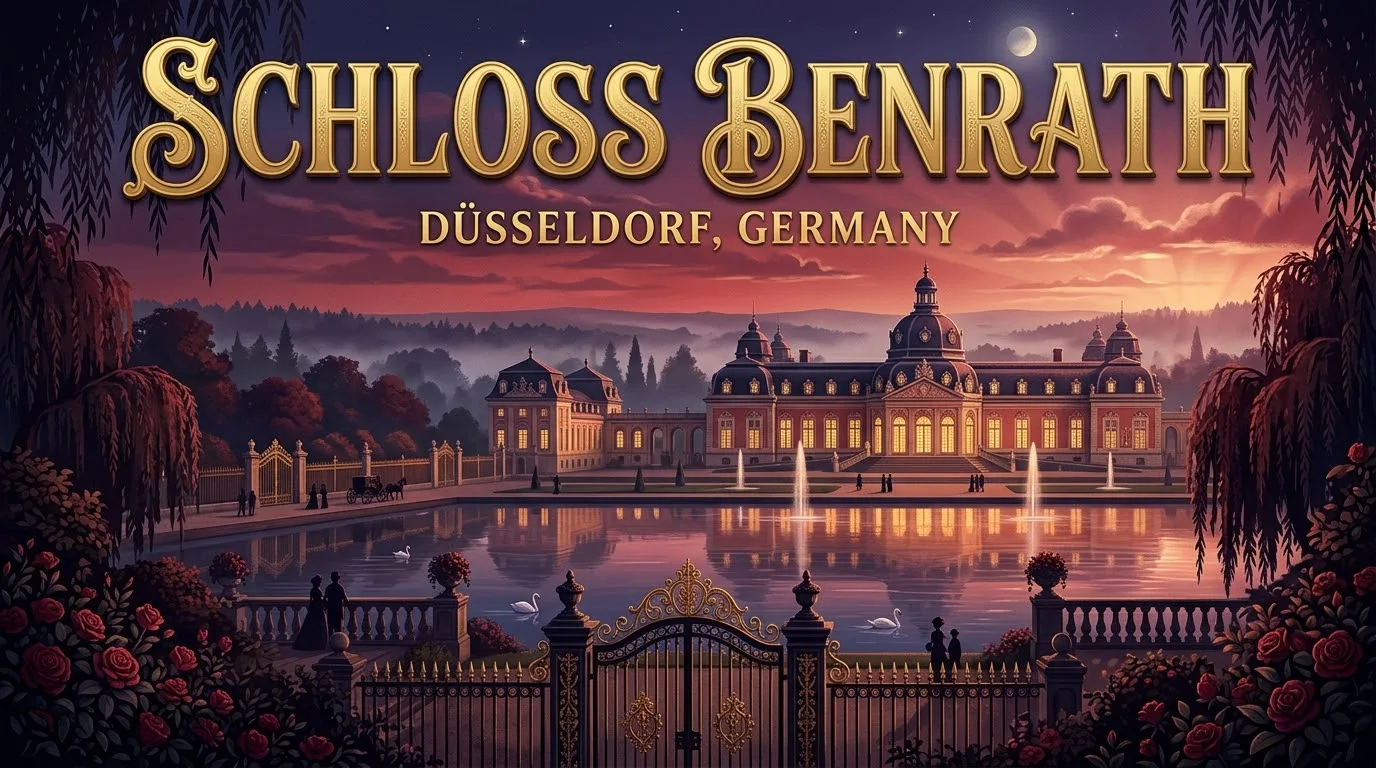
About ten kilometres south of central Düsseldorf, in the district of Benrath, stands one of the most elegant palace façades in western Germany. From the entrance drive, Schloss Benrath appears almost modest and single-storeyed, but this first impression is deliberately misleading: behind the soft pink-washed façade lies a four-storey building with around 80 rooms, constructed between 1755 and 1773 to designs by the Paris-trained architect Nicolas de Pigage. Elector Karl Theodor of the Palatinate commissioned the building as a pleasure and hunting palace, a retreat from the courtly ceremony of his main residences in Mannheim and Schwetzingen, where hunting, leisure and private relaxation took priority over political representation. Today Schloss Benrath remains one of Germany's best-preserved examples of the transition from late Rococo to early Neoclassicism, and it ranks among Düsseldorf's leading sights. The symmetrical three-wing layout, the large reflecting pond on the main axis, and the extensive landscaped park stretching west toward the Rhine make this one of the most atmospheric excursion destinations in the Rhineland. The palace today houses three separate museums under one roof, combining architecture, garden art and natural history.
History of Schloss Benrath
The story of Schloss Benrath begins with a ruler who rarely stayed in Düsseldorf. Elector Karl Theodor, who ruled as Elector Palatine and later also became Elector of Bavaria, already possessed a residential palace in Düsseldorf. Nevertheless, he decided to replace an older 16th-century hunting lodge on the site with an entirely new building. In 1755 he commissioned Nicolas de Pigage, an architect trained in Paris who had already worked on the gardens of Schwetzingen Palace, to design the new complex. De Pigage conceived not only the palace itself but also the entire garden and path layout as a unified work of art, in which architecture and landscape were designed to interlock seamlessly.
Construction continued until 1773, although the shell of the building was essentially complete by around 1770. The result is a structure that appears deliberately plain and almost single-storeyed from outside, yet internally rises through four floors cleverly concealed within the façade and the surrounding terrain. This visual trick was intentional: Karl Theodor wanted a house of leisure, not a palace designed to project power. After his death in 1799, the Palatine electoral line came to an end, and the palace lost its significance as a princely retreat. Throughout the 19th and early 20th centuries it served various purposes before gradually being converted into a museum complex over the course of the 20th century. Following extensive restoration work, the Schloss und Park Benrath Foundation took over responsibility for the entire estate, including the surrounding park and its two garden pavilions, in the year 2000. Investment in the building's fabric has continued ever since, although further renovation measures and infrastructure improvements are planned for the coming years to secure the palace's long-term preservation. This blend of courtly history, careful restoration and museum use makes Schloss Benrath a living testament to Palatine court culture on the Lower Rhine.
Highlights of Schloss Benrath
The most striking exterior feature of Schloss Benrath is its symmetrical three-wing layout, arranged around a large forecourt and defined by the pale pink, almost powdery façade colour that gives the building its unmistakable character. Directly in front of the Corps de Logis, the main building, lies the Spiegelweiher, a large rectangular reflecting pond that mirrors the façade perfectly and forms the central visual axis of the whole ensemble. This axis continues into the rear garden, where French parterre beds with geometrically trimmed hedges and gravel paths recall 18th-century courtly garden art, while to the west an expansive English-style landscape park stretches all the way to the Rhine.
Inside the Corps de Logis, visitors encounter the Museum Corps de Logis, which displays Karl Theodor's original living and reception rooms complete with stucco work, ceiling paintings and period furniture, offering a direct impression of 18th-century courtly life. The east wing houses the Museum für Gartenkunst (Museum of Garden Art), the only museum of its kind in the German-speaking world dedicated to the history and theory of garden design. The west wing contains the Naturkundemuseum (Natural History Museum), focused on the region's flora, fauna and the ecological relationships within the park. This combination of three thematically distinct yet physically connected museums is unique in Germany, allowing visitors to experience architecture, garden culture and natural history in a single location. Regular special exhibitions, guided tours and family programmes round out the offering, and in winter the palace grounds transform into an atmospheric setting for a Christmas market and a light festival, making Schloss Benrath a popular destination well beyond the classic summer season.
Opening Hours, Tickets & How to Get to Schloss Benrath
Schloss Benrath is located at Benrather Schloßallee 104 in southern Düsseldorf and is well connected by public transport. From the city centre, the S6 suburban train runs directly to Düsseldorf-Benrath station, just a short walk from the palace entrance. Several city bus lines also stop directly at the palace. By car, Benrath is easily reached via the A59 and A46 motorways, with parking available near the grounds.
The three museums inside the palace are generally open from Tuesday to Sunday, with Monday usually reserved as a closing day, though exact hours can vary by season and around special events. Admission is tiered: a combined ticket covering all three museums is cheaper than paying for each separately, and reduced rates apply for students, children and groups, with free entry for younger children. Tickets can be purchased both at the on-site box office and online through the official ticket shop run by the Schloss und Park Benrath Foundation, which is advisable especially on weekends and during the Christmas market period when visitor numbers are highest. The park itself remains freely accessible during daylight hours year-round and can be enjoyed for a stroll even outside museum opening times. Anyone planning a visit in 2026 or 2027 should check the official website for current opening hours and possible closures linked to the ongoing general renovation, since individual areas may be temporarily restricted while infrastructure work continues.
Attractions Near Schloss Benrath
The adjoining Benrather Schlosspark, blending a formal French garden with an English-style landscape park, invites long walks along the Rhine and is worth visiting in its own right. Those wanting to stretch their legs further will find a well-developed cycling and walking path along the Benrath riverbank, leading north toward Düsseldorf's old town or south toward Cologne. Benrath's historic village centre, with small cafés, restaurants and shops, lies just a short walk from the palace entrance and makes a pleasant stop before or after a museum visit. By S-Bahn, Düsseldorf's old town is roughly 15 to 20 minutes away, opening up further attractions such as the Rheinturm tower, the Königsallee shopping boulevard and the Kunstsammlung Nordrhein-Westfalen art museum. A day trip to nearby Cologne is also possible from Benrath by regional train in under 30 minutes, making the palace an excellent base for a full day of sightseeing in the Rhineland.
Where to stay in Dusseldorf, Germany
Compare current hotel prices and find the right place to stay.