Schifffahrtmuseum im Schlossturm
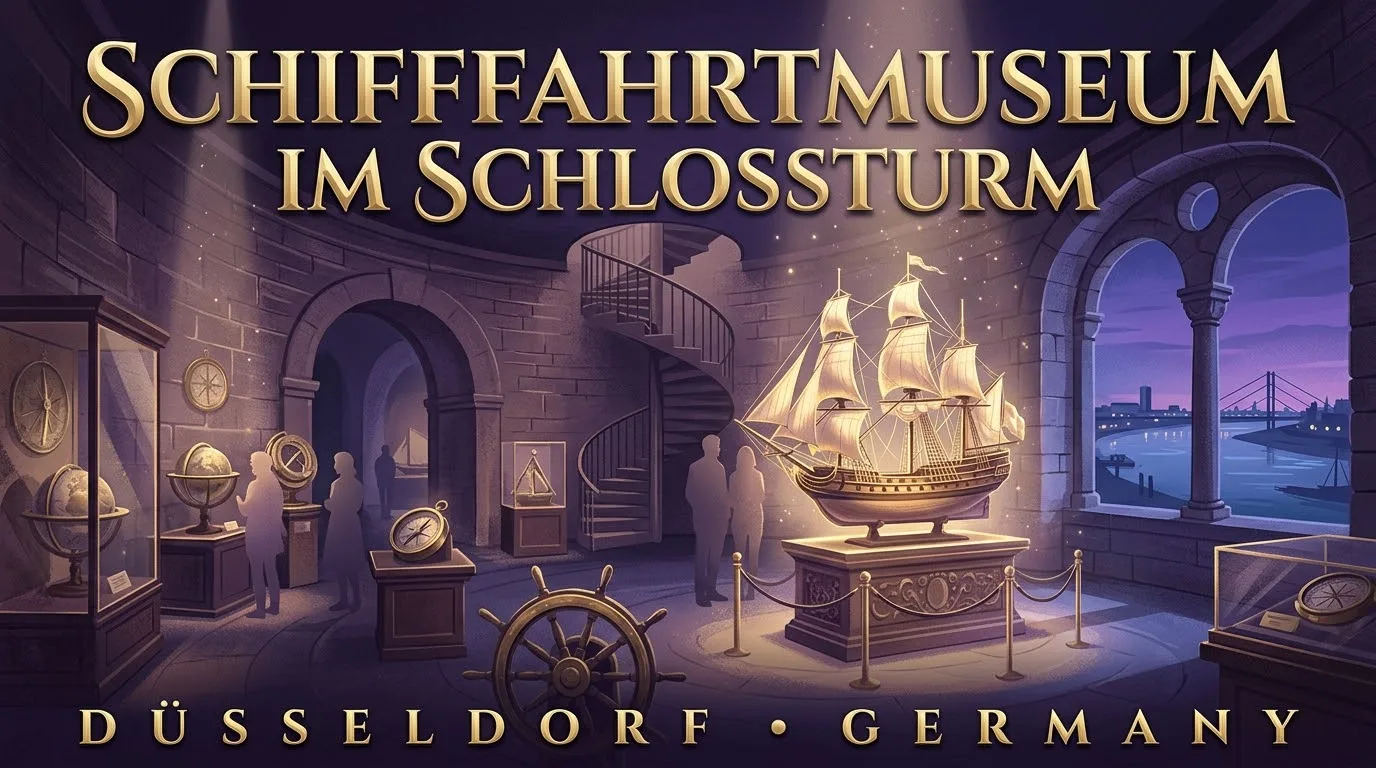
Anyone looking at the Düsseldorf Altstadt from the Rhine embankment spots it immediately: the Schlossturm on Burgplatz, the last surviving remnant of the city's former ducal castle. Inside, spread across tight spiral staircases and a series of round chambers, the tower has housed the Schifffahrtmuseum im Schlossturm for decades, a museum dedicated to the long and often turbulent relationship between Düsseldorf and the Rhine. Climbing the narrow spiral stairs means moving through centuries of river navigation, passing ship models, anchors, navigation instruments and photographs documenting the harbor and river traffic across different eras. At the end of the visit, the topmost platform opens onto a sweeping view over the Rhine, the Altstadt and the Rheinkniebrücke bridge - a panorama that brings the museum's thematic journey to a fittingly scenic close. The museum presents itself not simply as a collection of objects but as a narrative about the city itself, whose economic and cultural development has been closely tied to the river for centuries. For visitors exploring the Altstadt, the Schlossturm is therefore a double attraction: a striking historic landmark and, at the same time, a compact, content-rich museum that fits easily into even a short walk through the old town.
History of Schifffahrtmuseum im Schlossturm
The Schlossturm itself has deep architectural roots: its lower three stories date back to the 13th century and originally formed the northern end of Düsseldorf's medieval ducal castle. In 1552, architect Alessandro Pasqualini added a fourth, polygonal story decorated with Tuscan columns, giving the tower its distinctive silhouette. Centuries later, in 1845, King Friedrich Wilhelm IV commissioned a fifth story, designed by his court architect Friedrich August Stüler in a round-arch style. A new portal was added in 1883, and the tower's current tent roof dates from 1950, following alterations caused by wartime destruction and subsequent reconstruction. The rest of Düsseldorf's ducal castle burned down almost completely in 1872 and was later demolished, leaving the Schlossturm as the only visible relic of the old residence on Burgplatz today. Its spire carries a copper weather vane shaped like a "Feuerbläser" (fire-blower figure), created by sculptor Ferdi Walther in 1957 to commemorate the devastating 1872 fire. Since 1984, the tower has housed the Schifffahrtmuseum, which has since explored the close, often contradictory relationship between the city and the river: the Rhine brought Düsseldorf trade, prosperity and harbor infrastructure, while also being a recurring source of floods that repeatedly shaped the city's history. In 2001, the museum's interior was thoroughly renovated to present the exhibition in a more contemporary, visitor-friendly way, while deliberately preserving the historic character of the tower's cramped, round rooms.
Highlights of Schifffahrtmuseum im Schlossturm
The permanent exhibition leads visitors floor by floor through the history of navigation on the Rhine, starting with simple wooden barges and rafts and progressing to modern container shipping. Numerous scale ship models trace the transition from sailing vessels to the first steamships and on to the large freighters that still pass Düsseldorf today. Visitors see original navigation instruments, ship's wheels, anchors and equipment that illustrate the daily working life of river sailors, complemented by historic photographs and documents showing the Düsseldorf Rhine harbor at various stages of development. A dedicated thematic section is devoted to the flood disasters that repeatedly struck the city, using water-level markers and historical accounts to show how residents of the Altstadt had to adapt, generation after generation, to an unpredictable river. The Rhine's role as a trade and transport route for coal, steel and other goods from the wider Rhineland region is also traced, linking the history of navigation to the industrial development of the entire area. The architecture of the tower itself is part of the experience: tight spiral staircases, round rooms from different centuries and narrow window openings give an immediate sense of the historic fabric of the building. The high point of the tour is the tower's topmost platform, which offers a panoramic view over the Rhine, the Rheinkniebrücke bridge, the Altstadt and, on clear days, as far as the Medienhafen - a view that makes the river history told inside the museum tangible once again, and one that ranks among the finest free viewpoints in the Düsseldorf Altstadt.
Opening Hours, Tickets & How to Get to Schifffahrtmuseum im Schlossturm
The Schifffahrtmuseum im Schlossturm sits directly on Burgplatz in the heart of the Düsseldorf Altstadt, just steps from the Rhine embankment, making it easy to combine with a stroll through the old town. As a compact museum housed inside a historic tower, it keeps limited opening hours tailored to the rhythm of the Altstadt and regularly closes on one weekday; visitors are advised to check current opening times and admission prices through the city's official tourism channels or on site before visiting, since hours at this partly volunteer-supported institution can occasionally change. Admission is kept deliberately modest, with reduced rates available for children, students and groups. Getting there is straightforward: the Rheinbahn network serves the Altstadt via the Heinrich-Heine-Allee stop (U-Bahn lines U70, U74, U75, U76, U77, U78, U79) or several bus routes stopping near Burgplatz/Altstadt, from which it is only a short walk to the tower. Parking is available in the multi-story car parks around the Altstadt, for example near the Rhine embankment or close to Burgplatz, though weekends and sunny days tend to bring heavy demand. Because of the tower's narrow historic spiral staircases, accessibility for visitors with mobility impairments is limited, and those affected should contact the museum in advance. The unusual interior of the tower itself, quite different from a conventional museum building, is an added draw for photographers and lovers of historic architecture.
Attractions Near Schifffahrtmuseum im Schlossturm
Its location on Burgplatz makes the Schifffahrtmuseum an ideal starting point for exploring the Düsseldorf Altstadt, famously nicknamed the "longest bar in the world" for its dense cluster of traditional pubs. Just a short walk away stands the St. Lambertus Basilica with its distinctive twisted spire, one of the city's oldest churches. Following the Rheinuferpromenade along the river, the walk can be extended all the way to the Rheinturm tower and the neighboring Medienhafen district, known for its striking architecture, including the well-known Gehry buildings. In the Carlstadt, the quieter neighborhood just south of the Altstadt, several more museums sit within easy reach, including the Hetjens-Museum for ceramics and the Heinrich-Heine-Institut, making it easy to combine several cultural stops in a single day. The Königsallee, with its shops and the famous tree-lined Kö-Graben canal, is also reachable on foot in about fifteen to twenty minutes. For a more relaxed pace, the Altstadt itself is full of traditional brewery pubs serving Düsseldorf's top-fermented Altbier - a fitting way to end a visit that began with the river's history inside the Schlossturm.
Where to stay in Dusseldorf, Germany
Compare current hotel prices and find the right place to stay.