Schadowstraße
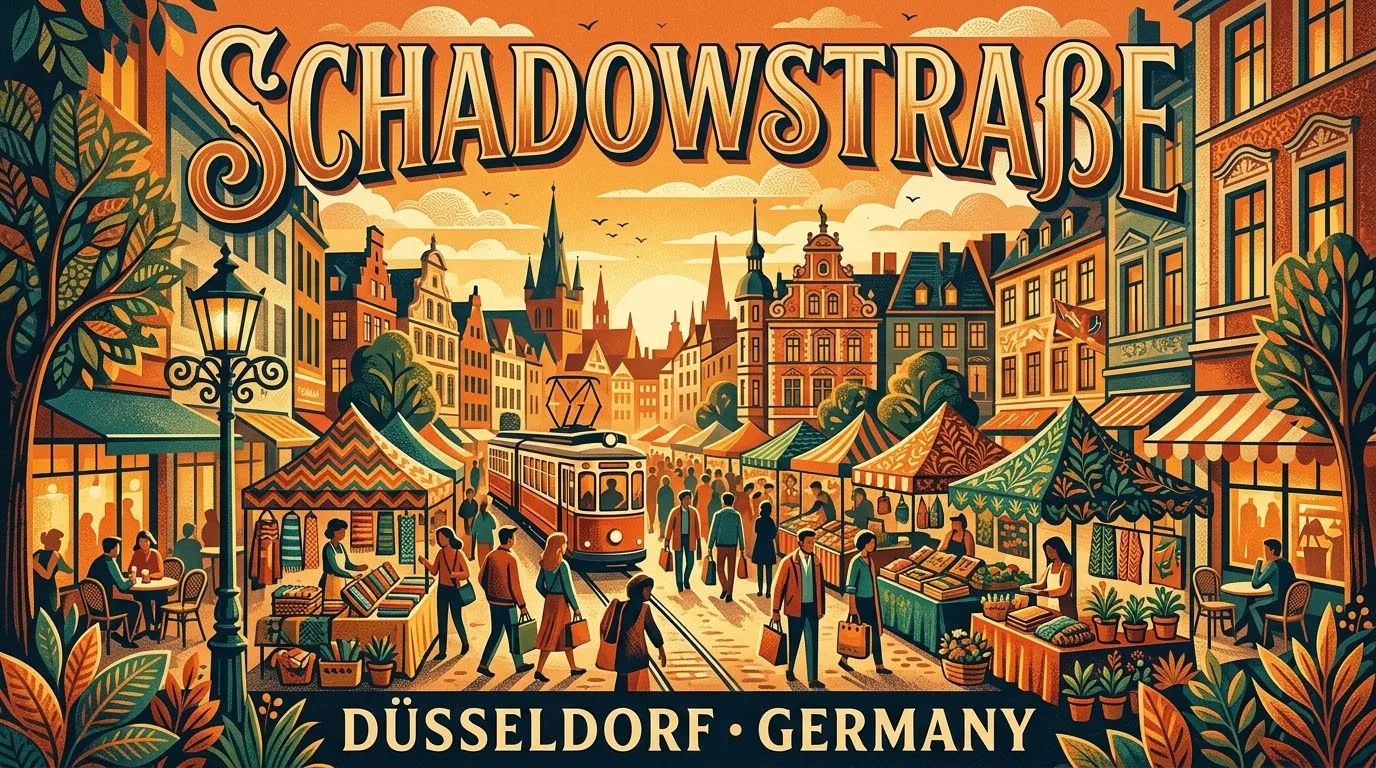
While the neighboring Königsallee stands for exclusive luxury brands and upscale flair, Schadowstraße is the shopping street of the broader public, and that is precisely what makes it an indispensable part of Düsseldorf's cityscape. Here, international fashion chains meet traditional department stores, small specialty shops meet modern shopping arcades, and on an ordinary Saturday afternoon, Schadowstraße ranks among the most densely crowded streets in the entire city. Anyone wanting to shop quickly and without fuss, while still being right in the middle of the state capital's urban buzz, almost inevitably ends up here. The street links the elegant Königsallee in the west with the lively area around Schadowplatz and Kirchgasse in the east over a short distance, and this central position makes it a natural connector between different quarters of the city center. Unlike the Kö, with its representative, almost museum-like layout, Schadowstraße feels noticeably more functional and lively: this is where people shop, eat, make phone calls, meet friends, and it is precisely this pulsing everyday quality that gives it its particular charm.
History of Schadowstraße
The origins of today's Schadowstraße date back to the 17th century, when the site was nothing more than a simple cart track known as "Flinger Steinweg", used primarily for transporting goods. It was only over the course of Düsseldorf's urban development in the 19th century that this modest path gradually turned into a more significant inner-city connecting road. The street received its current name in 1851, named after Friedrich Wilhelm von Schadow, an important painter who served as director of the Düsseldorf Art Academy from 1826 onward and was instrumental in founding the so-called Düsseldorf School of Painting, an artistic movement that gained international recognition in the 19th century and shaped Düsseldorf's lasting reputation as a city of the arts. Naming the street after an artist rather than a nobleman or politician was unusual for the time and underscores the standing that the visual arts already held in 19th-century Düsseldorf. Over the course of the 20th century, Schadowstraße increasingly developed into the city's commercial main axis, particularly with the establishment of large department stores such as Karstadt and Kaufhof, which shaped the streetscape for decades and served generations of Düsseldorf residents as a reliable shopping destination. A significant architectural milestone was the construction of the Peek & Cloppenburg building in 2001, designed by the renowned American architect Richard Meier, whose clean, brilliantly white facade is still regarded today as one of the street's most architecturally notable commercial buildings. During the 2000s and 2010s, the street's transport infrastructure was also fundamentally modernized: between 2008 and 2016, the new underground Wehrhahn-Linie was built, including the Schadowstraße station, significantly improving the street's connection to the city's U-Bahn network. However, over the past two decades, Schadowstraße has also had to accept a noticeable decline in foot traffic, driven by the broader structural shift affecting brick-and-mortar retail: while the street still counted around 17,865 passersby per hour in 2001, that figure had dropped to roughly 7,965 by 2011, a development that has since prompted ongoing municipal initiatives to upgrade and redesign the street.
Highlights of Schadowstraße
Stretching roughly 670 meters, Schadowstraße runs from Königsallee in the west to the street Am Wehrhahn in the east, passing through the city center and the adjoining district of Pempelfort. The pedestrian zone begins just about 30 meters after branching off from Königsallee and stretches between Tonhallenstraße and Blumenstraße, a section that is entirely car-free, making browsing the shop windows particularly pleasant. Arguably the most striking individual building along the street is the Schadow-Arkaden, a modern shopping arcade that brings together numerous national and international fashion chains, drugstores, electronics retailers, and dining options across several levels under one roof, offering a popular alternative to outdoor browsing in bad weather. Alongside the Schadow-Arkaden, long-established department stores such as Kaufhof shape the streetscape, offering fashion, cosmetics, household goods, and much more across multiple floors. Also architecturally notable is the aforementioned Peek & Cloppenburg building by Richard Meier, whose clean, light-filled design language forms a deliberate contrast to the older department store facades on the street and is often visited by architecture enthusiasts as a destination in its own right. Along the entire length of the street, countless international fashion chains, shoe stores, jewelry shops, and drugstores line up one after another, covering a wide price range and making the street considerably more accessible than the exclusive boutiques of the nearby Königsallee. Numerous cafés, bakeries, and quick-service restaurants along the route invite a break between shopping stops, while street musicians and occasional promotional stands add further urban atmosphere. Especially around Christmas time and during designated shopping Sundays, Schadowstraße becomes particularly lively and festively decorated, making it one of the city's busiest spots on such occasions.
Opening Hours, Tickets & How to Get to Schadowstraße
Since Schadowstraße is a public pedestrian zone, there are no fixed opening hours for the street itself and no admission fee. The shops located there, however, generally follow standard Düsseldorf retail hours, typically Monday to Saturday from around 10:00 to 20:00, with larger department stores and the Schadow-Arkaden sometimes open until 20:00 or later. On Sundays, most shops remain closed, except during the designated shopping Sundays held throughout the year, when the street is noticeably busier than usual. Getting there is remarkably convenient, since the street has had its own underground station, Schadowstraße, since the construction of the Wehrhahn-Linie, served by U-Bahn lines U71, U72, U73, and U83. Several tram lines, including routes 701, 705, 706, and 707, also run in the immediate vicinity of the street. From Düsseldorf's main train station, Schadowstraße can be reached within a few minutes by U-Bahn, or in about 15 to 20 minutes on foot. Visitors arriving by car will find paid parking in several garages along the route and in the surrounding area, but should expect increased parking pressure throughout the city center, especially on Saturdays and during shopping Sundays, and are therefore advised to use public transport whenever possible.
Attractions Near Schadowstraße
The central location of Schadowstraße makes it an ideal starting point for further discoveries in Düsseldorf's city center. Right at its western end connects the world-famous Königsallee with its picturesque Kö-Graben canal and international luxury boutiques, making it easy to combine a walk between both streets to experience both the upscale and the everyday shopping side of Düsseldorf. Close to the eastern end of the street stands the striking Dreischeibenhaus, a high-rise ensemble from the 1950s regarded as one of the most important post-war modernist buildings in Germany, as well as the Düsseldorf Schauspielhaus, one of the city's most renowned theater stages. The nearby Hofgarten, Germany's oldest public park, also offers a green break after a shopping trip. Those wanting to delve deeper into the city's history can reach the historic Altstadt within a few minutes' walk, with its narrow alleys, traditional brewery pubs, and the famous "longest bar in the world". South of Schadowstraße, a detour to Carlstadt with the long-standing Carlsplatz Wochenmarkt is also worthwhile, while the Rhine promenade with its riverside walk and the Rheinturm tower lies within a comfortable walking distance, making it an excellent choice for a relaxed end to the day.
Where to stay in Dusseldorf, Germany
Compare current hotel prices and find the right place to stay.