Schadowplatz
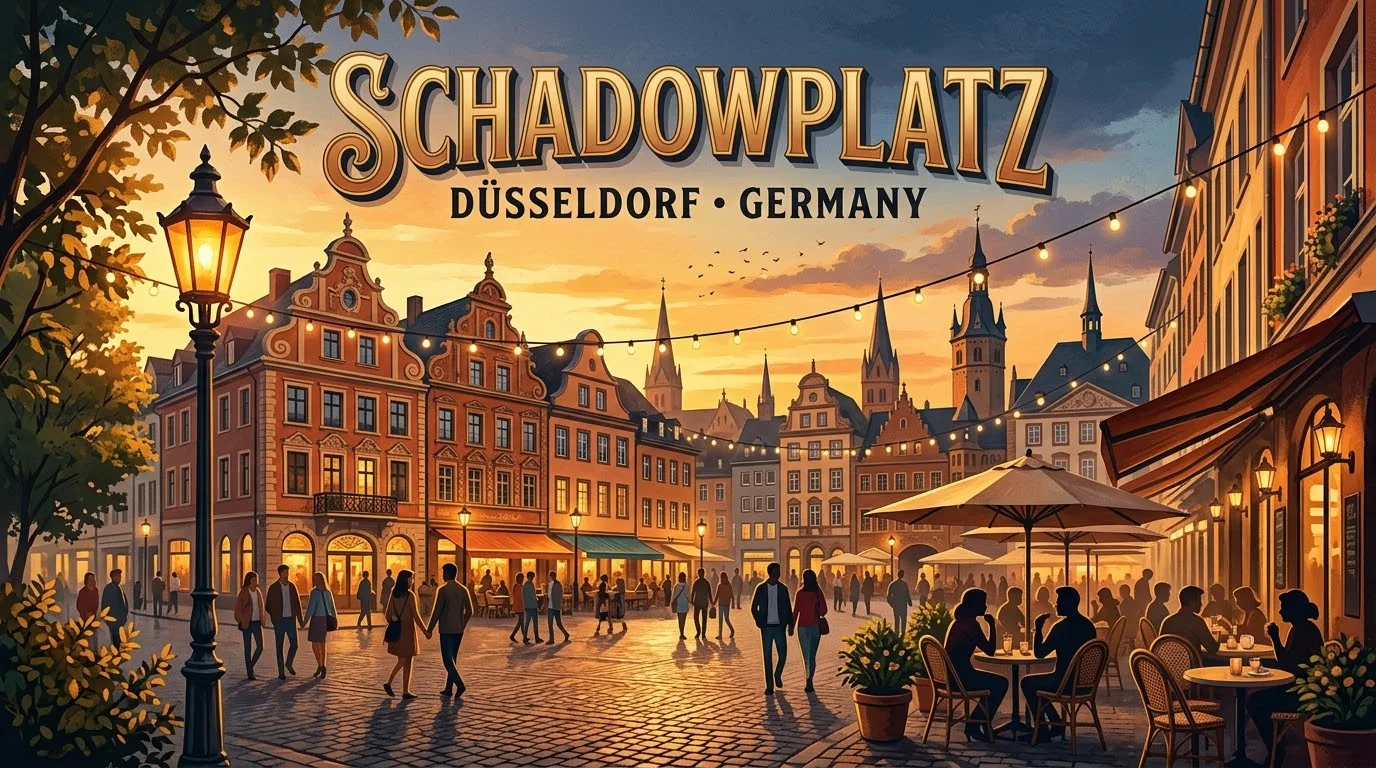
Schadowplatz lies at the very heart of central Düsseldorf, right where the shopping street Schadowstraße meets Heinrich-Heine-Allee and flows seamlessly into the adjoining Heinrich-Heine-Platz. Like the neighboring Schadowstraße, it is named after the painter Wilhelm von Schadow, who, from 1826 onward, served as director of the Kunstakademie Düsseldorf and founded the famous Düsseldorf School of Painting, turning the city into one of Europe's most significant art centers in the 19th century. Few places in Düsseldorf illustrate as clearly as Schadowplatz how closely the historic Altstadt, the classic shopping mile, and the modern urban development of recent decades are interwoven. As the central junction between Schadowstraße, Elberfelder Straße, Benrather Straße, and Heinrich-Heine-Allee, the square ranks among the most heavily used public spaces in the entire city, combining retail, cultural, and transit functions within a very small area.
History of Schadowplatz
The name of Schadowplatz derives directly from the 1851 naming of the adjoining Schadowstraße, through which the city of Düsseldorf honored the painter Wilhelm von Schadow. From 1826, Schadow had served as director of the Kunstakademie and founded the so-called Düsseldorf School of Painting, which gained international renown in the 19th century and attracted numerous significant artists. Before its renaming, today's Schadowstraße was known as Flinger Steinweg, an old cart track that had already been paved in the 17th century under Elector Jan Wellem to create a reliable route from the city toward the Bergisches Land region. As the street developed further in the late 19th and early 20th centuries - not least through the construction of large department stores - the adjoining square also grew in importance as a central transit junction of the city center. Following the massive destruction of the Second World War, the entire surrounding area was rebuilt over the following decades as a modern commercial district, with Schadowplatz retaining its role as the interface between shopping streets and public transport. One of the most recent and visible changes came with the large-scale Kö-Bogen II project: as part of the redevelopment of the area around Gustaf-Gründgens-Platz and the Hofgarten, a new pedestrian bridge was built that directly connects the Park an der Landskrone with the Kö-Bogen and Schadowplatz. This urban upgrade has demonstrably and significantly increased visitor footfall on Schadowstraße, at Schadowplatz, and in the northeastern part of Königsallee, embedding the square even more firmly into the network of central pedestrian zones downtown.
Highlights of Schadowplatz
Schadowplatz impresses above all through its role as a lively pivot point of Düsseldorf's retail scene: from here, Schadowstraße with its large department stores and fashion chains, the elegant Königsallee with its luxury boutiques, and the historic Altstadt are each just a few minutes' walk away. Large-scale commercial buildings shape the square's surroundings, including the Schadow-Arkaden, a shopping center built between 1990 and 1994, as well as the directly adjoining branch of Galeria Kaufhof. Due to its proximity to Heinrich-Heine-Allee and the square of the same name, Schadowplatz is also an important distribution point for public transport, since pedestrian flows from several directions converge here. The location became especially attractive with the new pedestrian connection to the Hofgarten realized as part of Kö-Bogen II: walking east from Schadowplatz, visitors reach the generous green space of the Hofgarten within a few minutes via the new bridge, offering a pleasant contrast to the dense shopping atmosphere of the square itself. The growing attention paid to the location is also reflected economically: once the redevelopment work was completed, retail rents on Schadowplatz rose noticeably, evidence of this stretch of the city center's increasing significance. Architecturally, the contrast is also notable between the largely post-war, functionally designed commercial buildings around the square and the far more modern, sculpturally shaped new buildings of the neighboring Kö-Bogen, which have given the entire area a new face in recent years.
Opening Hours, Tickets & How to Get to Schadowplatz
Since Schadowplatz is a public city square, it is freely accessible at all times and free of charge; there are no fixed opening hours, although the surrounding shops generally follow typical retail hours, open roughly from 10 a.m. to 8 p.m., Monday to Saturday. The square is conveniently located in the heart of the pedestrian zone and can easily be reached via the Heinrich-Heine-Allee station on the Wehrhahn-Linie underground, as well as via several Rheinbahn tram and bus lines. From there, it is only a short walk along Schadowstraße or Heinrich-Heine-Allee directly to the square. Schadowplatz is also just a few minutes away from the main train station by tram, making it a convenient first stop for visitors who want to start their trip with some shopping. Drivers will find several multi-storey car parks nearby, for instance around Königsallee or near the Kö-Bogen, since the square itself, as part of the pedestrian zone, is kept largely free of cars. Cyclists benefit from the well-developed bike paths along the Kö and Heinrich-Heine-Allee. Because Schadowplatz is lively year-round, a visit is worthwhile at any time, though the pre-Christmas season with its festive lighting and the summer months with outdoor dining at the surrounding cafés are especially pleasant times to visit.
Attractions Near Schadowplatz
Close to Schadowplatz lies the Hofgarten, Germany's oldest public park, easily reachable on foot via the new pedestrian bridge built as part of the Kö-Bogen II project, making it an ideal spot for a break after shopping. Just a few steps away rises the striking Kö-Bogen building complex with its greened façades, which, together with the neighboring Dreischeibenhaus, ranks among the city's best-known modern structures. Heading south, Schadowstraße leads directly to Königsallee, whose northeastern section offers exclusive shops and cafés, while a short walk west leads into the historic Altstadt with its traditional breweries. The square in front of the town hall and Burgplatz right on the Rhine are also about fifteen minutes' walk away, making Schadowplatz an ideal central starting point for exploring the many different facets of downtown Düsseldorf. The directly adjoining Elberfelder Straße and Benrather Straße, with their specialty shops, cafés, and service businesses, also help make Schadowplatz more than just a place to pass through, giving it the character of a small, self-contained center within downtown Düsseldorf. Since the opening of the Wehrhahn-Linie underground line in 2016, the squares connection to the citys metro network has improved further, allowing visitors from the eastern and northern districts to reach Schadowplatz conveniently and without having to change lines. This makes Schadowplatz one of the most accessible squares by public transport in the entire city center.
Where to stay in Dusseldorf, Germany
Compare current hotel prices and find the right place to stay.