Ratinger Tor
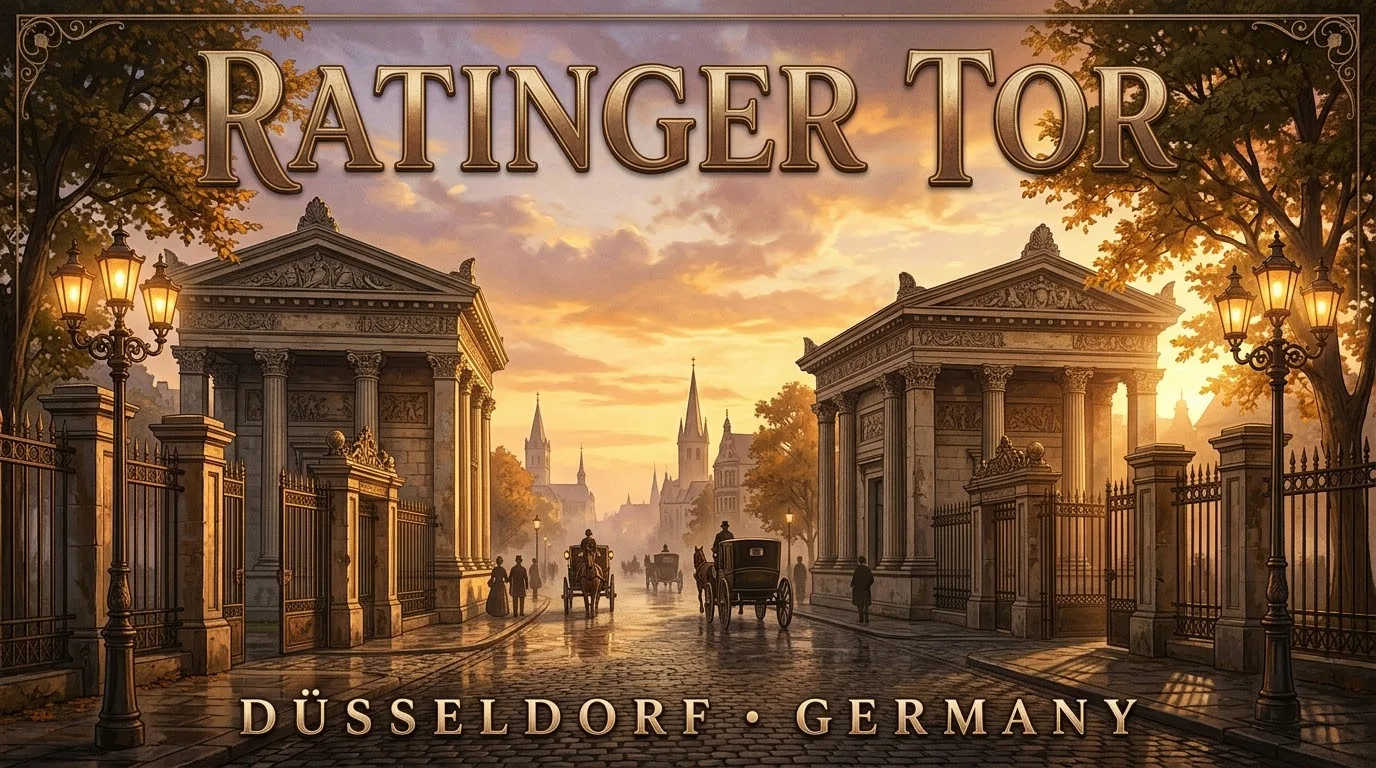
At the point where Düsseldorf's Altstadt gives way to the sweeping grounds of the Hofgarten stands the Ratinger Tor, the city's last fully preserved city gate and an impressive example of early nineteenth-century neoclassical gate architecture. Where a medieval fortification once protected the city with walls, ramparts and gates, an elegant structure of two symmetrically placed gatehouses now rises, fronted by Doric columns in a style clearly reminiscent of the famous Propylaea of the Acropolis in Athens. For visitors to Düsseldorf, the Ratinger Tor is a worthwhile stop, not only for its architectural beauty but also because, as the sole surviving city gate, it offers a direct window into the city's transformation from a fortified medieval town into a modern metropolis.
History of Ratinger Tor
The history of the Ratinger Tor dates back to 1397, when a medieval city gate was first erected on this site, controlling access to the fortified city of Düsseldorf from the north, toward the neighboring town of Ratingen. This original gate formed part of an extensive system of city walls, ramparts and moats that protected Düsseldorf from military threats for centuries. As warfare evolved and the political upheavals of the Napoleonic era swept through Europe, such fortifications increasingly lost their military relevance. Following the Peace of Lunéville in 1801, which required the demolition of Düsseldorf's fortifications, the medieval structure was largely torn down to make way for a modern expansion of the city. In this context, an entirely new Ratinger Tor was built between 1811 and 1815, serving no longer a primarily military purpose but a representative and administrative one, chiefly the collection of customs duties and excise taxes on goods entering the city. The design was entrusted to the architect Adolph von Vagedes, a student of the French classicist Jean-Nicolas-Louis Durand, who deliberately drew on the architectural vocabulary of classical Greek antiquity. The new gate was constructed roughly 115 meters east of its original location, allowing it to be integrated more harmoniously into the newly planned, classically ordered streets of the city's expansion. Until the mid-nineteenth century, the Ratinger Tor functioned as a customs checkpoint, a role that gradually disappeared as city administration modernized. In the following decades the building served various purposes, but unlike Düsseldorf's other city gates, it survived both the urban transformations of the nineteenth century and the destruction of the Second World War largely intact. On April 27, 1983, the Ratinger Tor was officially added to the city's register of protected monuments, recognizing its unique status as the last surviving city gate and an important testament to Düsseldorf's neoclassical urban planning.
Highlights of Ratinger Tor
The Ratinger Tor consists of two nearly square gatehouses facing one another, marking the transition between Heinrich-Heine-Allee and the landscaped grounds of the Hofgarten shaped by Lenné and Weyhe. Both buildings feature Doric columns on three sides, their simple yet powerful forms directly recalling ancient Greek temple architecture. Particularly characteristic are the laurel wreaths adorning the metopes of the gatehouses, lending the ensemble an additional touch of classical elegance. Visitors with an interest in architecture will recognize in the strict symmetry and the reduction to a few clearly structured forms the direct influence of the Parisian school of architecture around Durand, under whom Adolph von Vagedes was significantly shaped. A particular charm of the Ratinger Tor lies in the fact that it is not an isolated monument but remains woven into the everyday life of the city: the northern gatehouse, in the Pempelfort district, has been used since 1984 by the Düsseldorfer Jonges, a traditional civic association dedicated to preserving the city's local history and customs, while the southern gatehouse has in the past housed artists' studios and residential space. Since October 2022, a bronze sculpture dedicated to the composer couple Clara and Robert Schumann has complemented the ensemble in front of the southern gatehouse, commemorating the musicians' connection to Düsseldorf, where Robert Schumann served as municipal music director. Visitors to the Ratinger Tor should also take a moment to appreciate the surrounding square itself, lined with avenue trees and clear sightlines that reflect the classical design ambitions of the entire early nineteenth-century city expansion and create a harmonious transition between the dense Altstadt and the expansive Hofgarten.
Opening Hours, Tickets & How to Get to Ratinger Tor
The Ratinger Tor is a freely accessible outdoor monument in public street space, so there are no fixed opening hours and no admission fee. Both gatehouses and the surrounding square can be visited free of charge at any time of day or night, making the Ratinger Tor an easy destination for a spontaneous walk. Since the interiors of the gatehouses are occupied by the Düsseldorfer Jonges and private users, a typical visit is generally limited to admiring the exterior architecture, which, given the symmetrical design and striking colonnaded facades, already makes for a rewarding impression. For getting there, Düsseldorf's city center offers a dense network of light-rail and bus connections: the nearest stop, Heinrich-Heine-Allee, is served by several subway lines and lies only a few minutes' walk from the Ratinger Tor. Alternatively, the gate can comfortably be reached on foot from Königsallee or the central train station, with the route via the Kö or through the Hofgarten offering a pleasant walk through some of Düsseldorf's most attractive corners along the way. Drivers will find several paid parking garages in the surrounding area, for instance around Kasernenstraße or at the edge of the Altstadt, since the immediate vicinity of the gate is dominated by pedestrian and cycle traffic. A visit in the late afternoon or early evening is particularly rewarding, when the light sets off the pale stone facades of the gatehouses especially well and the adjoining Hofgarten invites a continuing stroll.
Attractions Near Ratinger Tor
The location of the Ratinger Tor at the edge of the Altstadt and at the entrance to the Hofgarten makes it an ideal starting point for further discoveries. Directly adjoining it stretches the expansive Hofgarten, one of the oldest public parks in Germany, laid out in the English landscape style with ponds, mature trees and footpaths inviting visitors to linger. At the edge of the Hofgarten stands Schloss Jägerhof, a baroque palace that today houses the Goethe Museum and provides an interesting contrast to the Ratinger Tor's neoclassical architecture. Just a few minutes' walk in the other direction lies Düsseldorf's Altstadt with its narrow lanes, historic breweries and the Basilica of St. Lambertus. The elegant Königsallee, with its luxury boutiques and the canal designed by Lenné, is also comfortably reachable on foot from here. Art and culture enthusiasts will also find several galleries as well as the Kunstsammlung Nordrhein-Westfalen nearby, making it easy to combine a visit to the Ratinger Tor with a more extensive cultural tour through the northern part of Düsseldorf's city center.
Where to stay in Dusseldorf, Germany
Compare current hotel prices and find the right place to stay.