Paradiesstrand
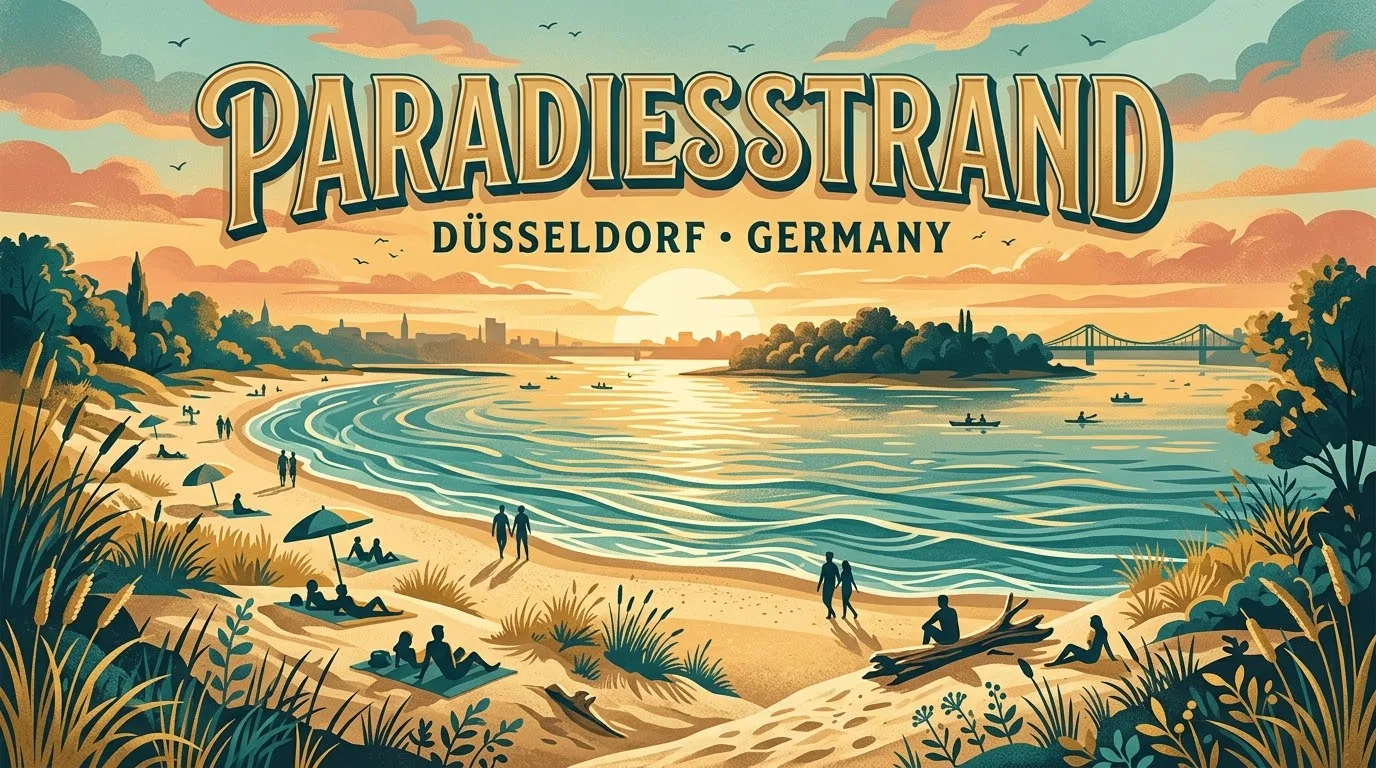
Paradiesstrand sits directly on the banks of the Rhine, just a short walk from the buzzing Medienhafen district, and ranks among the most popular informal swimming and sunbathing spots within the city limits of Düsseldorf. Unlike a classic lido with ticket booths and deckchair rental, this is a naturally formed strip of sand and gravel that widens considerably whenever the river level drops, drawing Düsseldorfers of every age group throughout the warmer months. Sandwiched between working harbor cranes, industrial silhouettes and the glass-and-steel architecture of the Medienhafen, the beach has an unusual, almost urban character that lets visitors experience the Rhine as a genuine recreational space rather than just a shipping lane. Anyone looking for a spontaneous sunbathing session, a riverside stroll or simply the sight of cargo ships gliding past will find Paradiesstrand an uncomplicated retreat right in the middle of the city, free of ticket counters, fixed hours or organised bathing operations.
History of Paradiesstrand
Paradiesstrand is not an official place name but a nickname that developed over the decades among locals for this stretch of the right bank of the Rhine in Düsseldorf's harbor district. Historically, the entire area around today's Medienhafen functioned as a working harbor well into the twentieth century, handling coal, grain and building materials for the city's industry, with heavy cranes dominating the skyline. It was only with the structural economic shift of the 1970s and 1980s that the old harbor basin began to lose its original purpose, and from the 1990s onward large parts of the site were redeveloped into the Medienhafen known today, with its striking office buildings, media companies and waterfront restaurants. The riverside strip directly on the open Rhine, however, remained largely untouched, since it lies outside the enclosed harbor basins and borders the free-flowing river itself. Nineteenth- and twentieth-century river regulation works, which straightened and deepened the Rhine for commercial shipping, created flat sand and gravel banks at several points along the bank, and Paradiesstrand is one of these natural formations. At the latest since the 2000s, it established itself as an unofficial meeting point for sunbathers, dog walkers and strollers, particularly during hot summers when the Rhine's water level drops and exposes a wide stretch of sand and gravel. The name has since become firmly established on social media and in local recommendations, even though the city of Düsseldorf does not operate an official supervised bathing site here, and the area legally remains simply a public riverbank.
Highlights of Paradiesstrand
The greatest appeal of Paradiesstrand lies in its unusual combination of nature and industrial backdrop. Sitting on the bank, visitors watch commercial traffic pass on one of Europe's busiest waterways while the silhouettes of harbor cranes and the striking modern office landscape of the Medienhafen rise in the background. This contrast between raw industrial charm and a relaxed beach atmosphere has made the spot a favourite photo location and a go-to place for anyone wanting to capture Düsseldorf's urban flair. The fine sand-and-gravel beach is pleasant for walking barefoot, sunbathing on a blanket or enjoying a riverside picnic. In the evening hours especially, when the sun sets over the Rhine and reflects in the glass facades of the Medienhafen buildings, the atmosphere becomes particularly dramatic, and locals consider it one of the most beautiful sunset spots in Düsseldorf. Dogs can run off-leash in the quieter sections, and children enjoy exploring the small coves and gravel banks that constantly reshape themselves as the water level changes. Because this is a natural, unsupervised area without official lifeguard services, many visitors come simply to relax, grill on portable barbecues, skate along the adjoining paths or take long walks beside the river toward the Altstadt or the Hafenspitze peninsula. Anglers also favour certain sections of the bank for their hobby. Since Paradiesstrand borders directly onto the lively Medienhafen with its bars, restaurants and office buildings, a relaxed afternoon by the water combines perfectly with a stroll past the Frank Gehry-designed buildings at Neuer Zollhof or a visit to one of the harbor's many restaurants.
Opening Hours, Tickets & How to Get to Paradiesstrand
Paradiesstrand is freely accessible year-round and completely free of charge, since it is a public riverbank section of the Rhine with no fixed opening hours, ticket booths or fencing. Visitors can come at any time of day or night, although the natural high season runs from May to September, when water temperatures are more pleasant and the Rhine's water level is often low enough for the sand-and-gravel strip to widen considerably. After heavy rainfall, when the river runs high, the beach area can shrink significantly or be temporarily submerged, so it is worth checking the current Rhine water level before setting out, for instance via the regional flood information services. Because no official supervised bathing area with lifeguards is in operation here, anyone who swims does so entirely at their own risk; as a federal waterway with heavy shipping traffic, the Rhine's current is strong at this point and can be dangerous for inexperienced swimmers, which is why most visitors use the spot mainly for sunbathing and relaxing rather than swimming. The easiest way to get there is on foot or by bicycle along the Rhine promenade, which leads directly to the water from both the Medienhafen and the Altstadt. By public transport, several Rheinbahn tram and bus lines serve stops around the harbor district and Bremer Straße, from which it is only a short walk to the riverbank. Street parking is available in the surrounding Medienhafen streets, though spaces fill up quickly on sunny summer weekends, so arriving by bike or bus is strongly recommended.
Attractions Near Paradiesstrand
Just a short walk from the riverbank lies the Medienhafen itself, one of Düsseldorf's most architecturally exciting quarters, home to the famous Frank Gehry-designed office buildings at Neuer Zollhof and numerous design bars and restaurants overlooking the harbor basin. Following the promenade further north quickly brings visitors to the Rheinturm television tower and the North Rhine-Westphalia state parliament building, around which sweeping views open up over the city and the river. A little further on lies the historic Altstadt with its narrow lanes, numerous traditional breweries and St. Lambertus Church, one of Düsseldorf's oldest buildings. Heading south along the riverbank leads to the Hamm district and its expansive Rhine meadows, ideal for longer walks or cycling trips. A detour to the K21 art collection in the Ständehaus or a stroll through the Carlstadt quarter, with its small galleries, antiquarian bookshops and cafés, also pairs very well with a relaxed afternoon at Paradiesstrand.
Where to stay in Dusseldorf, Germany
Compare current hotel prices and find the right place to stay.