Oberkasseler Brücke
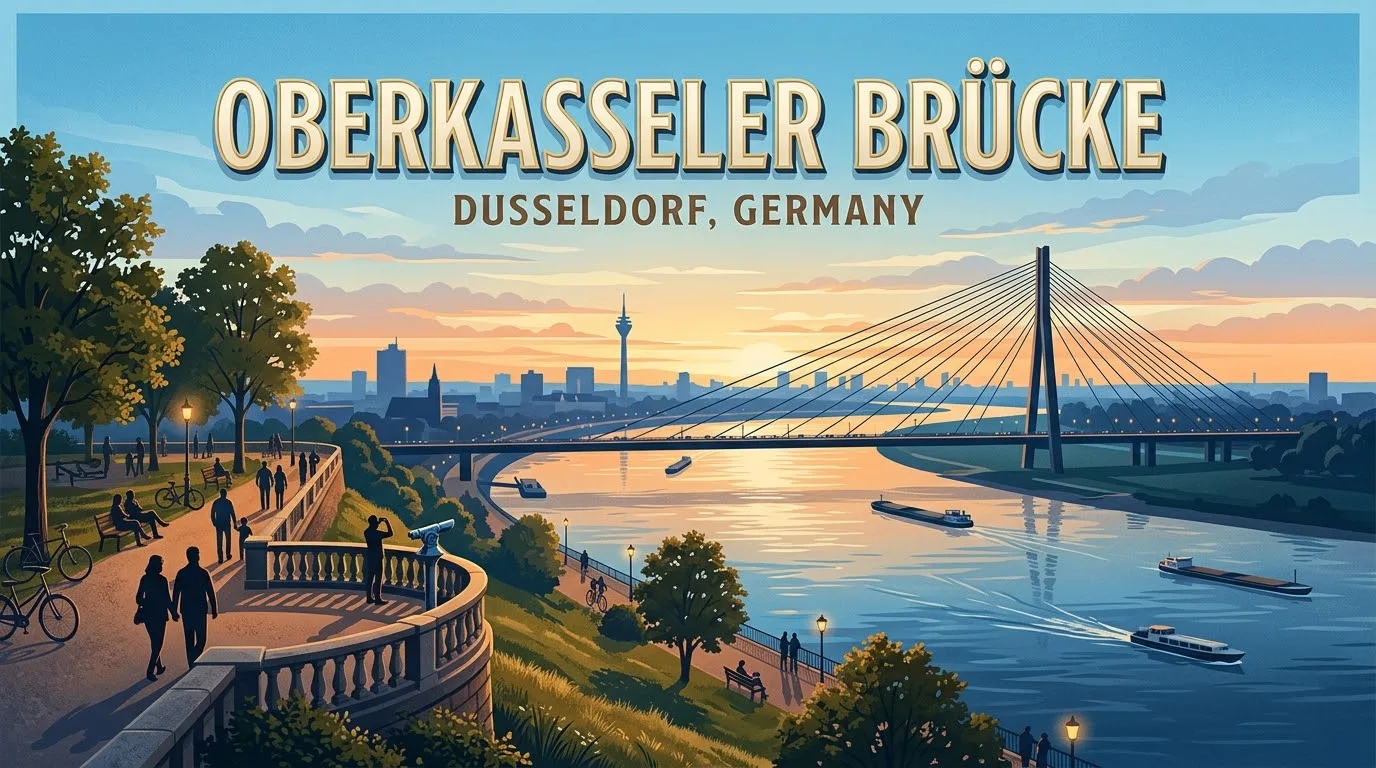
Anyone searching for Düsseldorf classic postcard view will almost inevitably end up on the Oberkasseler Brücke. This striking cable-stayed bridge connects the Oberkassel district on the left bank of the Rhine with the historic Altstadt and city centre on the right bank, making it not only a vital traffic artery but also one of the city's most popular viewpoints. From the middle of the bridge, a wide view opens up both up and down the Rhine: on one side, the historic gabled houses and church towers of the Altstadt cluster tightly along the riverbank, while in the background the Rheinturm and the modern skyline of the Medienhafen complete the silhouette. On the other side, the view sweeps across the Rhine meadows of Oberkassel and the broad river bends stretching south. Especially in the evening, when the lights of the Altstadt and the illumination of the Rheinturm are reflected in the waters of the Rhine, this view is considered one of the most impressive in the entire region and draws photographers, joggers and strollers alike every single day. The bridge itself, carried by a single slender pylon, is far more than just a means of crossing the river - its elegant, asymmetrical construction makes it an architectural eye-catcher in its own right, unmistakably marking the transition between Düsseldorf's two riverbanks.
History of Oberkasseler Brücke
The history of the crossing between Oberkassel and the Altstadt reaches back considerably further than today's bridge. As early as 1896 to 1898, a first permanent Rhine bridge was built at this location, connecting the then still independent suburb of Oberkassel with the growing city of Düsseldorf. Like many Rhine bridges, this structure fell victim to military destruction at the end of the war: on 3 March 1945, the bridge was blown up by the Wehrmacht to delay the advance of Allied troops. Between 1947 and 1948, a provisional temporary bridge was erected to restore this crucial river crossing, at least for the time being. Construction of today's actual bridge took place between 1969 and 1973, based on designs by engineer Hans Grassl, while architect Friedrich Tamms played a decisive role in shaping its exterior appearance. The structure became a technical sensation that attracted worldwide attention on 7 and 8 April 1976: in order to minimise disruption to river shipping during construction, the already-completed bridge, weighing several thousand tonnes, was moved 47.5 metres downstream to its final position in an elaborate operation - a feat considered the first of its kind and scale anywhere in the world, and still regarded today among bridge engineering specialists as a masterpiece of technical achievement. The bridge was finally opened to traffic on 30 April 1976. Since then, the Oberkasseler Brücke has not only served as one of the city's most important river crossings, also carrying two light rail tracks, but has also become a permanent fixture of Düsseldorf's visual memory, appearing in countless photographs, paintings and film footage of the city.
Highlights of Oberkasseler Brücke
The central experience of any visit is simply walking across the bridge, which, with a total length of 614.72 metres and a longest span of 257.75 metres, ranks among Germany's most significant cable-stayed bridges. The roadway is carried by a single pylon, 103 metres tall, on the left bank, from which the supporting cables fan out in a harp-like, almost symmetrical arrangement across the entire length of the bridge - a design detail that has made the bridge well known even among bridge engineering enthusiasts. For most visitors, however, the real highlight is the panoramic view: the wide pedestrian and cycle paths on both sides of the roadway offer an unobstructed view of the entire Altstadt riverfront, including its characteristic row of historic gabled houses, the towers of St. Lambertus church, and the Rhine promenade with its many cafés. Looking south, the view takes in the Rheinturm rising above the Medienhafen, while to the north stretch the wide green Rhine meadows of Oberkassel, popular with locals for relaxing and picnicking, especially on summer evenings. Among photographers, the golden hour shortly before sunset is considered the best time to visit, when the light bathes the facades of the Altstadt in warm orange tones, shortly followed by the first city lights beginning to reflect in the river. At night, too, when the bridge itself as well as the Rheinturm with its famous light sculpture are illuminated, the scene offers an atmospheric panorama that ranks among the most shared city views on photo platforms and social media. Those crossing the bridge on foot or by bike can also watch the Rhine ships passing regularly beneath the structure, adding an extra maritime touch to the scene.
Opening Hours, Tickets & How to Get to Oberkasseler Brücke
As a public transport link, the Oberkasseler Brücke is accessible around the clock, 365 days a year, to pedestrians, cyclists, cars and the light rail. No admission fees apply, since it is a freely accessible bridge rather than a commercial attraction. For the most rewarding walk, late afternoon or early evening light is recommended, when both the Altstadt silhouette and the Rheinturm are optimally illuminated; on windy days, visitors should expect a noticeable breeze on the exposed structure. The bridge sits between Düsseldorf's Altstadt and the Oberkassel district and is extremely well connected by public transport: several light rail lines cross the bridge directly, stopping on both the Oberkassel and Altstadt sides, so the bridge can be conveniently reached on foot from either riverbank. From the Altstadt, the bridge is just a few minutes' walk along the Rhine promenade; from Oberkassel's Rheinallee, a direct footpath and cycle path lead straight onto the bridge. Parking can be found within walking distance on both the Altstadt and Oberkassel sides, though increased crowds along the promenades should be expected on sunny weekends. The wide, structurally separated pedestrian and cycle paths on both sides of the roadway are step-free and well suited for wheelchair users and families with strollers.
Attractions Near Oberkasseler Brücke
Right on the Altstadt side of the bridge begins the Rhine promenade, inviting a walk along the river toward Burgplatz and the Schlossturm, only a few hundred metres away. From there, it is a short distance into the narrow lanes of the Altstadt, with its traditional breweries often referred to as the "longest bar in the world." Heading south along the Rhine, a roughly 20-minute walk leads to the Medienhafen with the Rheinturm and the striking buildings designed by Frank Gehry. On the Oberkassel side of the bridge, the expansive Rhine meadows invite strolls, picnics and sunbathing, and themselves offer a beautiful view back toward the bridge and the Altstadt skyline. The lively Oberkassel district, with its bustling shopping street Luegallee, is also just a few minutes' walk from the bridge and makes for a pleasant stop at one of its many cafés after crossing the river.
Where to stay in Dusseldorf, Germany
Compare current hotel prices and find the right place to stay.