Nordpark
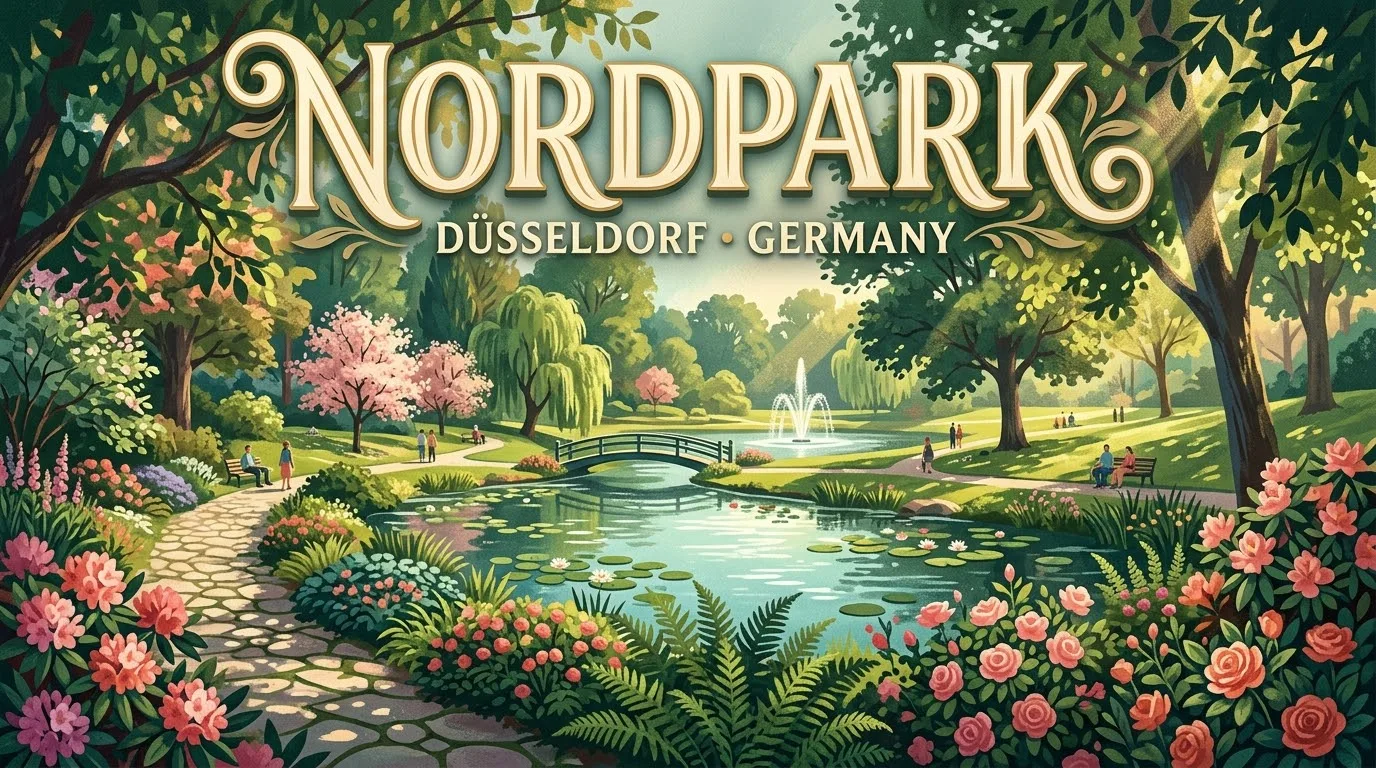
Just north of Düsseldorf's old town, in the district of Stockum, lies Nordpark — one of the most elaborate and spacious green spaces in the whole of North Rhine-Westphalia. Covering 36.6 hectares between Kaiserswerther Straße and the banks of the Rhine, the park combines broad, tree-lined lawns with a series of distinct themed gardens. Visitors entering through the main gate on Kaiserswerther Straße are immediately greeted by the largest fountain display in Düsseldorf: a 170-metre-long basin lined with cross-spraying jets leading the eye toward a grand central fountain. At the heart of the park lies the internationally admired Japanese Garden, while the Aquazoo-Löbbecke-Museum, built directly on the park grounds in 1987, draws a steady stream of families and nature lovers. Nordpark is open to the public free of charge around the clock, and its loose tables and chairs — which visitors are free to rearrange as they wish — speak to the relaxed, welcoming character the park has cultivated since its creation. Whether for a quiet morning walk, a weekend picnic on the lawns, or a slow wander through manicured garden rooms, Nordpark remains one of the most rewarding green destinations in the city.
History of Nordpark
The story of Nordpark begins in 1936, when Willi Tapp, then director of Düsseldorf's garden authority, was tasked with transforming a stretch of undeveloped land in Stockum into a sweeping landscaped park organised around clear main and secondary axes. To give the newly laid-out grounds a mature, established feel from the very start, several hundred large trees were transplanted from the nearby Nordfriedhof cemetery and from other public and private green spaces across the city. The park officially opened on 8 May 1937 as the centrepiece of the Reichsausstellung "Schaffendes Volk" ("Working People"), a large-scale garden, industry, and housing exhibition organised under the Nazi regime that drew approximately 6.9 million visitors during its run. Sculptures, pavilions, fountain installations, and elaborate light, flag, and water displays designed by set designer Walter von Wecus formed a central part of the exhibition's presentation. The monumental entrance portal was flanked by the "Rossebändiger" ("Horse Tamers"), two massive granite sculptures by Edwin Scharff that sparked considerable public controversy at the time because they remained visibly unfinished at the exhibition's opening — a dispute that today only adds to their historical interest as surviving witnesses of the period. After the Second World War, the British Army of the Rhine initially requisitioned the grounds as a recreation centre for its soldiers, before the park was gradually reopened to Düsseldorf's residents starting in 1953. Many of the original exhibition halls were demolished during this period and replaced with flower beds, while the underlying path network and garden architecture were largely preserved. In the late 1950s, young landscape architect Georg Penker, working under garden authority director Ulrich Wolf, redesigned the Sommerblumengarten (summer flower garden) in the asymmetrical style typical of the era. Since the 1960s, the city has continuously enriched the historic grounds with contemporary sculpture by international artists such as André Bloc and George Rickey, so that Nordpark today presents a fascinating dialogue between the formal garden art of the 1930s and modern, often abstract, outdoor sculpture.
Highlights of Nordpark
For many visitors, the undisputed centrepiece is the Japanese Garden by the Rhine, presented to the city in 1975 as a gift from Düsseldorf's Japanese community. A dedicated association invested 1.9 million Deutsche Mark at the time to realise the roughly 5,000-square-metre pond garden, designed by gardener Iwaki Ishiguro and his son in the traditional pond-garden style. A path winds around a small body of water fed by an artificial stream, complete with a symbolic boat landing and a tiny island, while carefully pruned black pines and Japanese maples define the garden's outer zones. Every four to six years, Japanese gardeners travel to Düsseldorf to carry out intensive maintenance, while city staff handle ongoing upkeep in between. Equally impressive are the fountains at the main entrance: the 170-metre basin with its cross-spraying jets leads the eye to a grand fountain fed by 160 separate nozzles — the largest water feature anywhere in Düsseldorf. Right beside it stands the neoclassical "Ballhaus," designed by architect Fritz Becker, which originally served as a café for the city's confectioners' guild and today functions as an exhibition hall for emerging artists. The themed water-lily garden, its pool framed by shade-giving columns, invites quiet contemplation, while the cactus garden, with its striking ceramic vases by artist Gwendolyn Liselotte Blume, showcases a surprising range of botanical diversity. Art lovers will also find works by André Bloc, George Rickey, Erich Reusch, and other sculptors scattered throughout the grounds, often read as a deliberate counterpoint to the monumental sculpture of the 1930s. Directly adjoining the park, the Aquazoo-Löbbecke-Museum combines a zoological museum and aquarium under one roof, making it easy to pair a walk through Nordpark with a deep dive into the underwater world for the whole family.
Opening Hours, Tickets & How to Get to Nordpark
As a public green space maintained by the city of Düsseldorf, Nordpark is freely accessible year-round and around the clock, with no admission charge for the park itself or for the Japanese Garden within it. Only the neighbouring Aquazoo-Löbbecke-Museum charges its own separate entry fee, with current prices and opening times available directly on the museum's website. The main entrance is located on Kaiserswerther Straße, while a quieter access point on the Rhine side can be found on Rotterdamer Straße. Several Rheinbahn tram and bus lines serving Stockum and Golzheim stop within a short walk of the main gate, making the park easy to reach without a car. Drivers will find a handful of paid parking options nearby, including spaces near the Aquazoo and along surrounding residential streets, though spots can fill up quickly on sunny weekends. Cyclists benefit from a direct link to the Rhine promenade cycle path, which connects Nordpark to the old town and Hofgarten. The main paths are largely flat and well paved, suitable for strollers and wheelchairs, though parts of the Japanese Garden's more naturalistic terrain can be slightly uneven. For a quieter visit, weekday mornings are recommended; weekends and sunny afternoons draw noticeably larger crowds, especially around the fountains and the Japanese Garden.
Attractions Near Nordpark
Right on the edge of Nordpark sits the Aquazoo-Löbbecke-Museum, a combined zoo, aquarium, and natural history museum that is especially popular with families. Just a short walk south, Rheinpark Golzheim unfolds along the riverbank, offering wide lawns for sunbathing and spectacular views of the Düsseldorf skyline — a natural extension for anyone wanting to continue their walk along the Rhine. Following the riverside promenade further toward the city centre, visitors can reach Düsseldorf's old town, with its historic lanes, traditional breweries, and the Rhine Tower, in roughly 30 to 40 minutes on foot. The central Hofgarten, Germany's oldest Volksgarten, is also easily reached via the riverside paths or by tram, offering a charming contrast to Nordpark's more formal garden architecture with its historic monuments and gas lanterns. Toward Oberkassel, the striking Rheinkniebrücke bridge and the skyline view across the river are especially photogenic at golden hour. Culture lovers can round off their day with a visit to the Tonhalle Düsseldorf, one of the city's most important concert halls, located just a few kilometres away and hosting regular performances of both classical and contemporary music. Taken together, Nordpark sits at the centre of a dense network of green and cultural destinations that can comfortably be combined on foot, by bike, or using Rheinbahn public transport, easily filling an entire day out in the northern part of Düsseldorf.
Where to stay in Dusseldorf, Germany
Compare current hotel prices and find the right place to stay.