Marktplatz
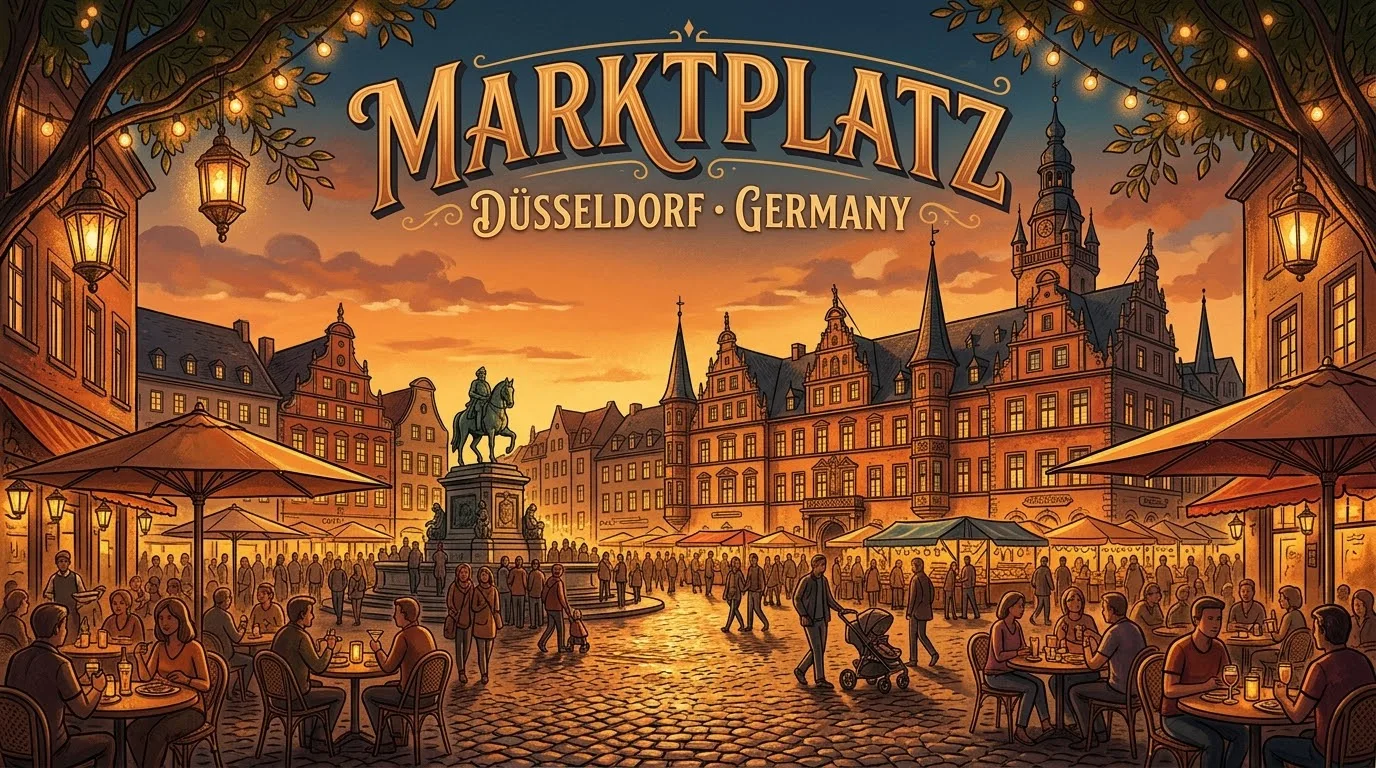
Marktplatz is the political and historic center of Düsseldorf's Altstadt and has served as the forecourt of the town hall for centuries. Framed by gabled townhouses, cafés and the imposing Rathaus building, the center of the square is dominated by the bronze equestrian statue of Prince-Elector Jan Wellem, one of the city's best-known monuments. Just a few steps from the Rhine and from Burgplatz, Marktplatz brings together administration, history and city life: official receptions and civic events take place here just as readily as spontaneous photo stops by tourists who sit down on the steps around the monument. With its compact, almost square shape and historic façades, Marktplatz is one of the most photogenic corners of the entire Altstadt.
History of Marktplatz
Marktplatz emerged during Düsseldorf's first major urban expansion between 1382 and 1394 and was first documented in writing in 1392. As early as 1482, markets are recorded as being held on the square, securing its central role as the city's trading and supply hub for centuries. In 1544, the mayor, town council and city officials moved into a building directly on the square, making it the immediate predecessor of today's town hall. Between 1570 and 1573 the city had this building rebuilt and extended in Renaissance style by master builder Heinrich Tussmann from Duisburg - today the oldest surviving part of Düsseldorf's town hall. In 1881 an adjacent old theater building was demolished, and in 1884 city architect Eberhard Westhofen added a new town hall wing at right angles to the historic original, which still defines the square's appearance today. At the center of Marktplatz, the equestrian statue of Prince-Elector Johann Wilhelm, known as "Jan Wellem," has stood since 1711, created by sculptor Gabriel de Grupello; Jan Wellem ruled the Duchy of Jülich-Berg from 1679 to 1716. For a long time, Marktplatz was also the site of the weekly market, until it was increasingly relocated to Carlsplatz around 1910; today's market stalls on the square are more touristic in character.
Highlights of Marktplatz
The undisputed highlight of Marktplatz is the bronze equestrian statue of Prince-Elector Jan Wellem, one of the most important Baroque monuments in the Rhineland. It was created in 1711 by the Italian-Flemish sculptor Gabriel de Grupello, who was given a house near the Altstadt specifically for the project - the so-called Grupellohaus, built around 1706 and gifted to him in 1708 - which contained his workshops and the foundry where the monumental equestrian statue was cast. The monument depicts the prince-elector in ornate armor on horseback and remains one of the most photographed sights in Düsseldorf's Altstadt to this day. Around the statue stand the historic façades of the town hall, which in its current form combines two distinct architectural styles: the 16th-century Renaissance building and the 1884 extension wing set at a right angle to it. The simple yet elegant architecture of the surrounding gabled houses, with ground-floor arcades, invites visitors to enjoy a relaxed coffee or a glass of Altbier overlooking the square. Marktplatz is especially charming in the evening, when the façades are illuminated and the square becomes a calm contrast to the lively nightlife of the surrounding Altstadt lanes. In the run-up to Christmas, Marktplatz is also one of the venues of the Düsseldorf Christmas Market, when the historic square is filled with wooden huts, handicrafts and mulled wine. Visitors wanting to dig deeper into Düsseldorf's city history can view historic council chambers and murals inside the town hall itself, where accessible as part of guided tours. The town hall building itself is characterized by red brick combined with pale natural stone for cornices and window surrounds, a material combination typical of Rhenish Renaissance architecture of the period, giving the building a warm, inviting appearance despite its function as an administrative seat.
Opening Hours, Tickets & How to Get to Marktplatz
As a public square, Marktplatz is freely and permanently accessible at no cost. The town hall itself, as an administrative building, is open during regular business hours on weekdays, though certain historic rooms can only be viewed as part of pre-arranged guided tours; opening times for such tours should be checked in advance with Düsseldorf's city marketing office. The square itself charges no admission and can be visited at any time of day or night. Getting to Marktplatz is very easy thanks to its location in the heart of the Altstadt: from the Heinrich-Heine-Allee U-Bahn and light rail stop, a roughly five-minute walk through the Altstadt lanes leads directly to the square. The Steinstraße/Königsallee stop and several bus and tram lines in the city center are also within walking distance. Düsseldorf's main railway station is about two kilometers away and can be reached by light rail in around ten minutes or on foot in about 25 minutes. Since the entire Altstadt is largely car-free or traffic-calmed, drivers are advised to park in one of the car parks at the edge of the Altstadt, for example near Schadowplatz, Carlsplatz or Schlossufer, from where Marktplatz is an easy walk away. Cyclists, too, can easily reach the square via the Rhine promenade or the Altstadt's pedestrian zones.
Attractions Near Marktplatz
Marktplatz lies right in the historic center of Düsseldorf and makes an ideal starting point for a walk through the Altstadt. Just a few steps away is Burgplatz with the Schlossturm and its sweeping views over the Rhine, while St. Lambertus Basilica with its distinctive twisted spire is likewise close by. Heading south, visitors quickly reach Carlsplatz, Düsseldorf's best-known gourmet market with fresh fruit, fish and regional specialties. The lively pub lanes around Bolkerstraße and Kurze Straße, known as the "longest bar in the world," adjoin Marktplatz directly and are especially worth visiting in the evening. Walking further north from there leads via Heinrich-Heine-Allee to Königsallee and Schadowplatz with its well-known shopping streets. The Rhine promenade, with its views of the Medienhafen district, is also only a few minutes' walk away. Those with more time can continue to the Kunstsammlung Nordrhein-Westfalen (K20) art museum and the Kunstakademie Düsseldorf art academy, both within a short stroll of Marktplatz. Northeast of the Altstadt, the sprawling Hofgarten park, one of the oldest public parks in Germany, also invites visitors to enjoy a relaxing stroll away from the busy lanes and combines well with a visit to Marktplatz for a full day exploring the city center.
Where to stay in Dusseldorf, Germany
Compare current hotel prices and find the right place to stay.