Lantz'scher Park
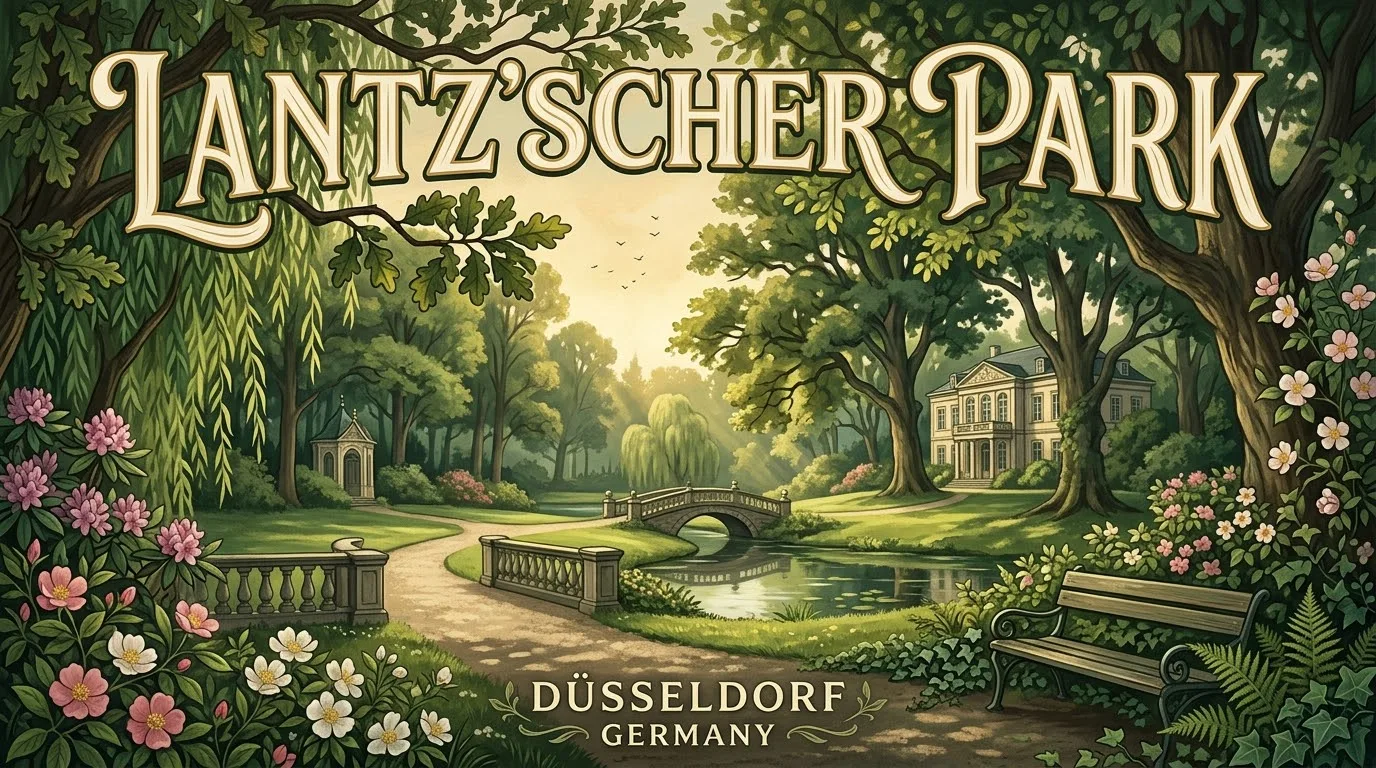
Lantz'scher Park lies in the quiet, airport-adjacent district of Lohausen in northern Düsseldorf, and ranks among the city's most tranquil yet historically rich parks. Across roughly 14.5 hectares, the grounds combine a neoclassical manor house, a small historic burial chapel, and an expansive landscape garden shaped by old trees into a self-contained, almost private-feeling ensemble that today is freely open to all visitors. Unlike the large, bustling Rhine parks in central Düsseldorf, Lantz'scher Park feels more like a hidden gem: narrow, winding paths beneath centuries-old trees, a circular walk framed by a double row of lime trees, and, in recent years, ever-changing contemporary sculptures that create an appealing contrast with the historic grounds. Anyone wishing to experience the history of a prosperous Düsseldorf merchant family, neoclassical architecture, and quiet natural surroundings in a single place will find in Lantz'scher Park one of the most authentic historic gardens in the north of the city.
History of Lantz'scher Park
The history of Lantz'scher Park begins in 1804, when the wealthy Düsseldorf merchant Heinrich Balthasar Lantz, who had made a considerable fortune partly through the colonial trade, acquired the estate in Lohausen. Around 1805 to 1806, he had a late-neoclassical manor house built on the foundations of an older moated castle; the Latin inscription above its entrance, "Pax Intrantibus" — roughly "Peace to those who enter" — can still be read today and underscores the hospitable character of the estate. The park itself took shape over several construction phases across almost three generations of the Lantz family: the front section, facing the manor house, was designed in 1858 by the renowned landscape architect Joseph Clemens Weyhe in the style of an English landscape garden, with winding paths and loosely scattered trees, while the rear section of the park was planned in 1880 by Carl Friedrich Julius Bouché and is still defined today by a striking double row of lime trees and a circular walking path. When Mathilde Lantz, the wife of Heinrich Victor Lantz, died in 1878, her husband had a small burial chapel built in the park between 1878 and 1879, which survives today as a quiet, heritage-protected testament to 19th-century bourgeois mourning culture. In June 1972, the Lantz family finally sold the entire estate to the city of Düsseldorf, which, after extensive restoration work, opened the park to the public for the first time in 1978. Since 1982, the entire Lantz'scher Park has been protected as a listed garden monument. Here too, storm Ela caused considerable damage in June 2014, destroying more than 90 old trees, which have since been gradually replanted.
Highlights of Lantz'scher Park
Lantz'scher Park impresses above all through its successful combination of historic garden architecture and a lively, contemporary cultural program. At the center of the front section of the park stands the late-neoclassical manor house of the Lantz family, its facade bearing the inscription "Pax Intrantibus," still one of the most distinctive sights on a walk through the park, even though the building itself now serves other purposes and is not continuously open to the public. Close by stands the small burial chapel, built between 1878 and 1879, a quiet structure surrounded by old trees that offers visitors a glimpse into 19th-century bourgeois memorial culture. The front section of the park, designed by Joseph Clemens Weyhe, captivates with its typically English landscape-garden character, featuring gently winding paths, individually placed old trees, and open lawns, while the rear section, planned by Julius Bouché, shows a markedly stricter, almost symmetrical structure with its double row of lime trees and circular path — an intriguing design contrast within the same site. Since 2020, Lantz'scher Park has also hosted rotating international sculpture exhibitions, in which contemporary artworks are placed seasonally among the historic trees and paths, lending the long-established park ever-new and surprising points of interest. Families will find a well-equipped children's playground in the park, while those seeking nature and quiet particularly appreciate its seclusion and its old, in places centuries-old, tree stock, which rarely feels crowded even on sunny weekends. Thanks to its location away from the major tourist routes, Lantz'scher Park remains, to this day, a place used mainly by Düsseldorf locals as a nearby recreational area — a circumstance that lends the park its special, almost private charm and makes it a worthwhile destination for anyone wishing to discover an authentic piece of Düsseldorf garden history away from the main attractions.
Opening Hours, Tickets & How to Get to Lantz'scher Park
Lantz'scher Park is a public green space maintained by the city of Düsseldorf and is accessible free of charge year-round; there are no fixed opening or closing times for the outdoor grounds. Visitors can enter the park and its paths at any time of day throughout the year, with the quiet morning hours being especially well suited to a relaxed walk. The park is located in the Lohausen district on Lohauser Dorfstraße and is best reached by public transport via the Lohauser Dorfstraße stop on bus line 760, from which the entrance is only a few minutes' walk away. Since there are no designated public parking spaces in the immediate vicinity of the park, visitors are generally advised to arrive by bus or bicycle; by bike, Lantz'scher Park is easily reached via the quiet residential streets of Lohausen. As Düsseldorf Airport is nearby, the park also makes for a short, peaceful stop before or after a flight. For up-to-date information on the rotating sculpture exhibitions, directions, or a downloadable site map, it is worth checking the city of Düsseldorf's website; no tickets or advance registration are required to visit the freely accessible outdoor grounds.
Attractions Near Lantz'scher Park
Lantz'scher Park lies just a few minutes from Düsseldorf Airport, making it an unusual but worthwhile stop for travelers with some time to spare before a flight. In the adjoining Lohausen district, quiet residential streets and small green spaces invite further short walks, while just a few kilometers to the south lies the expansive Nordpark with the Aquazoo Löbbecke Museum and the Japanese Garden, which combines well with a visit to Lantz'scher Park. Toward the Rhine lies the Stockum district, home to the Messe Düsseldorf exhibition center and the ISS Dome, one of the region's largest event arenas, while further downstream Rheinpark Golzheim and central Düsseldorf are also easily reached by public transport within a reasonable time. For a day outdoors in northern Düsseldorf, the combination of the quiet Lantz'scher Park and the much larger, livelier Nordpark works particularly well.
Where to stay in Dusseldorf, Germany
Compare current hotel prices and find the right place to stay.