Kunstsammlung Nordrhein-Westfalen K20
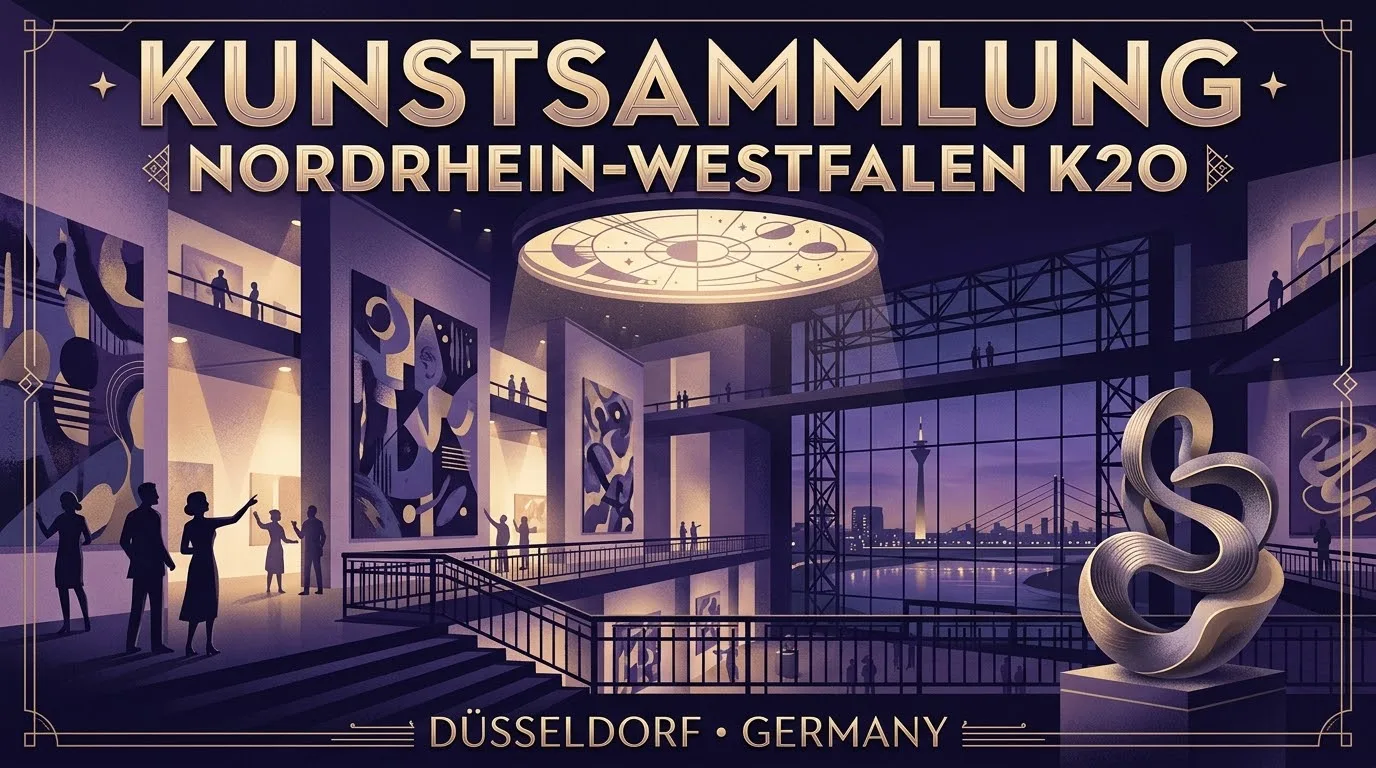
Kunstsammlung Nordrhein-Westfalen K20 is one of the most important museums of twentieth century art in Germany and one of the most distinctive pieces of museum architecture in the Rhineland. Housed in a striking black granite building on Grabbeplatz in Düsseldorf's old town, it holds one of the largest collections of works by Paul Klee anywhere in the world, complemented by major pieces by Pablo Picasso, Henri Matisse, Max Ernst and Max Beckmann as well as key positions in American post-war art and German contemporary art. The building's dark, polished facade already signals that this is no ordinary municipal museum but an institution of genuine international standing. For visitors interested in the development of painting from the early twentieth century to the present, a visit to Kunstsammlung Nordrhein-Westfalen K20 ranks among the essential stops on any trip to Düsseldorf, not least because the permanent collection is regularly complemented by ambitious temporary exhibitions.
History of Kunstsammlung Nordrhein-Westfalen K20
The history of Kunstsammlung Nordrhein-Westfalen K20 begins in 1961, when the state parliament of North Rhine-Westphalia made a consequential decision: for around 2.75 million Deutschmarks, an enormous and politically controversial sum at the time, it purchased 88 works by Paul Klee from a Swiss private collection. That acquisition formed the founding core of the newly established Kunstsammlung Nordrhein-Westfalen, which was initially shown in temporary quarters. Werner Schmalenbach, the museum's first director from 1962 to 1990, shaped the institution's profile and expanded the collection with major works of Cubism, Surrealism and American art after 1945. Only in 1986 did the collection receive a permanent home with the building on Grabbeplatz that still houses it today: the Danish architects Hans Dissing and Otto Weitling, both former students of Arne Jacobsen, designed a compact cube clad in polished black Swedish granite that has defined the appearance of the square ever since. Because exhibition space soon proved insufficient, the building underwent an extensive renovation and underground extension between 2007 and 2010 under the Munich firm Kiessler + Partner; the museum reopened in 2010 as the so-called new K20 with considerably larger galleries. Since 2016 the institution has operated together with its sister site K21 under the shared name Kunstsammlung Nordrhein-Westfalen, led by a rotating artistic directorate that continues to expand the collection with contemporary positions.
Highlights of Kunstsammlung Nordrhein-Westfalen K20
The heart of Kunstsammlung Nordrhein-Westfalen K20 is its own collection of around 100 paintings, watercolours and drawings by Paul Klee, one of the most comprehensive anywhere in the world, offering an almost unbroken overview of the artist's career from his early graphic work to the often darker canvases of the 1930s. Specially designed, softly lit cabinets allow visitors to study Klee's pictorial experiments at close range. The tour then moves into classical modernism: paintings by Pablo Picasso from both his Cubist and later figurative periods hang alongside works by Henri Matisse, while Max Ernst and his Surrealist vocabulary of collage, frottage and grattage form a dedicated focus. Expressionism and New Objectivity are represented through works including those by Max Beckmann. Another highlight is the large gallery devoted to American post-war art, where action paintings by Jackson Pollock meet screen prints and objects by Andy Warhol that reflect the consumer culture of the 1960s. German art after 1945 occupies a prominent place as well, with central works by Joseph Beuys, whose fat corners and felt objects remain a core part of the collection, alongside paintings by Gerhard Richter, Sigmar Polke and Georg Baselitz; installations by Katharina Fritsch extend the view into the present. Visitors to Kunstsammlung Nordrhein-Westfalen K20 during the 2026/2027 season can also experience the major Franz Marc exhibition, running from September 2026 to January 2027, which brings together key works by the Expressionist painter and co-founder of Der Blaue Reiter, as well as the group exhibition "Playground", on view from April 2026 to May 2027, which explores the relationship between art and play. Regular curator-led tours and an extensive education programme for families make even complex works approachable.
Opening Hours, Tickets & How to Get to Kunstsammlung Nordrhein-Westfalen K20
Kunstsammlung Nordrhein-Westfalen K20, at Grabbeplatz 5, 40213 Düsseldorf, is open Tuesday to Sunday and on public holidays from 11am to 6pm; the museum is closed on Mondays. On the first Wednesday of every month, opening hours are extended until 10pm, which makes for a quieter evening visit. Admission depends on the exhibition currently on view and typically ranges from 9 to 17 euros for a single ticket; a combined ticket valid for one year at both K20 and its sister site K21 in the Ständehaus costs 21 euros. Students aged 18 and over pay 5 euros, children and teenagers up to 17 enter free of charge, and frequent visitors can buy an annual pass for 49 euros. Tickets can be reserved online through the Kunstsammlung's web shop, which is advisable for popular temporary exhibitions. Getting there by public transport is straightforward: several Rheinbahn light rail lines, including U70 through U79 and U83, stop at Heinrich-Heine-Allee, just a short walk from the museum. From the main railway station, the journey by light rail takes around ten to fifteen minutes. Several multi-storey car parks serve the old town, though expect queues on weekends and during events. Before visiting, it is worth checking the official Kunstsammlung Nordrhein-Westfalen website for current information on special exhibitions, guided tours and any closure dates.
Attractions Near Kunstsammlung Nordrhein-Westfalen K20
Its location on Grabbeplatz makes Kunstsammlung Nordrhein-Westfalen K20 an excellent starting point for a walk through Düsseldorf's old town. Just a few steps away lies the Burgplatz with the historic Schlossturm tower and the distinctive Basilica of St. Lambertus, whose slightly twisted spire is one of the city's landmarks. From there, the Rhine embankment promenade runs along the river, lined on fine days with cafés and wide steps where people like to linger. Numerous traditional Altbier breweries, such as Füchschen and Zum Schlüssel, are also within easy walking distance and pair well with a museum visit. Art lovers can reach the sister museum K21, housed in the historic Ständehaus, by light rail in around ten minutes to explore its collection of international contemporary art. The Museum Kunstpalast at the Ehrenhof, with its broad holdings ranging from old masters to glass art, is likewise only a short ride away. For shopping, the nearby Königsallee offers international boutiques, while families with children might plan a trip to the Aquazoo Löbbecke Museum in the Nordpark.
Where to stay in Dusseldorf, Germany
Compare current hotel prices and find the right place to stay.