Königsallee
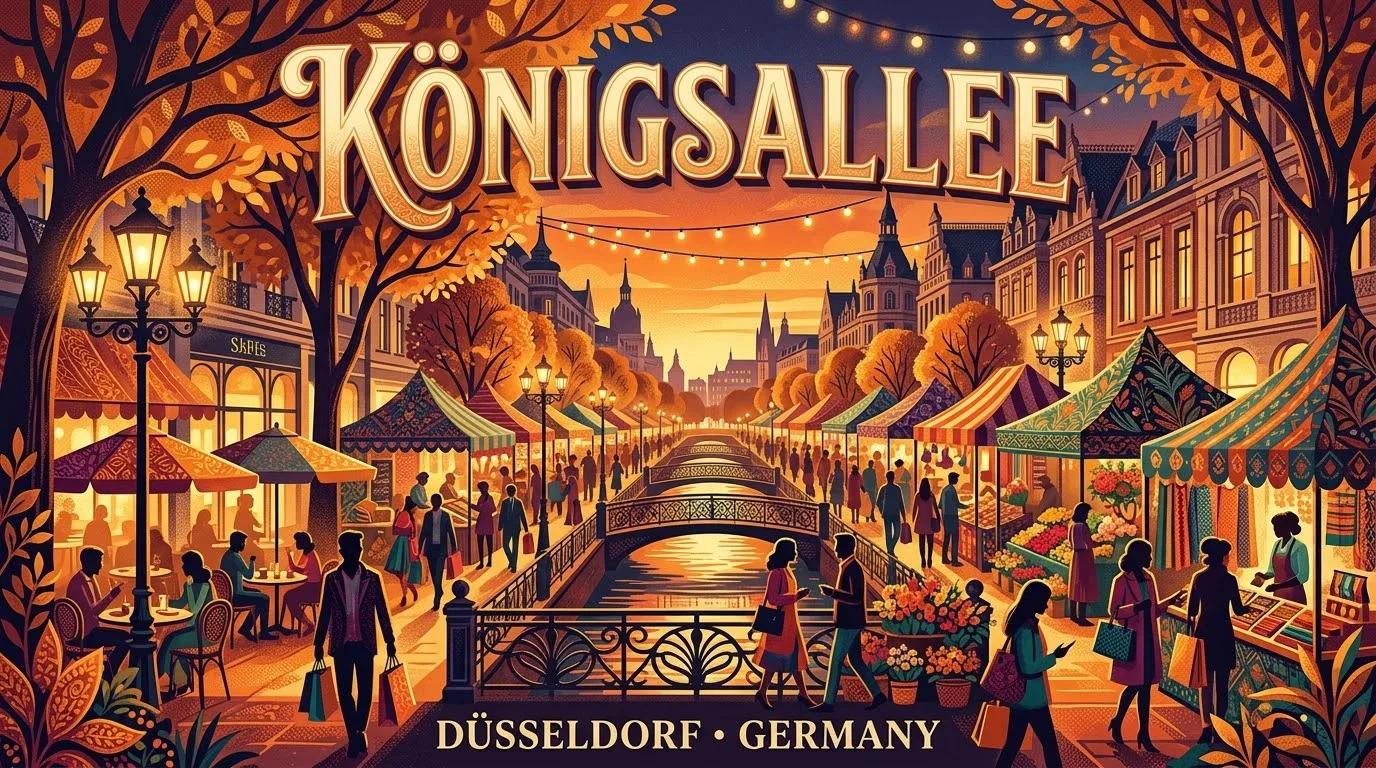
Anyone visiting Düsseldorf who wants to experience just a single street almost inevitably ends up on Königsallee. Locals simply call the boulevard "Kö", and this nickname has long become a brand in itself, standing for elegance, fashion, and upscale lifestyle far beyond the borders of North Rhine-Westphalia. What makes Königsallee so unique is not only the sheer density of luxury stores but its unusual urban layout: a nearly 30-meter-wide water channel framed by old plane trees divides the boulevard into two parallel roadways and pedestrian promenades. On one side, international designer boutiques line up one after another; on the other, banks, law firms, and cafés overlook the water. This combination of nature, architecture, and consumption has given Königsallee a reputation for decades as one of the most beautiful and most expensive shopping streets on the European continent. Especially in summer, when ducks and swans glide across the Kö-Graben and tourists stroll under the trees with shopping bags in hand, the boulevard shows itself at its finest.
History of Königsallee
The origins of Königsallee date back to 1802-1804, a period shaped by the Treaty of Lunéville of 1801. This treaty forbade the reconstruction of Düsseldorf's fortifications, freeing up the former moat area of the city for new use. The court architect Kaspar Huschberger, court gardener Maximilian Friedrich Weyhe, and hydraulic engineer Wilhelm Gottlieb Bauer transformed this land into a representative promenade in the classicist style, initially known simply as "Neue Allee", "Mittelallee", or "Kastanienallee", since chestnut trees were predominantly planted at the time. The boulevard only received its current name in 1851, and the story behind it is one of the city's most amusing: in 1848, King Friedrich Wilhelm IV of Prussia rode through the avenue and, according to tradition, came into unfortunate contact with fresh horse manure, triggering a minor diplomatic incident and furious complaints. Shortly afterward, the city of Düsseldorf officially renamed the avenue "Königsallee" ("King's Avenue") in his honor, a gesture intended to smooth over the affair in the following years. Throughout the 19th century, the Kö first developed into a preferred residential address for Düsseldorf's upper middle class before its gradual transformation into a commercial street began. In 1838, the first railway station of the Düsseldorf-Elberfeld line opened nearby, giving the area an economic boost. In 1876, a horse-drawn tram began operating along the avenue, which was electrified in 1896. Between 1906 and 1907, the Girardet Bridge was built, one of the distinctive crossings over the Kö-Graben still standing today. Over the course of the 20th century, the use of the boulevard increasingly shifted from residential to commerce, banking, and gastronomy, a process that peaked after the Second World War during reconstruction and the economic miracle of the 1950s and 1960s. In 2013, a new architectural chapter opened with the Kö-Bogen, a building complex by star architect Daniel Libeskind at the northern end of the avenue, which reinterpreted the connection between Hofgarten park and the city center in urban design terms. In July 2026, the city council also approved a comprehensive redesign of Königsallee, although construction is not expected to begin before 2029 at the earliest, proof that the avenue remains subject to continuous urban planning development to this day.
Highlights of Königsallee
The centerpiece of Königsallee is undoubtedly the Kö-Graben, the elongated waterway that divides the avenue into its eastern and western sides. Flanked by old plane trees that form an impressive canopy in autumn, the channel invites quiet strolls, whether you have just finished shopping or simply want to admire the architecture. Along the canal stand several historic fountains, including the Triton Fountain erected in 1902, an ornate bronze sculpture that remains one of the avenue's most popular photo spots. The sculpture of the Bergischer Löwe (Bergisch Lion) from 1963 and the historic Kö-Uhr, a standing clock installed in 1905 and elaborately restored in 2017, are among the small but charming details waiting to be discovered while strolling. In terms of shopping, Königsallee is considered one of the densest luxury shopping streets in Europe, second only to New Bond Street in London. Within a very compact stretch, international houses such as Dior, Tiffany & Co., and numerous other haute couture brands have established flagship stores, complemented by the traditional department store Breuninger and an Apple Store whose glass architecture has become a minor attraction in its own right. Visitors more interested in architecture than shop windows should take time for the aforementioned Kö-Bogen, whose curved building volumes with green facade elements form a clear contrast to the classicist layout of the rest of the avenue. The numerous street cafés along the canal also invite visitors to watch the lively bustle of passersby over a cup of coffee, a fixture of Düsseldorf's leisure culture for generations. On special occasions, such as during the Christmas season, the avenue is additionally decorated with elaborate lighting that bathes the entire canal in an atmospheric glow, tempting even casual visitors into a winter stroll. The blend of manicured nature, high-quality architecture from different eras, and international retail makes the Kö a place where shopping, strolling, and sightseeing merge seamlessly.
Opening Hours, Tickets & How to Get to Königsallee
Since Königsallee is a public street, there are no fixed opening hours and no admission fee; the avenue itself is freely accessible around the clock. The shops located there follow the usual Düsseldorf retail hours, generally Monday to Saturday from around 10:00 to 19:00 or 20:00, though individual boutiques and flagship stores may have different hours. On Sundays, most shops remain closed, except for occasional designated shopping Sundays held throughout the year, which are announced in advance through the city's event calendars. For getting there, public transport is recommended, as parking in the city center is limited. No fewer than three U-Bahn stations lie in the immediate vicinity of the avenue: Graf-Adolf-Platz at the southern end, Steinstraße/Königsallee in the middle, and Heinrich-Heine-Allee at the northern section toward the Altstadt. From all three stations, the Kö is reachable within a few minutes' walk. Numerous tram and bus lines also cross the avenue or run close by, ensuring good connections from virtually every part of the city. Visitors arriving by car will find paid parking in nearby garages, such as at Schadowplatz or near the Carsch-Haus, though they should expect heavier traffic especially on Saturdays. Coming from the main train station, Königsallee can comfortably be reached on foot in about 15 to 20 minutes, or within a few minutes by U-Bahn.
Attractions Near Königsallee
The location of Königsallee at the heart of Düsseldorf's city center makes it an ideal starting point for further discoveries. Just a few minutes' walk to the north lies the Hofgarten, Germany's oldest public park, offering expansive lawns, mature trees, and several ponds, a welcome green respite after a shopping stroll. Close to the northern end of the avenue is the aforementioned Kö-Bogen with its striking architecture, which flows seamlessly into the facing Kö-Bogen II complex. Heading west, visitors reach the historic Altstadt within a few minutes, with its narrow alleys, traditional brewery pubs, and the famous "longest bar in the world". There you will also find St. Lambertus Basilica and the castle tower at Burgplatz, two of the city's oldest surviving buildings. South of the Kö, a short walk brings you to Carlstadt with its Carlsplatz and the long-standing weekly market there, while to the east, the busy Schadowstraße continues as another major shopping axis of the city. The Rhine promenade with its distinctive Rheinturm tower is also reachable from Königsallee in a pleasant walk of about 20 minutes, making it easy to combine a visit to the Kö with an evening view of the river.
Where to stay in Dusseldorf, Germany
Compare current hotel prices and find the right place to stay.