Kö-Bogen
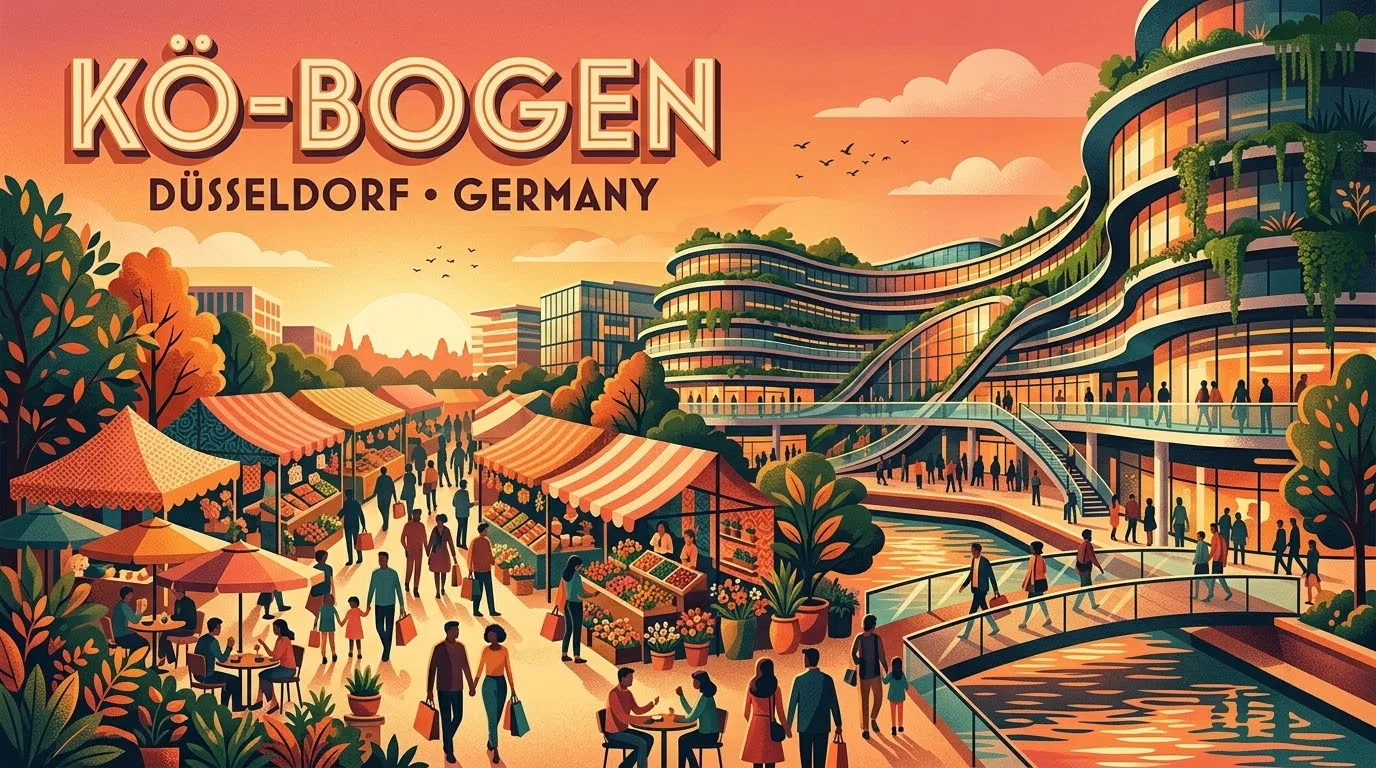
The Kö-Bogen is one of the most striking architectural landmarks in central Düsseldorf, marking the transition between the world-famous Königsallee boulevard and the lively pedestrian zone around Schadowstraße. With its curved glass and travertine façades designed by the renowned American architect Daniel Libeskind, the complex has set an unmistakably modern counterpoint to the historic buildings of the surrounding Altstadt since its opening in 2013. The Kö-Bogen is far more than an ordinary shopping center: it combines upscale retail, office space, dining and planted terraces across a total area of roughly 74,000 square meters, and together with the immediately adjoining Schadow-Arkaden forms the pulsing heart of premium shopping in Düsseldorf. Anyone looking to shop in style in Düsseldorf is hard-pressed to avoid the Kö-Bogen, where international flagship stores meet ambitious architecture in one of the busiest locations in the entire city.
History of Kö-Bogen
The history of the site on which the Kö-Bogen now stands reaches back long before the building's actual opening in 2013. The project took its name from the semicircular route of the historic Hofgartenstraße, which once curved toward Königsallee in an arc, giving the area the name "Kö-Bogen" that is still used today. The site was once home to the magnificent Trinkaus-Palais, which was almost completely destroyed during the devastating bombing raids on Düsseldorf in 1944. In the decades following the Second World War, the area developed into an important junction for the city's tram network, which, as traffic volumes grew, was increasingly seen as an urban-planning eyesore. It was only the construction of the underground Wehrhahn-Linie, which rendered the surface-level tram junction obsolete, that created the conditions for a fundamental redevelopment of the site. Urban planning for a comprehensive renewal project began as early as 2005, with the commission eventually going to star architect Daniel Libeskind, who had already achieved international fame for his curved, dynamic museum and cultural buildings. After several years of construction and an investment of roughly 150 million euros, the eastern building, home to the Breuninger department store, was ceremonially opened on October 17, 2013; just a few weeks later, in December 2013, an Apple Store opened in the western building, attracting international attention. The Kö-Bogen has received numerous awards for its architectural and urban-planning concept, including LEED Platinum certification in 2014, the MIPIM Award for Best Urban Regeneration the same year, and the German Brand Award in Gold in both 2018 and 2022. A few years after the completion of the first phase, a second, directly adjoining complex known as Kö-Bogen II was built, designed by the Düsseldorf-based architecture firm Ingenhoven and completed in 2020; it makes its own striking green statement in the city center with Europe's largest hornbeam hedge façade.
Highlights of Kö-Bogen
Architecturally, the Kö-Bogen impresses above all through its two curved building volumes, made up of around 2,400 individual glass and travertine elements whose diagonal lines and vertical incisions, known as "cuts," create an unmistakable façade. These incisions incorporate planted areas that give the concrete and glass structure an unusually organic touch, clearly setting it apart from conventional shopping centers. A bridge at third-floor level connects the two building volumes, allowing visitors to move seamlessly between the different sections. In total, the complex offers around 19,000 square meters of retail space for numerous international brands and flagship stores, complemented by approximately 15,000 square meters of office space and around 1,100 square meters of dining space ranging from cafés to upscale restaurants. Among the best-known tenants is the large Breuninger department store, which serves as the anchor tenant with its broad range of goods, along with an Apple Store that has consistently ranked among the most visited Apple retail locations in Germany since it opened. Directly adjoining the Kö-Bogen is the long-established Schadow-Arkaden, which opened back in 1994 to a design by architect Walter Brune and forms its own architectural highlight with its gleaming granite façade, its distinctive glass entrance cylinder, and the prism-shaped dome created by artist Otto Piene. Inside the Schadow-Arkaden, around 55 shops are spread across two levels, along with a dining area in the basement, including well-known names such as Esprit, Anson's, Sephora and Starbucks, complemented by the Theater an der Kö, medical practices and a fitness studio. Beneath the entire site lies an underground garage with around 650 parking spaces across four levels, allowing for convenient arrival by car. Together, the Kö-Bogen and Schadow-Arkaden form a connected, upscale shopping and leisure district that links the classic Königsallee with the lively pedestrian zone of Schadowstraße, offering visitors an impressive concentration of shopping, architecture and dining within a short distance.
Opening Hours, Tickets & How to Get to Kö-Bogen
Access to the exterior areas and façades of the Kö-Bogen is possible free of charge at any time, as it is an openly accessible urban quarter rather than an enclosed facility. The individual shops within the Kö-Bogen and the adjoining Schadow-Arkaden follow standard German retail hours and are generally open Monday through Saturday from around 10 a.m. to 8 p.m., though individual flagship stores such as the Apple Store may have different, typically longer hours; most shops remain closed on Sundays, with the exception of occasional designated shopping Sundays. Dining establishments within the complex are often open in the evenings and sometimes on Sundays as well. Since no admission fee is charged, the Kö-Bogen can be visited entirely spontaneously without any advance planning. Its address at Königsallee 2, at the intersection with Schadowstraße, could hardly be more central: the Heinrich-Heine-Allee tram stop is in the immediate vicinity, as is the Steinstraße/Königsallee stop, making the Kö-Bogen reachable within minutes via almost every tram line in the city center. Düsseldorf's main train station is also about a ten-minute tram ride away. Drivers will find convenient paid parking in the building's own underground garage with around 650 spaces directly beneath the complex, which is especially practical for longer shopping trips. Given its central location, a visit to the Kö-Bogen pairs perfectly with a walk along Königsallee or through the adjoining Hofgarten.
Attractions Near Kö-Bogen
The Kö-Bogen's location at the head of Königsallee makes it the perfect starting point for a walk through the most important attractions of central Düsseldorf. Just a few steps away begins the famous Königsallee itself, whose chestnut-lined boulevard with a canal running down its center ranks among the most exclusive shopping streets in Europe. Directly across lies the expansive Hofgarten, Germany's oldest public park, home to the striking Düsseldorf Schauspielhaus theater and the imposing Dreischeibenhaus office tower. A short distance further brings visitors to Martin-Luther-Platz, with the Kaiser-Wilhelm-Denkmal and the Bismarck-Denkmal, two significant historical monuments from the Wilhelmine era. Following the route of Schadowstraße leads within minutes to the historic Altstadt with its narrow lanes, traditional brewery pubs and the Rhine promenade. The Kunstsammlung Nordrhein-Westfalen, with its K20 building on Grabbeplatz, is also within comfortable walking distance, rounding off a visit to the city center with a cultural highlight. To end the day, a stroll along the Rhine promenade with views of the Rheinturm tower is a great option, reachable from the Kö-Bogen on foot in around 15 to 20 minutes.
Where to stay in Dusseldorf, Germany
Compare current hotel prices and find the right place to stay.