Kaiser-Wilhelm-Ring
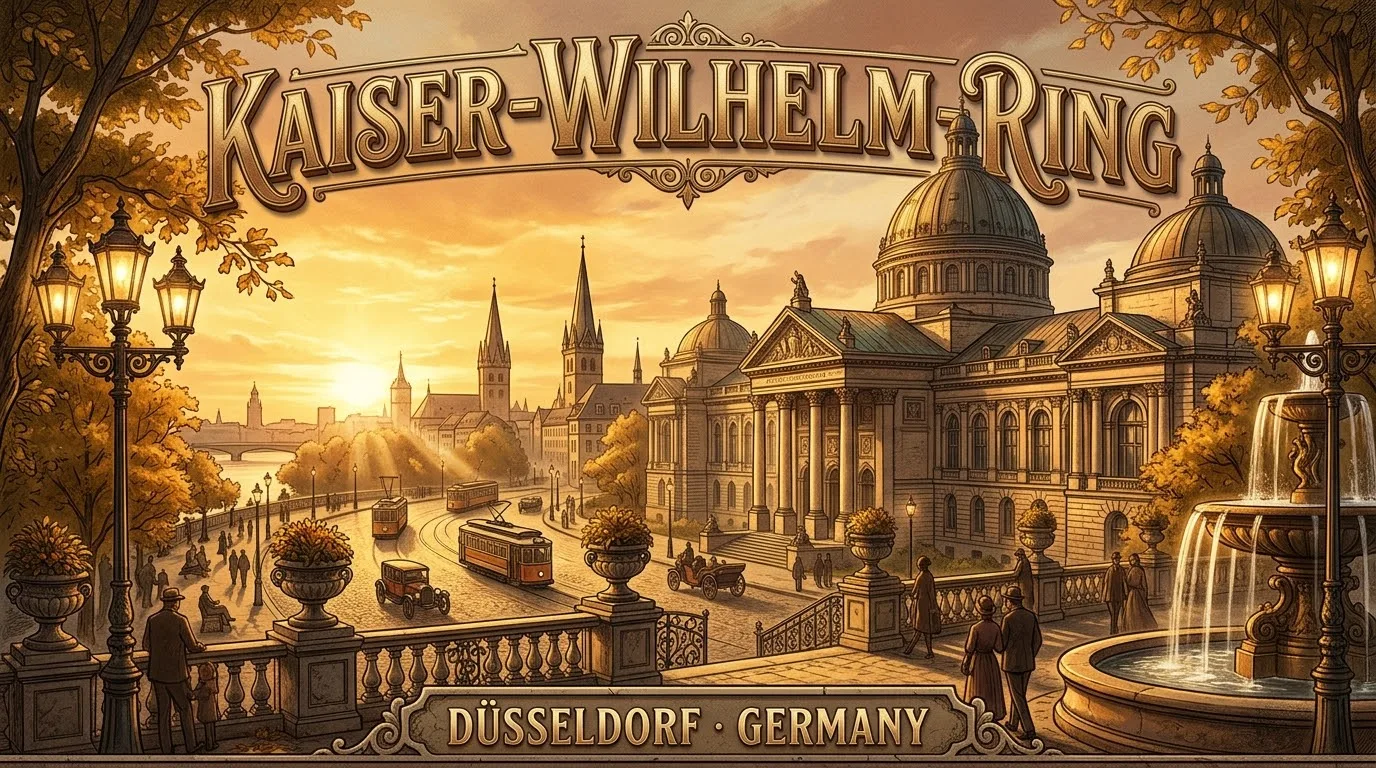
On the left, western bank of the Rhine, in the elegant district of Oberkassel, runs the Kaiser-Wilhelm-Ring, one of Düsseldorf's finest addresses for lovers of late nineteenth and early twentieth-century residential architecture. Unlike most of the city's attractions, the Kaiser-Wilhelm-Ring is not a single monument but an entire street lined with richly decorated facades, elaborate stucco work and ornate bay windows that together create an impressive picture of upper-middle-class living around the turn of the twentieth century. Anyone interested in how Düsseldorf grew from a quiet riverside settlement into a modern metropolis will find, in Oberkassel and along the Kaiser-Wilhelm-Ring in particular, an unusually dense and well-preserved ensemble from this period, just a short walk or bridge crossing away from the Altstadt.
History of Kaiser-Wilhelm-Ring
The history of the Kaiser-Wilhelm-Ring is closely tied to the rapid development of Oberkassel around the turn of the century. Until the late nineteenth century, Oberkassel was an independent, largely rural settlement on the left bank of the Rhine, only officially incorporated into Düsseldorf in 1909. However, the construction of the Oberkasseler Brücke in 1898, which dramatically improved the connection to Düsseldorf's Altstadt, had already triggered an enormous building boom that transformed Oberkassel within just a few years into a sought-after residential district for the upper middle class. The renowned urban planner Josef Stübben, who had already contributed to numerous other German city expansions, was commissioned to redesign the district and devised a carefully considered system of ring, radial and diagonal streets for Oberkassel. The Kaiser-Wilhelm-Ring, as one of the central ring streets, formed the backbone of this plan, deliberately following the gentle curve of the Rhine so that the new development harmonized with the natural topography of the area. Between roughly 1900 and 1914, a closed block of high-quality residential buildings arose along this and neighboring streets, built predominantly in the style of the late Gründerzeit and the emerging Art Nouveau, known in Germany as Jugendstil. Wealthy merchants, factory owners and members of the educated middle class commissioned representative townhouses and villas here, featuring elaborate floral ornamentation, flowing lines and intricate facade details that embraced the fashionable Jugendstil taste of the time. The outbreak of the First World War put a temporary stop to this intense building activity, but the structures completed by then largely retained their original form. Unlike many other Düsseldorf districts, Oberkassel came through the destruction of the Second World War comparatively unscathed, meaning that an exceptionally cohesive picture of this architectural period survives to this day. In 1992, a large part of Oberkassel, particularly the area south of Luegallee, was officially designated as a protected heritage area comprising more than 400 listed buildings, a recognition of the district's unique urban and architectural quality, with the Kaiser-Wilhelm-Ring counted among its defining streets.
Highlights of Kaiser-Wilhelm-Ring
The particular appeal of the Kaiser-Wilhelm-Ring lies in the density and quality of its historic facades, which reveal themselves piece by piece on a leisurely walk. Time and again, the multi-story residential buildings display elaborate stucco ornamentation with floral motifs, curved bay windows, wrought-iron balcony railings and richly decorated entrance doors, all characteristic of the transition from the late Gründerzeit to Jugendstil. Many of the buildings feature elaborately designed gables and roof structures that give the street a lively, distinctive silhouette despite its closed block development. Particularly charming is the contrast between the calm, almost stately character of the wide, tree-lined ring road and the often very playful, ornament-rich facades of the individual houses, a typical feature of upper-middle-class residential architecture around 1900. Visitors who look closely will also notice subtle differences between the buildings, ranging from strictly symmetrical, classically inspired facades to much freer, organic Jugendstil forms, vividly documenting the fluid stylistic transition of that era. The curving path of the ring street itself, following the bend of the Rhine, also means that new perspectives on the building fronts continually emerge while walking, making the Kaiser-Wilhelm-Ring a rewarding destination for architectural photography. Since this remains a lively residential district, the historic character of the street can easily be combined with everyday Oberkassel life: small cafés, boutiques and restaurants on the ground floors of many buildings invite a pause between observations. Altogether, a walk along the street is less about a single spectacular building than about the harmonious overall effect of an exceptionally well-preserved Gründerzeit and Jugendstil ensemble.
Opening Hours, Tickets & How to Get to Kaiser-Wilhelm-Ring
Since the Kaiser-Wilhelm-Ring is a public street in an inhabited residential district, there are no opening hours and no admission fee. The historic facades can be viewed freely at any time of day or night, though a walk in the morning or early afternoon is recommended, when daylight best highlights the stucco details and ornamentation of the facades. As these are private residential buildings, visitors should respect residents' privacy and limit themselves to viewing the exteriors from the street. Oberkassel is very well connected to Düsseldorf's public transport network, with several tram and bus lines linking the district to the city center, and the journey across the nearby Oberkasseler Brücke from the Altstadt takes only a few minutes. Alternatively, the route can also be covered on foot, since the Oberkasseler Brücke has its own generous pedestrian and cycle path and offers an excellent view of Düsseldorf's Rhine front and the Altstadt. Visitors arriving by car will generally find public parking available on the residential streets around the Kaiser-Wilhelm-Ring, though they should pay attention to resident-parking zone signage, which is common in this sought-after neighborhood. As the Kaiser-Wilhelm-Ring is a fairly long street, it is worth combining the walk with a visit to the adjoining Luegallee, Oberkassel's lively shopping street, which likewise features numerous historic facades.
Attractions Near Kaiser-Wilhelm-Ring
The Kaiser-Wilhelm-Ring sits embedded within one of Düsseldorf's most attractive residential districts, offering plenty of opportunities to extend the walk. Just a few minutes away lies Luegallee, Oberkassel's central shopping and strolling street, inviting visitors to browse its cafés, boutiques and further impressive Gründerzeit facades. Crossing the nearby Oberkasseler Brücke quickly brings visitors to the Altstadt on the opposite bank, with its Rathaus, the Basilica of St. Lambertus and traditional breweries, making it easy to combine both sides of the Rhine in a single day trip. The Rhine promenade on the Oberkassel side also offers one of the best views of the Altstadt skyline, the Rheinturm tower and the modern architecture of the Medienhafen, particularly striking in the evening hours. Also nearby is Luegallee with its lively market activity, as well as several small parks and playgrounds that make Oberkassel one of Düsseldorf's greenest and most family-friendly districts. Visitors interested in architecture and history can further combine a visit to the Kaiser-Wilhelm-Ring with a longer walk through the surrounding, equally protected residential streets of Oberkassel, gaining an even more comprehensive impression of the district's Gründerzeit and Jugendstil architecture.
Where to stay in Dusseldorf, Germany
Compare current hotel prices and find the right place to stay.