Jan-Wellem-Reiterstandbild
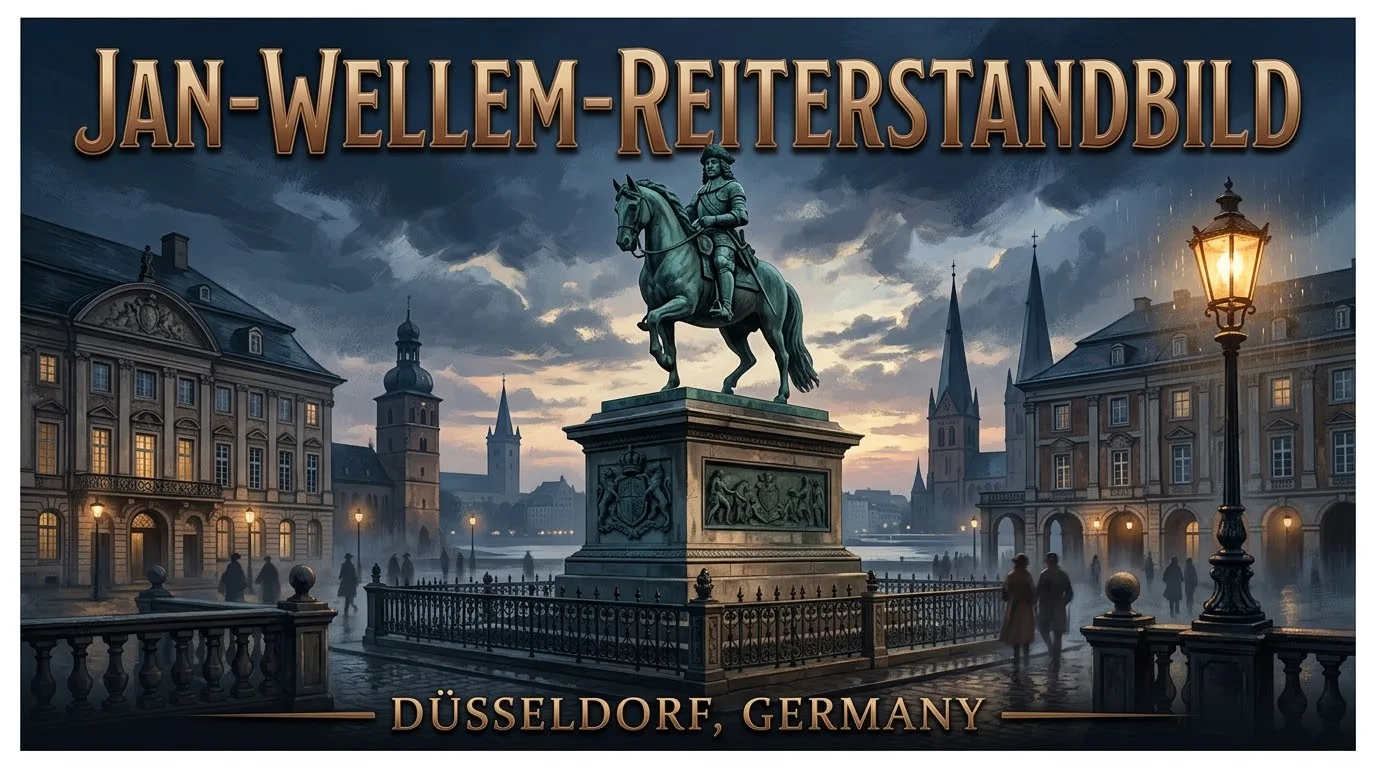
Standing directly in front of the historic town hall on the Marktplatz of Düsseldorf's Altstadt is one of the city's most recognizable landmarks: the Jan-Wellem-Reiterstandbild. The gleaming, gold-toned bronze figure depicts the former Elector Johann Wilhelm of the Palatinate mounted high on horseback, dressed in full armor and bearing every insignia of his power. Few other monuments are as closely bound up with the identity of the state capital as this Baroque masterpiece, which has dominated the Marktplatz for more than three hundred years. For locals, "Jan Wellem" is no longer merely a historical ruler's name but a familiar figure of everyday life, living on in postcards, club names, and countless anecdotes passed down through generations. Anyone exploring the Altstadt will almost inevitably pass this imposing equestrian statue; it marks the symbolic heart of the city while simultaneously telling the story of a ruler who sought to turn Düsseldorf into a Baroque residence city of European standing.
History of Jan-Wellem-Reiterstandbild
Johann Wilhelm of the Palatinate, known affectionately as Jan Wellem, ruled as Elector Palatine from 1690 until his death in 1716 and made Düsseldorf his preferred residence. Under his rule the city experienced a cultural golden age: he built up significant art collections, invited Italian and Dutch artists to his court, and drove forward the expansion of the Düsseldorf electoral palace. While still alive, Jan Wellem commissioned the Flemish-born sculptor Gabriel de Grupello, regarded at the time as one of the foremost Baroque sculptors north of the Alps, to create an equestrian statue in his own honor, a rather unusual act of self-representation for the period. Work began around 1703 in a specially constructed foundry building that would later become the site of the Altes Schauspielhaus theatre. According to local legend, Jan Wellem personally threw gold and silver coins into the molten bronze during casting to give the statue a particular richness and shine, an anecdote still fondly recounted on Düsseldorf city tours today, even if it cannot be confirmed with historical certainty. The finished statue was ceremonially erected and unveiled on the Marktplatz in 1711, while the Elector was still alive, allowing him to admire his own monument. The originally planned, far more elaborate pedestal flanked by four lion figures was never fully realized; in 1830 the base was replaced with a simpler, classicist granite pedestal, which still stands today.
Highlights of Jan-Wellem-Reiterstandbild
The Jan-Wellem-Reiterstandbild impresses above all through its elaborate Baroque attention to detail. Gabriel de Grupello depicted the Elector in full armor, adorned with an electoral hat, a heavy chain of office, and a marshal's baton in hand, all symbols of secular and military power meant to leave no doubt about the rank of the man portrayed. The horse itself is captured in dynamic motion, one foreleg raised, lending the entire composition a surprising sense of vitality despite its considerable age. Particularly striking is the golden sheen of the bronze, which forms an impressive contrast with the historic half-timbered and Baroque façades surrounding the Marktplatz, especially in direct sunlight. Many visitors also notice the finely worked reliefs and decorative elements on the pedestal, which hint at the monument's eventful building history. Its position directly in front of the Altes Rathaus, whose construction dates back to the sixteenth century, creates a harmonious historical ensemble that ranks among the most photographed corners of the entire old town. During numerous festivals and parades, such as Düsseldorf's carnival celebrations or city anniversaries, the square around the statue traditionally serves as a central gathering point, placing Jan Wellem quite literally at the center of city life. Not least, the equestrian statue functions as a beloved local landmark: Düsseldorfers to this day happily arrange to meet "at Jan Wellem," turning the Baroque artwork into a living part of the city's daily rhythm.
Opening Hours, Tickets & How to Get to Jan-Wellem-Reiterstandbild
Since the Jan-Wellem-Reiterstandbild stands freely accessible in the middle of the public Marktplatz, there are no fixed opening hours and no admission fee; the monument can be visited free of charge at any time, on any day of the week, around the clock. The bronze figure is especially atmospheric in the evening, when the old town's historic street lighting bathes the Marktplatz in warm light and brings out the golden accents of the statue. The Marktplatz lies at the heart of the Altstadt, just a short walk from the Rhine and from Burgplatz, and is within walking distance of virtually every central point in the city. Visitors relying on public transport should get off at the Heinrich-Heine-Allee stop, served by several underground lines, from where a short walk of just a few minutes through the old town's lanes leads directly to the Marktplatz. From the main railway station, the statue can be reached either by underground in a few minutes or on foot in roughly 20 to 25 minutes. Drivers should note that the entire Altstadt is largely a restricted traffic zone; however, several paid parking garages on the edge of the old town and along the Rhine embankment offer convenient alternatives. The Marktplatz is also easily reached by bicycle via the riverside promenade and the adjoining old town streets.
Attractions Near Jan-Wellem-Reiterstandbild
Directly behind the equestrian statue rises the historic Altes Rathaus, parts of which date back to the Renaissance and which still serves as the seat of the city administration today. Just a few minutes' walk away lies Burgplatz, home to the Schlossturm, the last surviving remnant of the former electoral castle, as well as the modern Stadterhebungsmonument, which recounts the story of the city's 1288 founding charter in bronze. Also close by is the Radschlägerbrunnen, dedicated to Düsseldorf's famous cartwheeling children. Heading toward the river, the Rheinuferpromenade offers one of the city's most beautiful walking routes, with views of the river, the Rheinturm tower, and the Oberkasseler Brücke bridge. The Basilika St. Lambertus, recognizable by its distinctive twisted spire, is also only a few steps away and pairs well with a visit to the Marktplatz. Anyone looking for refreshment after sightseeing will find numerous traditional brewery pubs tucked into the narrow lanes of the Altstadt, serving Düsseldorf's top-fermented Altbier, an experience that for many visitors is just as essential as seeing Jan Wellem himself.
Where to stay in Dusseldorf, Germany
Compare current hotel prices and find the right place to stay.