Hofgarten
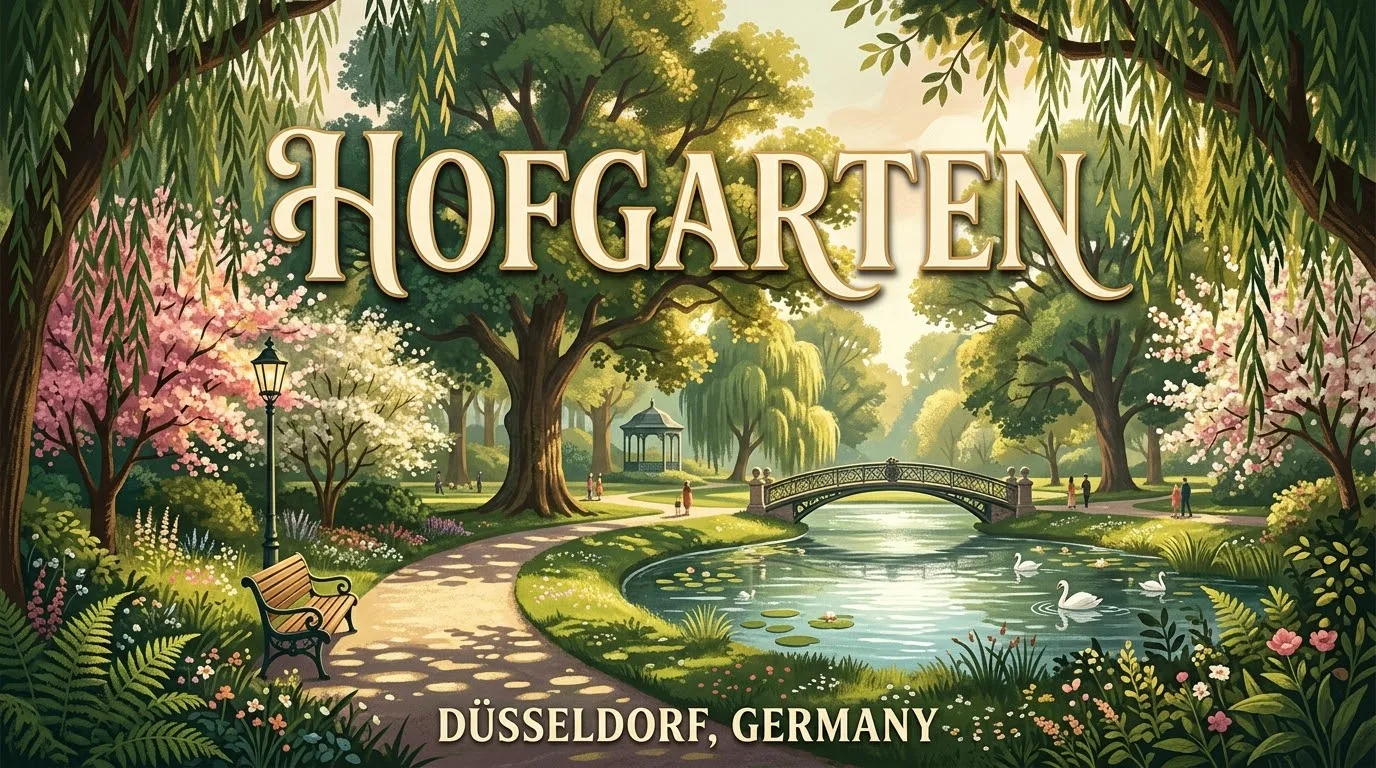
Few parks combine history, garden artistry, and urban life as densely as Hofgarten in the heart of Düsseldorf. Covering a total of 27.73 hectares, of which 13 hectares are open meadows, the park stretches from Schloss Jägerhof on Jacobistraße to Heinrich-Heine-Allee at the edge of the old town, and from Königsallee to the Ehrenhof on the banks of the Rhine. Its oldest publicly accessible section was laid out in 1769, making Hofgarten the first and oldest Volksgarten (public park) in all of Germany — long before comparable parks existed in other German cities. Numerous historic monuments and modern sculptures punctuate the grounds, which trace a visible stylistic journey from strict Baroque geometry to the freer English landscape style. Running right through the lively city centre, Hofgarten is regarded by locals as the "green lung" of Düsseldorf and serves as a favourite gathering place for strollers, office workers on their lunch break, and families on sunny weekends alike.
History of Hofgarten
Hofgarten's roots stretch back to the era of Duke Wilhelm the Rich: a princely garden outside Düsseldorf's former fortress walls is first documented in 1557, extending north of the Düssel stream toward Pempelfort. In the 17th century, Count Palatine Wolfgang Wilhelm had the garden, laid out as a strict parterre, expanded further, but after the court residence ended in 1716 — following the death of Elector Johann Wilhelm, known as Jan Wellem — the grounds gradually fell into neglect. It was not until 1769 that Elector Karl Theodor, prompted by his governor Count Goltstein, ordered the overgrown garden transformed into a public promenade "for the pleasure of the townspeople." The design was entrusted to the Lorraine-born architect Nicolas de Pigage, who had recently completed Schloss Benrath and its park; his work produced the Jägerhofallee, still the park's main axis today, running from Schloss Jägerhof toward the court church of St. Andreas. At the end of this avenue lies the Runder Weiher (Round Pond), fitted in 1900 with a fountain and the bronze figure "Jröne Jong" by sculptor Joseph Hammerschmidt. During the French occupation of 1795, this oldest part of the park was almost entirely destroyed by military earthworks; it was only restored, in landscape style, in 1804 by garden master Maximilian Friedrich Weyhe, who simultaneously created the "New Hofgarten" in the English landscape style on the site of the demolished city fortifications. In 1811, Napoleon Bonaparte's "Beautification Decree" granted Düsseldorf's residents the former ramparts down to the Rhine for the creation of green spaces; in his honour, the hill built from excavated material near the nearby Sicherheitshafen harbour — the Napoleonsberg, in the park's northwest — still bears his name today. In 1815, the Rhineland's first gymnastics ground was also established here, inspired by Friedrich Ludwig Jahn, founder of the German gymnastics movement. Throughout the 20th century, Hofgarten repeatedly weathered serious threats: Nazi-era plans for a wide parade avenue through the park were thwarted, as was city planner Friedrich Tamms's 1958 proposal to partially fill in the Landskrone pond to build the Jan-Wellem-Platz — massive public protest ultimately saved the park from this intervention. Hofgarten was added to the city's register of protected monuments in 1998, underwent a comprehensive renovation as part of EUROGA 2002plus in 2002, and was included in the "Straße der Gartenkunst zwischen Rhein und Maas" garden route in 2004. On the evening of 9 June 2014, the storm "Ela" destroyed roughly half of the park's mature tree stock, from which it has been gradually recovering ever since, while ongoing infrastructure projects such as the Wehrhahn-Linie subway and the Kö-Bogen development continue to reshape the park's topography to this day.
Highlights of Hofgarten
A world-class technical curiosity is Hofgarten's historic gas lighting system: with 219 gas lanterns, it is believed to be the only municipal park in the world lit predominantly by gas. The "Modell Frankfurt" lanterns still in use today mostly date from 1951 to 1953 and build on an older system installed around 1908; together with Prague's Charles Bridge, the park's Goldene Brücke (Golden Bridge) is one of only two gas-lit bridges anywhere in the world. Following a 2023 city council decision, of Düsseldorf's roughly 14,500 gas lanterns citywide, only those in Hofgarten are to be permanently preserved — a clear statement of this place's unique character. Nature lovers appreciate the park's two ponds, home to ducks and swans cared for from the listed brick-and-timber Schwanenhaus (Swan House); since 1994, dedicated animal welfare volunteers have tended to sick or injured waterfowl there. Attentive visitors strolling through the grounds will also spot squirrels, ring-necked parakeets, cormorants, and herons. Artistically, the standout piece is the bronze sculpture "Harmonie" by Aristide Maillol on the Napoleonsberg, donated by the Kunstverein in 1953 in honour of the poet Heinrich Heine, alongside the monument to playwright Christian Dietrich Grabbe near Heinrich-Heine-Allee. On balmy summer Sundays, the traditional matinee at the park's music pavilion draws crowds of visitors, while the "UVA-UVB" light benches by Düsseldorf artist Stefan Sous, which glow after dark along the Jägerhofallee, form a contemporary counterpart to the historic gas lanterns. Families will find one large and two smaller playgrounds plus two dog-exercise areas, while the broad lawns invite sunbathing throughout the summer months. Altogether, Hofgarten offers a rare density of garden history, wildlife, sculpture, and urban recreation right in the middle of the city centre.
Opening Hours, Tickets & How to Get to Hofgarten
As an inner-city public park, Hofgarten is freely accessible year-round with no restricted hours and no admission fee. Thanks to its central location between the old town, Königsallee, and the Ehrenhof, the park is easily reached on foot from virtually anywhere in the city centre. By public transport, the U-Bahn stops Heinrich-Heine-Allee and Schauspielhaus, as well as the tram and bus stops at Jan-Wellem-Platz, provide convenient access points, and Düsseldorf's main railway station is only a few minutes away by light rail. Drivers will find several paid car parks around Königsallee and the Ehrenhof, since the park itself is traffic-calmed and largely car-free. The broad paths of the Jägerhofallee and adjoining promenades are flat and well paved, making the park easy to navigate with a pushchair or wheelchair. Visitors looking to escape the bustle of Königsallee will find quiet, shaded corners around the ponds, particularly on weekdays and in the early morning, while the large lawns tend to fill up on sunny weekends. Given the various construction projects in the surrounding area, such as around the Kö-Bogen development, it is worth checking current notices about path closures before planning a visit.
Attractions Near Hofgarten
At the southern end of Hofgarten lies the Ehrenhof, home to the Museum Kunstpalast and the Tonhalle Düsseldorf, one of the city's most important concert halls — an ideal pairing for anyone with an interest in culture. Just a few steps away stands the Düsseldorf Schauspielhaus, whose striking architecture borders the park directly and regularly hosts high-calibre theatre productions. Heading west, visitors quickly reach the world-famous Königsallee, lined with luxury boutiques and cafés and bisected by the Schwanenspiegel canal from which it takes its nickname "Kö," while heading toward the Rhine leads into the historic old town with its narrow lanes, traditional breweries, and riverside promenade. At the park's eastern edge stands Schloss Jägerhof, now home to the Goethe-Museum Düsseldorf, one of Germany's most significant Goethe collections. Following the Rhine promenade, visitors can reach the Rhine Tower and the Medienhafen harbour district, with its striking architecture designed by Frank Gehry, in under half an hour on foot. Nordpark with its Japanese Garden and the riverside lawns of Rheinpark Golzheim are also comfortably connected via the riverside promenade or by tram. This dense neighbourhood of museums, theatres, shopping boulevards, and further green spaces makes Hofgarten one of the best starting points for exploring central Düsseldorf.
Where to stay in Dusseldorf, Germany
Compare current hotel prices and find the right place to stay.