Heinrich-Heine-Institut
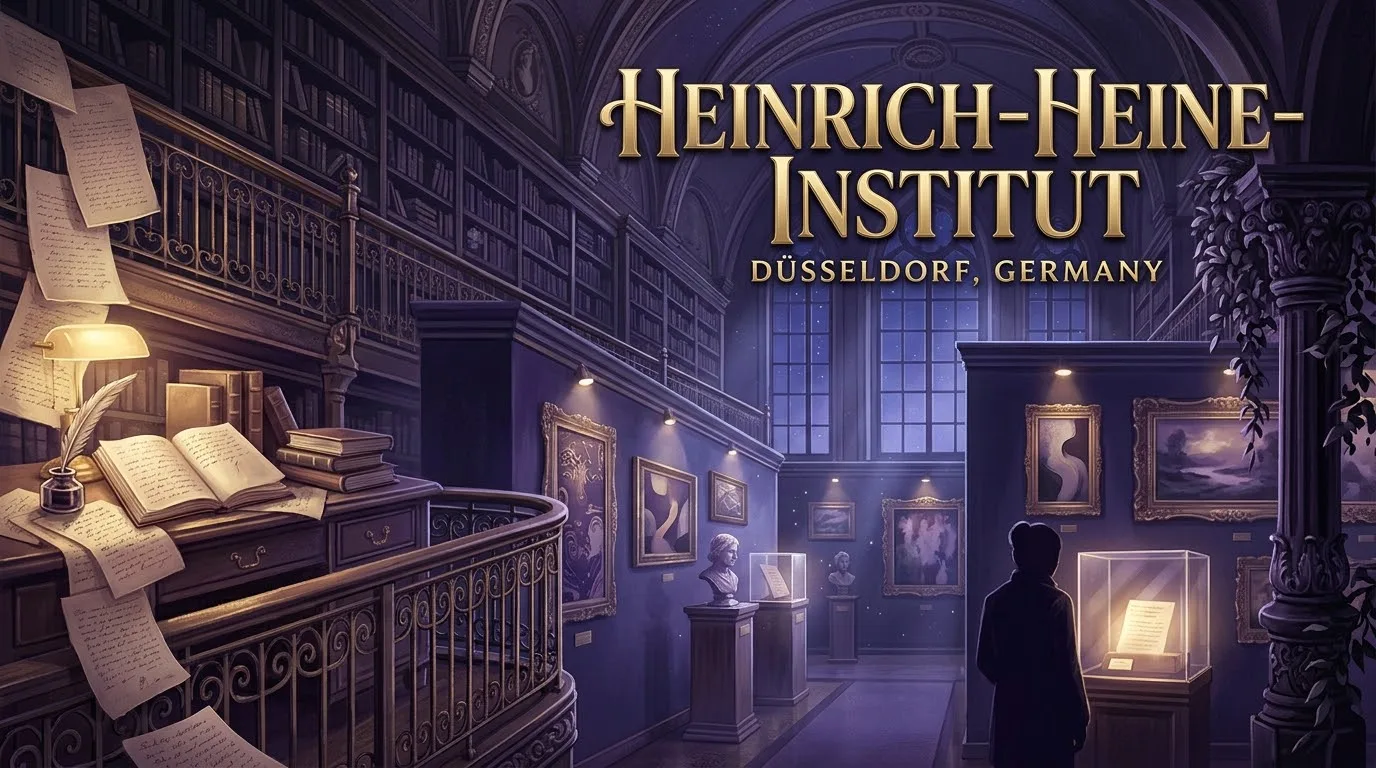
In the Carlstadt, the history-rich district between the Altstadt and the Rhine embankment, Bilker Straße is home to an institution entirely devoted to the memory of one of Germany's most significant poets, who was born in Düsseldorf: the Heinrich-Heine-Institut. As a center of international Heine research and, at the same time, a museum, archive and library, the institute brings together under one roof everything that defines Heinrich Heine (1797-1856) as both a literary figure and a historical personality - his wit, his political combativeness, his sense of being torn between Germany and his Paris exile, and the linguistic elegance that still resonates today. For visitors interested in German literary history, the nineteenth century, or simply the origins of famous lines such as those about the Loreley, the institute offers a concentrated, well-researched insight into Heine's life and circle. At the same time, the institute is far more than a pure literature museum: as a research institution, it preserves significant holdings not only on Heine himself but also on the Schumann family and on Rhineland literary history as a whole, and it conveys these holdings to a broad, international audience through exhibitions, events and a dedicated digital Heine portal. This combination of museum, archive and lively events venue sets the institute apart from many conventional literature museums, where research and public outreach often take place in separate spheres.
History of Heinrich-Heine-Institut
The Heinrich-Heine-Institut was founded in 1970, growing out of the manuscript department of the former Landes- und Stadtbibliothek Düsseldorf. When the remaining holdings of that library were transferred to the newly founded University of Düsseldorf, later renamed Heinrich-Heine-Universität, the valuable manuscript collection stayed in the city and became the starting point for an independent institute specializing in Heine. This origin explains why the institute has had a dual function from the very beginning: both a research institution with academic standing and a publicly accessible museum. Over the following decades, the institute systematically expanded its holdings and broadened its collecting mandate considerably beyond Heine himself. The Schumann Archive, preserving important documents on Clara and Robert Schumann, gained particular significance, as did around 50 further literary estates transferred to the institute over time. With the Rheinisches Literaturarchiv, focused exclusively on authors from the Rhineland from the nineteenth century to the present, the institute also built a collection reaching well beyond Heine research in the narrower sense. The long-running permanent exhibition "Romantik und Revolution" had to close temporarily in 2025 due to necessary ceiling repair work; the permanent exhibition's reopening is expected in the second half of 2026, while the institute continues its research and events program throughout this period.
Highlights of Heinrich-Heine-Institut
The regular permanent exhibition "Romantik und Revolution" spans nine rooms across roughly 180 square meters and displays around 250 objects tracing Heine's life from his childhood in Düsseldorf through his student years to his Paris exile. Among the particularly striking exhibits are the manuscript of the world-famous Loreley poem, a lock of the poet's hair, the well-known portrait by Gottlieb Gassen, and a death mask of Heine - objects that connect the literary myth to the historical person in a vivid, almost tangible way. Throughout the exhibition, explanatory texts place Heine's biography within the political and social context of his time, including the censorship of pre-revolutionary Germany that ultimately drove him into Parisian exile, as well as his enduring reputation as a sharp-tongued observer of European politics. Beyond the permanent exhibition, the institute regularly presents changing special exhibitions on literary, musical and cultural-historical themes; from September 2026 to January 2027, for example, the exhibition "Seitenwechsel. Literatur und Fußball," supported by the DFB Kulturstiftung, explores the unusual interplay between literature and football. For visitors unable to visit in person, the institute offers a 360-degree online tour of its exhibition rooms. The Heinrich-Heine-Institut also organizes literary walking tours through the Altstadt, following Heine's traces in his home city, along with workshops, children's birthday programs and its own podcast titled "Romantik & Revolution," which discusses Heine and his contemporaries in an accessible format. Researchers also have access to the institute's extensive archive of autographs from the seventeenth to nineteenth centuries, along with a substantial image and photograph collection.
Opening Hours, Tickets & How to Get to Heinrich-Heine-Institut
The Heinrich-Heine-Institut is located at Bilker Straße 12-14 in Düsseldorf's Carlstadt district, an area that likes to describe itself as the "street of Romanticism and Revolution." Because the permanent exhibition is currently in a temporary closure due to ceiling repair work, with reopening expected in the second half of 2026, visitors are especially encouraged to check the institute's website or call ahead for current opening hours, the status of the exhibition rooms, and any admission fees, as operations during the construction phase may differ from the regular schedule. Events, readings and access to the archive and library for research purposes generally continue even during the renovation, usually by prior appointment. The Carlstadt is an easy walk from Düsseldorf's city center; by public transport, the stops around Heinrich-Heine-Allee and Benrather Straße are convenient, placing the institute within a few minutes' walk. Parking is available in the surrounding multi-story car parks of the Carlstadt and Altstadt. Visitors wishing to access the collections online can use the 360-degree tour and the Heinrich-Heine-Portal, which offers digitized letters and critical text editions independent of the institute's opening hours.
Attractions Near Heinrich-Heine-Institut
The Carlstadt is one of Düsseldorf's most culturally dense neighborhoods, and several further museums lie within easy walking distance of the Heinrich-Heine-Institut. Just a short walk away is the Hetjens-Museum / Deutsches Keramikmuseum in the Palais Nesselrode, devoted to international ceramic history and easy to combine with a visit to the Heine-Institut in a single afternoon. The same building complex as the Hetjens-Museum also houses the Filmmuseum, which explores the history of film. Heading north, visitors quickly reach Burgplatz with its historic Schlossturm and the Düsseldorf Altstadt, known for its dense pub scene and traditional Altbier. South of the Carlstadt, the Rheinuferpromenade invites a riverside stroll, while the Königsallee with its shops is only a few minutes' walk away. Visitors with a further interest in literary history can join the institute's guided city walks to explore additional sites in the Altstadt connected to Heinrich Heine's childhood and youth in Düsseldorf.
Where to stay in Dusseldorf, Germany
Compare current hotel prices and find the right place to stay.