Heinrich-Heine-Denkmal
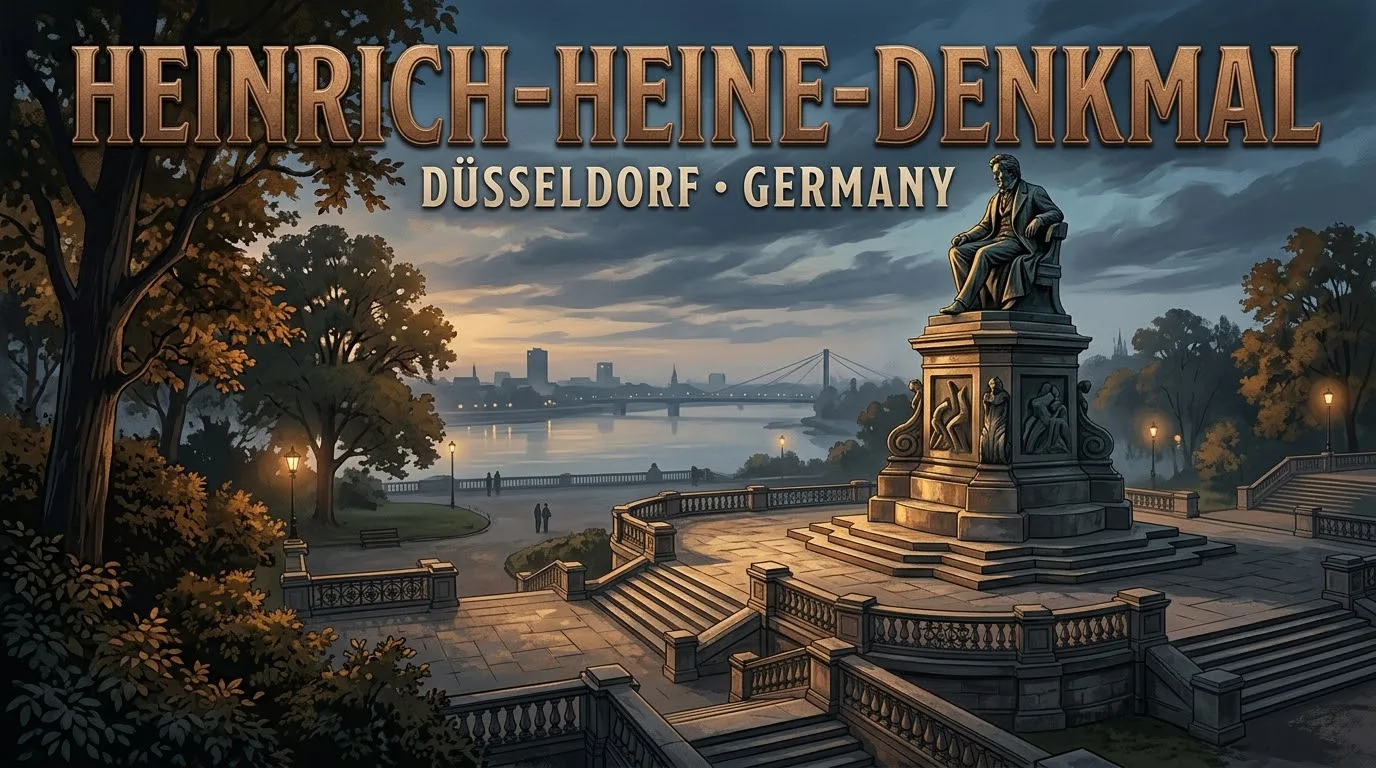
On Schwanenmarkt, in the transitional area between the Altstadt and the Baroque quarter of Carlstadt, stands a monument that looks nothing like a classical statue: the Heinrich-Heine-Denkmal. Rather than a single, harmonious bust or figure, visitors encounter a deliberately fragmented, splintered bronze composition intended to reflect the contradictory character of the great poet it honors. Heinrich Heine, born in Düsseldorf in 1797, ranks among the most important German lyric poets of the 19th century and remained emotionally attached to his birth city throughout his life, even though he spent most of it in exile in Paris. The relationship between Heine and Düsseldorf was never entirely straightforward, however, and the history of how the city chose to remember him was marked by controversy for more than a century. The monument on Schwanenmarkt expresses this inner conflict in a singular way and today ranks among the most artistically ambitious and most discussed public artworks in the city.
History of Heinrich-Heine-Denkmal
The history of honoring Heine in Düsseldorf is unusually long and turbulent. A first attempt to erect a monument to the poet was already made in 1887, but the project collapsed amid fierce, partly antisemitically motivated public controversy; the Loreley figure by sculptor Ernst Herter, originally intended for Düsseldorf, was eventually installed in New York in 1899 instead. Further attempts during the 20th century, including works by Georg Kolbe and Aristide Maillol, were indeed erected in the city, but mostly ended up in the Ehrenhof complex or the Hofgarten park and were only later associated with Heine's name. During the Nazi era, any public honoring of Heine as a Jewish poet was banned outright. It was not until 1981 that a breakthrough came with the work now standing on Schwanenmarkt: the renowned Düsseldorf sculptor Bert Gerresheim, who would later also create the Stadterhebungsmonument on Burgplatz, designed a monument that deliberately broke with the tradition of classical poet statues. His composition of fragmented, interlocking profiles and textual excerpts was meant to make visible Heine's inner conflict between his German homeland and French exile, between Jewish heritage and Christian baptism, between recognition and persecution. The unveiling of the work initially sparked controversial public debate, as many viewers struggled at first to interpret the unfamiliar, fragmented visual language. Over time, however, appreciation grew for how precisely this unconventional design did justice to the complexity of Heine's life.
Highlights of Heinrich-Heine-Denkmal
What makes the Heinrich-Heine-Denkmal special is its radical departure from classical monument design. Bert Gerresheim deliberately avoided a unified portrait and instead created a cluster of incomplete, partially merging facial profiles and bodily fragments in bronze that, at first glance, barely register as a depiction of a single person. Only on closer inspection does the composition reveal itself as an expression of a deeply divided life: Heine was simultaneously a German patriot and a critic of his homeland, born Jewish and later converted, censored in Germany yet world-famous abroad. Lines of text and quotations from Heine's work, worked directly into the bronze surface, reinforce this multi-layered impression further and invite a reading that goes beyond the purely visual. Its location on Schwanenmarkt, a quieter square shaped by Baroque architecture at the transition to Carlstadt, lends the monument a contemplative atmosphere quite different from the busier squares of the Altstadt proper. Visitors who take the time to view the monument from different angles repeatedly discover new facets and connections between the individual fragments. For those interested in literature, the monument also serves as a popular starting point for exploring Heine's work more deeply, such as his famous "Buch der Lieder" or his political writings, which remain standard school reading and the subject of ongoing scholarly research to this day.
Opening Hours, Tickets & How to Get to Heinrich-Heine-Denkmal
The Heinrich-Heine-Denkmal stands freely accessible in the public space of Schwanenmarkt, so there are no fixed opening hours and no admission fee; the artwork can be visited free of charge at any time of day or night. A visit in the evening, when the square becomes quieter, is particularly rewarding, allowing the fragmented bronze sculpture to be absorbed in a calmer setting. Schwanenmarkt lies between the Altstadt proper and the Carlstadt district and is within a few minutes' walk from either side. For those using public transport, the Heinrich-Heine-Allee stop, served by several underground lines, is the most convenient option, from which only a short walk of a few minutes leads to the monument. The Benrather Straße or Kunstakademie stop is also within comfortable walking distance and is served by bus and tram. From the main railway station, it takes about 20 minutes on foot, though the underground offers a noticeably faster alternative. Drivers will find several paid parking garages in the surrounding area, as this part of the city center is likewise largely designed as a traffic-restricted zone.
Attractions Near Heinrich-Heine-Denkmal
Schwanenmarkt makes an ideal starting point for exploring both the Altstadt and the noticeably quieter neighboring district of Carlstadt, with its elegant classicist and Baroque town houses. Just a few minutes' walk away stands the Maxkirche, one of Düsseldorf's most significant Baroque sacred buildings, offering a striking architectural contrast to the modern Heine monument. Heading toward the river, it takes only a short while to reach the Rheinuferpromenade, with views of the river and the distinctive Rheinturm tower. Burgplatz, home to the Schlossturm, the Stadterhebungsmonument, and the Radschlägerbrunnen, is also within comfortable walking distance and pairs well with a visit to the Heine monument. At the nearby Marktplatz, the Jan-Wellem-Reiterstandbild awaits in front of the historic town hall. Literature enthusiasts can extend their walk with a visit to the Heinrich-Heine-Institut, which houses extensive collections on the poet's life and work. Anyone wanting a break after this cultural stroll will find plenty of cafés and traditional brewery pubs serving Düsseldorf's top-fermented Altbier tucked into the surrounding lanes of the Altstadt and Carlstadt.
It is also worth noting that Heinrich Heine himself hoped throughout his life for public recognition from his home city, as surviving letters from 1837 reveal, an acknowledgment that was nonetheless denied to him during his lifetime. This makes the monument on Schwanenmarkt all the more significant, as it can be read not only as an artistic statement but also as a symbolic, belated reconciliation between the city and its most famous son. Alongside Gerresheim's work, several other Heine monuments now exist across Düsseldorf, including one on the campus of the Heinrich-Heine-Universität named in his honor, yet the Schwanenmarkt monument is widely regarded by art historians as the most conceptually ambitious and is regularly discussed in scholarly publications on postwar German art. Visitors interested in the complex history of how Heine has been received in his hometown will therefore find it rewarding not only to view this monument itself, but also to briefly compare it with the other tributes to the poet scattered throughout the city.
Where to stay in Dusseldorf, Germany
Compare current hotel prices and find the right place to stay.