Goethe-Museum
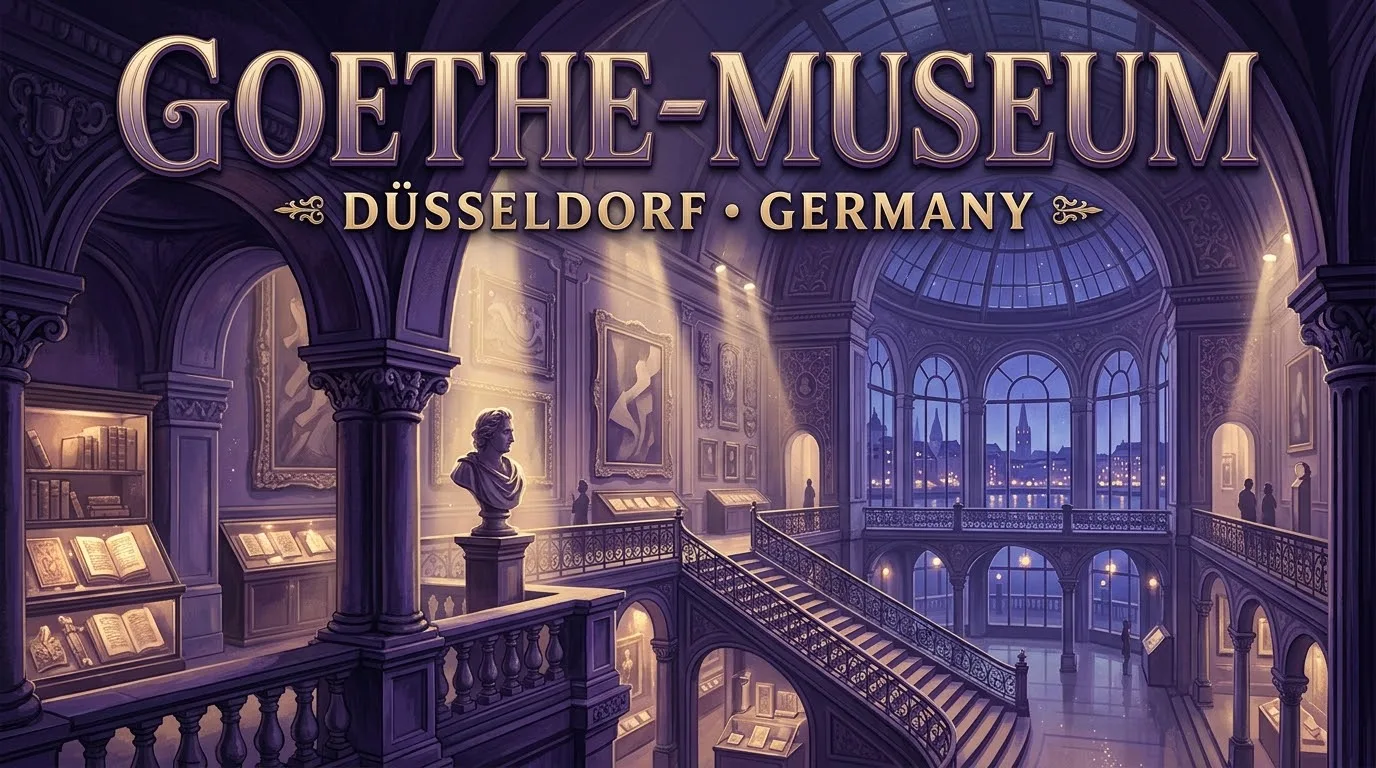
Nestled among the park-like grounds between the Hofgarten and the Pempelfort district stands Schloss Jägerhof, one of Düsseldorf's most elegant historic buildings - and inside it, the Goethe-Museum, one of Germany's most important research and collection centers devoted to Johann Wolfgang von Goethe. Unlike the better-known Goethe sites in Weimar or Frankfurt am Main, the Düsseldorf institution is not built around an original residence or workplace of the poet, but around one of the largest private collections ever assembled on his life and work. Visitors should therefore not expect a reconstructed home, but rather a dense, carefully curated encounter with original manuscripts, letters, first editions, artworks and decorative objects from Goethe's era. At the same time, the museum functions as a living research center: alongside its exhibition rooms, it operates an extensive manuscript archive and one of the largest specialist libraries on Goethe and his period anywhere in the world. For lovers of literature, cultural historians and anyone drawn to the intellectual life of the late eighteenth and early nineteenth centuries, the Goethe-Museum is therefore a place of particular distinction, set within the quiet, green surroundings of Düsseldorf's Hofgarten.
History of Goethe-Museum
The foundation of today's collection was laid by the Leipzig publisher Anton Kippenberg, who over several decades assembled one of the most extensive private Goethe collections of his time. As publisher of the Insel Verlag, Kippenberg was closely tied to the German literary scene of his era and systematically collected manuscripts, letters, first editions, portraits and decorative objects connected to Goethe and his circle. After his death, the collection was preserved and made accessible to the public by the Anton-und-Katharina-Kippenberg-Stiftung. Following several intermediate locations, the museum found its current, permanent home in 1987 at Schloss Jägerhof, a building originally erected in the eighteenth century for the Düsseldorf court, whose neoclassical facade and setting at the edge of the Hofgarten provide a fitting frame for the collection. Since then, the institution has been jointly supported by the Kippenberg Foundation and the City of Düsseldorf, giving the museum both financial stability and a close connection to the city's cultural life. Over the decades, the collection has continued to grow through further donations, acquisitions and bequests, and today comprises roughly 50,000 objects, including an estimated 30,000 to 35,000 manuscripts, letters and documents. Alongside its museum presentation, the Goethe-Museum has established itself as a research institute, granting international scholars access to its holdings and continuing to actively shape Goethe scholarship to this day.
Highlights of Goethe-Museum
The heart of the collection is its extensive manuscript archive, holding roughly 30,000 to 35,000 objects that include original letters, manuscript pages and documents from Goethe himself as well as from numerous contemporaries, offering direct insight into the genesis of well-known works. This holding is complemented by numerous first editions and early prints of Goethe's works, which trace the journey from manuscript to printed book. The research library, with around 25,000 volumes on Goethe and his era, ranks among the most significant of its kind and is open for consultation to interested visitors by appointment, alongside academic researchers. The collection also includes portraits, drawings and decorative objects from Goethe's circle, as well as a collection of musical scores and settings that show how intensively his texts were taken up by composers of his own time and later periods. Beyond the permanent exhibition, the museum regularly presents changing special exhibitions on particular aspects of Goethe's life, work and circle; in 2026, for instance, the exhibition "Aus dem Schatten" is dedicated to the women of Goethe's era who long remained in the background of scholarship. The museum's varied events program ranges from literary readings and lectures to guided tours and age-appropriate programs for school classes and families, including thematic events around Halloween that cast the castle in a special light.
Opening Hours, Tickets & How to Get to Goethe-Museum
The Goethe-Museum at Schloss Jägerhof is open Wednesdays, Thursdays, Saturdays and Sundays from 12 to 6 pm, and Fridays from 12 to 9 pm; the museum is closed on Mondays and Tuesdays. Regular admission costs 5 euros, with a reduced rate of 2.50 euros; group tours are priced on a tiered scale of 60 euros for up to 5 people, 90 euros for 6 to 15 people and 120 euros for 16 to 25 people. Access to the library and reading room is by prior arrangement. By public transport, the museum is conveniently reached via tram line 707 toward Unterrath to the Schloss Jägerhof stop, or line 704 toward Derendorf to the Adlerstraße stop; alternatively, U-Bahn lines U71, U72, U73 and U83 bring visitors to the Schadowstraße or Pempelforter Straße stops, from which the castle is only a few minutes' walk away. By car, visitors coming from Essen are advised to take the A52 toward Münsterstraße and continue toward the city center, those from Cologne or Wuppertal the A46 with an exit toward the center followed by signs to Jägerhofstraße, and those from Mönchengladbach the A52 toward the city center. Parking is available at the Malkasten car park and the Kaufhof parking garage nearby. Around certain public holidays such as New Year's Day, Carnival, Easter Monday, 1 May, Whit Monday and Christmas, special, usually closed hours apply, while the museum remains open as usual on Easter Sunday and 26 December.
Attractions Near Goethe-Museum
Schloss Jägerhof sits right at the edge of the Düsseldorf Hofgarten, the city's largest and oldest public park, which makes for an ideal extended stroll before or after visiting the museum. Just a short walk away is the Malkasten villa and artists' association, set in its own park-like grounds and a storied meeting place for Düsseldorf's art scene since the nineteenth century. Heading toward the city center via Schadowstraße, visitors quickly reach the Königsallee with its exclusive shops as well as the Altstadt on the Rhine, home to the historic Schlossturm and its Schifffahrtmuseum. The Kunstpalast art museum and its neighboring exhibition halls are also within walking distance and combine well with a visit to the Goethe-Museum for a cultural tour through Pempelfort and the adjoining city center. On a rainy day, several cafés and restaurants around the Hofgarten offer a pleasant spot for a break between museum visits.
Where to stay in Dusseldorf, Germany
Compare current hotel prices and find the right place to stay.