Carlsplatz Wochenmarkt
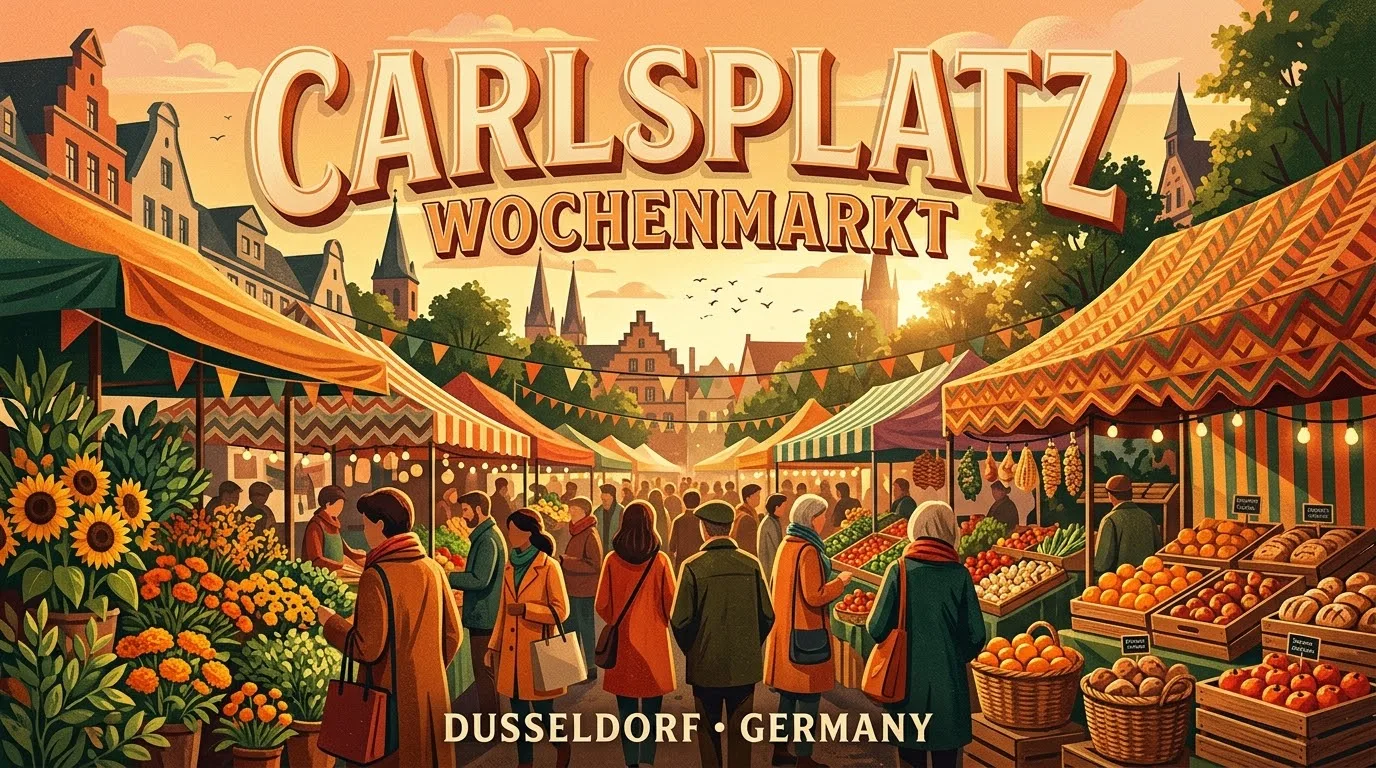
In the heart of Carlstadt, just a few minutes' walk from Königsallee and the Altstadt, lies the Carlsplatz Wochenmarkt, for many Düsseldorf residents the very embodiment of a genuine, lively market. While shopping centers and flagship stores dominate daily life elsewhere in the city, Carlsplatz has preserved its character as a place of direct, personal shopping to this day. Beneath a light-permeable glass canopy, around 60 market stalls offer fresh fruit and vegetables, eggs, meat, fish, poultry, and baked goods, while the smell of freshly made Reibekuchen (potato pancakes) with apple sauce and crispy fried fish wafts across the entire square. The market is far more than a simple source of groceries: it is a meeting point where families, students, office workers from the nearby city center, and tourists mingle in a confined space, strolling between the stalls, enjoying a glass of wine at one of the bistro tables, or simply soaking in the atmosphere of a traditional Rhineland marketplace. This colorful mix of traditional food trade and modern gastronomy makes Carlsplatz a place where Düsseldorf's culinary heritage meets its present-day urban life.
History of Carlsplatz Wochenmarkt
The history of this market square reaches surprisingly far back and is closely interwoven with the market history of the entire city. As early as 1288, Düsseldorf was granted town and market rights by Count Adolf V of Berg, initially comprising two major fairs at Pentecost and on the feast day of the city's patron saint, St. Lambertus, along with regular weekly market days. However, today's Carlsplatz itself only established itself as an independent market location considerably later. Around 1808, the square began to gain prominence as a preferred site for fairs in the up-and-coming Carlstadt district, a neighborhood that had been laid out in the late 18th century as a planned classicist extension of the Altstadt. In 1821, the traditional St. Nicholas fair also relocated to this site, lending the square additional weight as a trading location. Carlsplatz finally established itself as a permanent weekly market in 1910, a status it has maintained ever since with only one notable interruption: between 1940 and 1951, the market had to move to the nearby Schwanenmarkt during and after the Second World War, due to an air-raid shelter built on the square, before returning to its original location in 1951. In the following decades, the market continued to develop steadily. In 1997, the traders founded their own association, which has since leased the square from the city of Düsseldorf and taken responsibility for organizing daily market operations, a structure that continues to ensure continuity and quality today. In 1998, the characteristic glass roof was erected, which has made visiting the market pleasant even in bad weather ever since and gives Carlsplatz its distinctive, light-filled appearance. In May 2024, a comprehensive redesign of the square was also completed, which included new furnishings, additional bicycle parking, and a mobility station with a bicycle repair point, a sign that the traditional market is adapting to the demands of a modern, sustainable city center as well.
Highlights of Carlsplatz Wochenmarkt
Anyone visiting Carlsplatz for the first time will quickly notice that there is far more on offer here than just fruit and vegetables. Around 60 market stalls are spread across the roughly 7,000-square-meter square, which is framed by the streets Benrather Straße, Berger Straße, Mittelstraße, Hohe Straße, and Bilker Straße. Besides seasonal regional fruit and vegetables, fresh eggs, high-quality meat, poultry, and an impressive selection of fish specialties, handmade baked goods and regional cheese varieties are also firmly part of the offering. Particularly popular among locals and visitors alike are the traditional Reibekuchen, crispy fried potato pancakes classically served with apple sauce, as well as freshly fried fish, prepared right on the spot and counted among the square's culinary trademarks. A fixed part of the market culture is the "Schinken-Toni" stall, an institution among the market vendors, as well as the "Dauser" food stand, which has been present at the square since 1979 and originated as a simple soup kitchen but has since grown into a popular meeting point with a diverse menu. In recent years, the market's profile has shifted slightly: alongside the classic food trade, gastronomic stalls offering international snacks, wine, and coffee have noticeably increased, so that Carlsplatz today is also used as a place for a spontaneous lunch or an after-work drink. Since the 2024 redesign, pink and light-blue beer-garden-style tables have shaped the appearance of the square, where visitors can sit down with their shopping or a small meal, while around 52 new bicycle racks and a mobility station have significantly improved accessibility by bike. The combination of traditional market operations, culinary variety, and the special atmosphere beneath the glass canopy makes Carlsplatz one of the most authentic places in Düsseldorf.
Opening Hours, Tickets & How to Get to Carlsplatz Wochenmarkt
Carlsplatz Wochenmarkt opens six days a week, Monday through Saturday, with the exception of public holidays, on which the market usually remains closed. Standard opening hours generally run from the morning into the early afternoon, though individual stalls, particularly the gastronomic ones, sometimes remain open into the late afternoon as well. Visitors planning their trip around the specific hours of individual stalls are best advised to come in the morning, as the widest selection of fresh goods is available at that time. Admission to the market is naturally free of charge, as it is a public marketplace; payment is only required for the goods and food purchased. Getting there is remarkably simple, since Carlsplatz lies centrally within Carlstadt, just a few minutes' walk south of Königsallee and west of the Altstadt. The nearest U-Bahn and tram stops, such as Heinrich-Heine-Allee or Poststraße, can be reached in about five to ten minutes on foot, and numerous lines depart from there in all directions across the city. Visitors arriving by car will find several paid parking garages in the vicinity, but should expect full parking areas especially on Saturdays, when the market is particularly busy, and are advised to prefer public transport instead. From Düsseldorf's main train station, Carlsplatz can be reached in about 20 to 25 minutes on foot, or considerably faster with a short tram or U-Bahn ride.
Attractions Near Carlsplatz Wochenmarkt
The location of Carlsplatz in the middle of Carlstadt offers countless opportunities to combine a market visit with further experiences. Just a few steps away lies the historic Altstadt with its narrow, winding alleys, traditional brewery pubs, and the legendary "longest bar in the world", an ideal way to round off a market visit with a cool glass of Altbier. Also close by are St. Lambertus Basilica with its characteristically crooked tower and the Schlossturm Museum at Burgplatz, two of the city's oldest surviving historic buildings. Carlstadt itself is known for its classicist architecture and numerous small galleries, antiquarian bookshops, and concept stores, which are ideal for an extended stroll after visiting the market. Heading north, Königsallee with its international luxury boutiques and the picturesque Kö-Graben canal is reached in a short time, while to the east the busy Schadowstraße continues as another central shopping axis of the city. The Rhine promenade with its expansive waterfront walk, the Neuer Zollhof with its striking Gehry buildings, and the Rheinturm tower are also just a short walk away, making for a relaxing way to wind down after a market stroll, especially on sunny days.
Where to stay in Dusseldorf, Germany
Compare current hotel prices and find the right place to stay.