Carlsplatz
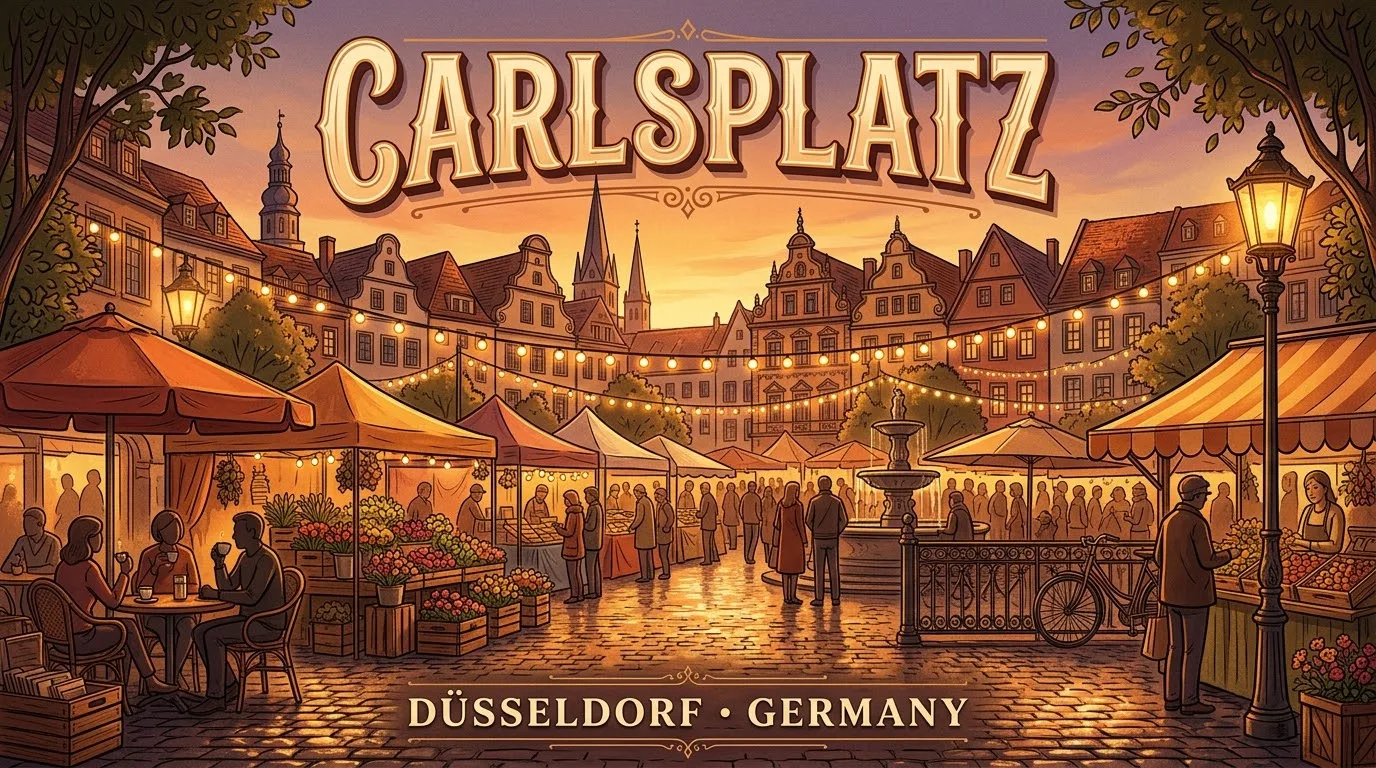
Carlsplatz sits at the heart of Carlstadt, Düsseldorf's oldest planned city district, just a short walk from the Rhine and the historic Altstadt. Named after Elector Carl Theodor, who drove the city's southward expansion in the late 18th century, the square ranks among the most tradition-rich public spaces in the city. Originally spelled "Karlplatz," the name evolved over the course of the 20th century into "Carlsplatz" with its connecting "s." Today the rectangular square is framed by neoclassical townhouses and, together with the surrounding streets of Carlstadt, forms a coherent architectural ensemble dating from just before and after 1800. Strolling through the surrounding lanes offers a mix of small-town charm and big-city urbanity that makes Carlsplatz one of Düsseldorf's most popular meeting points - quite apart from the long-established market that takes place here six days a week and has its own extensive history.
History of Carlsplatz
The origins of Carlsplatz date back to the planned urban expansion that began under Elector Carl Theodor toward the end of the 18th century. The newly created district of Carlstadt was designed to extend Düsseldorf to the south and followed a regular, grid-like street pattern, at the center of which the square was laid out as a generous open space. During the French occupation that began in 1797, Napoleon's troops temporarily used the square as a parade and drill ground, before it became, in 1808, the central venue for Düsseldorf's four major annual fairs, thereby taking over this role from the old market in the Altstadt. This change marked the beginning of the square's enduring significance as the commercial heart of the district, even though the daily market itself was only established as a permanent, year-round institution in 1910. Most of the surrounding building stock dates from the late 18th century: the houses at Carlsplatz 3 and 4 were built between 1787 and 1790 to designs by court master builder Peter Köhler as a group of three-storey structures, and today they are protected as listed monuments, as is the corner building at number 6 on Benrather Straße. Carlstadt's building fabric did not escape the Second World War unscathed, yet the square itself retained its function and basic layout. From 1940 to 1951 the market had to relocate to Schwanenmarkt because of wartime construction of an air-raid bunker on the site, and it was not until May 1951 that activity finally returned to its traditional home. Since the 1950s, the fountain created in 1958 by sculptor Ferdinand Heseding has also shaped the square's appearance, a lasting reminder of this location's long continuity within Düsseldorf's urban history.
Highlights of Carlsplatz
The particular charm of Carlsplatz lies in its enclosed, neoclassical spatial character, which contrasts noticeably with the winding lanes of the neighboring Altstadt. The symmetrically arranged townhouses along the edges of the square, especially the listed buildings at Carlsplatz 3 and 4 from 1787-1790, convey a sense of how deliberately and generously Carlstadt was once laid out. The Heseding fountain from 1958 forms a calm focal point amid the lively square and is popular both as a meeting spot and a photo subject. In May 2024 the square reopened following a comprehensive redesign costing roughly 900,000 euros: motorized traffic was significantly reduced, 52 new bicycle racks and a mobility station were installed, a bicycle repair station was added, and new seating and sun umbrellas now invite visitors to linger outdoors. This redesign has made the square even more of a meeting place, where residents, market-goers, and visitors from across the city come together. Small cafés, wine bars, and owner-run shops line the square, reflecting Carlstadt's bourgeois character and offering a pleasant counterpoint to the busier shopping streets of the city center. Architecturally, the corner building at Benrather Straße 6b is also worth noting; it, too, is a listed monument and documents the original perimeter-block development of Carlstadt. For anyone interested in urban history, Carlsplatz offers a vivid example of how planned urban expansion was carried out in a late-18th-century residence city like Düsseldorf - compact, yet executed with real design ambition and still vibrant with everyday life today.
Opening Hours, Tickets & How to Get to Carlsplatz
As a public city square, Carlsplatz is freely accessible at all times and charges no admission, since it is an open space rather than a ticketed attraction. Visitors can therefore explore the square around the clock, although a visit in the morning or early afternoon is especially worthwhile, when the long-established market is open and the atmosphere is at its liveliest. On foot, Carlsplatz can be reached from the Altstadt within a few minutes via Hafenstraße or Berger Straße; a short walk from the Rhine promenade also leads directly into Carlstadt. By public transport, the stops Benrather Straße and Kirchplatz are convenient, served by several Rheinbahn tram and bus lines, from which it is only a short walk to the square. Since the 2024 redesign, accessibility by bicycle has improved considerably: a mobility station, 52 additional bicycle racks, and a repair station are now available directly on the square, while through traffic by car has been deliberately reduced to improve the quality of the public space. Parking for cars can be found in the surrounding multi-storey car parks of Carlstadt and the Altstadt, since the square itself has been made largely car-free. Because Carlsplatz is accessible year-round, a visit is worthwhile at any time of year, although the outdoor dining areas and newly designed seating are especially inviting during the warmer months from April to October.
Attractions Near Carlsplatz
Its location in the middle of Carlstadt makes Carlsplatz an ideal starting point for a walk through central Düsseldorf. Within a few minutes on foot, visitors reach the historic Altstadt with its narrow lanes, numerous traditional breweries, the Basilika St. Lambertus, and Burgplatz right on the Rhine. The Rhine promenade, with views of the river and the Oberkasseler Brücke, is also close by and makes an excellent extension to a visit to the square. Culture lovers will find several small galleries and museums in and around Carlstadt itself, including the Hetjens-Museum for ceramics, one of the most significant collections of its kind in Europe. Heading south, Bilker Straße leads into the lively district of Bilk with its own dining scene, while heading north, Königsallee with its exclusive shops and boutiques is reachable in about twenty minutes on foot. This central position between the Rhine, the Altstadt, and the modern shopping mile makes Carlsplatz a convenient stop for anyone wishing to experience the many different facets of Düsseldorf in a single day.
Where to stay in Dusseldorf, Germany
Compare current hotel prices and find the right place to stay.