Benrather Schlosspark
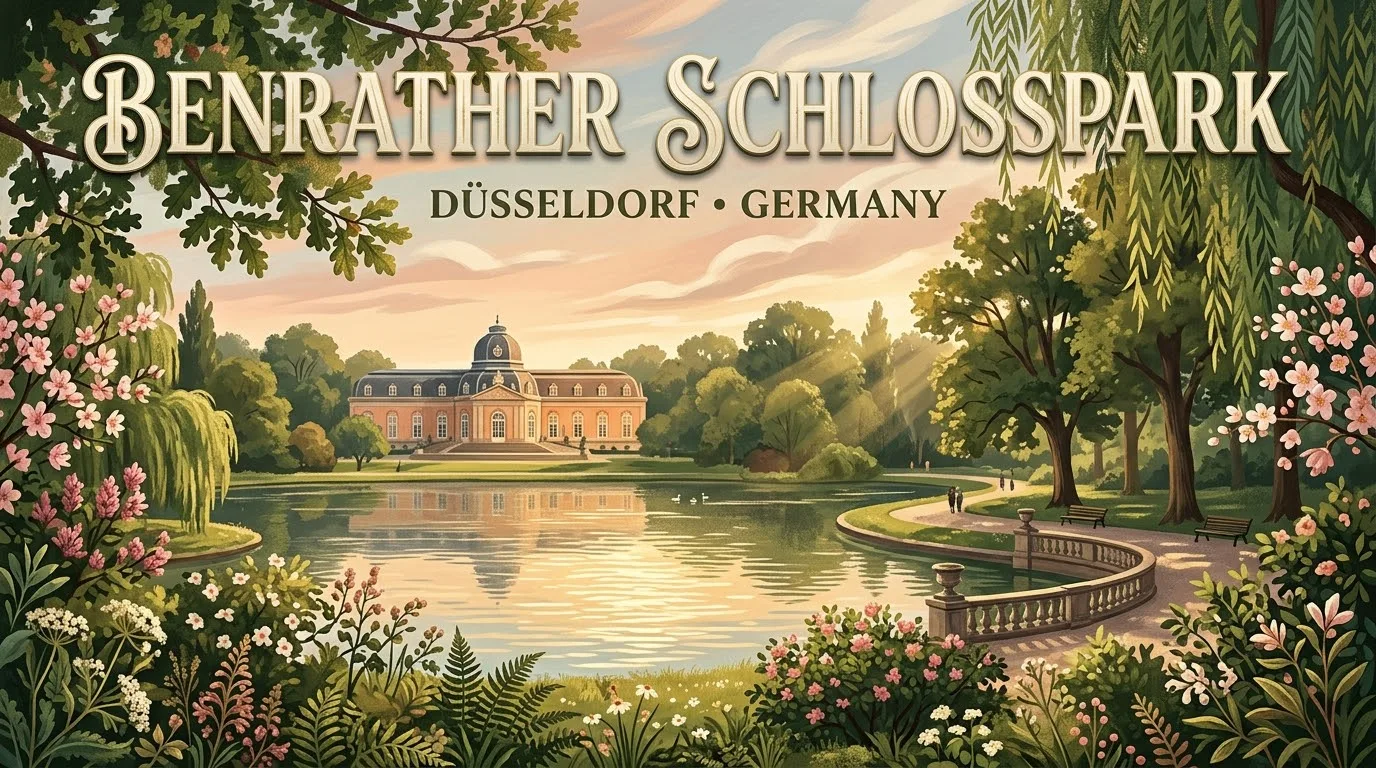
Benrather Schlosspark is one of the most significant historic garden landscapes in North Rhine-Westphalia, spreading across roughly 61 hectares around the electoral Schloss Benrath in Düsseldorf's Benrath district. Unlike many other palace gardens, Benrather Schlosspark is not a single, uniformly designed garden but a fascinating juxtaposition of two completely different garden styles: to the east, a strictly symmetrical, French-inspired Baroque garden with geometric path axes and water basins; to the west, an expansive, naturalistic English landscape park with winding paths, old tree stock, and a sprawling former hunting ground. The entire park is free and open to the public year-round and ranks among the most visited green spaces in southern Düsseldorf, precisely because it combines garden-art history, long walking paths, and natural experience within a single site. Anyone strolling through its long avenues, along its mirror-smooth water surfaces, or through the dense undergrowth of the former hunting park gets a vivid sense of how differently European garden design was conceived in the 18th and 19th centuries — from strict courtly symmetry to romantic, seemingly untouched nature.
History of Benrather Schlosspark
The history of today's Benrather Schlosspark begins between 1755 and 1771, when the electoral architect Nicolas de Pigage, commissioned by Elector Karl Theodor, planned not only the new Schloss Benrath but, from the very outset, the surrounding garden landscape as one inseparable work of art. Pigage laid out the eastern section, associated with Electress Elisabeth Auguste, as a strictly symmetrical French Baroque garden with clear path axes, clipped hedges, and an elaborate system of canals and water basins running through the entire site. Around the actual pleasure palace, an extensive hunting ground for courtly hunting parties also took shape, which later developed into today's roughly 44-hectare Jagdpark, officially designated a nature reserve since 1992. At the beginning of the 19th century, as garden taste increasingly shifted toward naturalistic English landscape gardens, the western part of the grounds was fundamentally redesigned by the important landscape architects Maximilian Friedrich Weyhe and, later, Peter Joseph Lenné, transforming it into an expansive English landscape park with winding paths and loosely grouped stands of trees. In the late 19th century, additional, then-exotic tree species such as ginkgo and giant sequoia enriched the park landscape and still provide striking botanical accents today. Benrather Schlosspark has not been spared the challenges of more recent times either: storm Ela caused severe damage to large parts of the historic tree population in June 2014, including on the island in the castle pond, which was replanted in 2016 as part of extensive restoration work. Since its creation in the 18th century, Benrather Schlosspark has thus remained a living history book of European garden art spanning more than 250 years.
Highlights of Benrather Schlosspark
The visual centerpiece of the eastern, French section of Benrather Schlosspark is the Spiegelweiher, a roughly 470-meter-long, perfectly straight reflecting basin that forms the park's central sightline and, on calm days, mirrors Schloss Benrath impressively on its glassy surface. From this long basin, an elaborate canal system branches out, feeding further ponds, basins, and water features throughout the garden — already considered a technical masterpiece of courtly garden design in the 18th century. The western section, laid out as an English landscape park, presents an entirely different picture: wide meadows framed by old trees, winding walking paths, and individual, deliberately picturesque groups of trees that give the landscape a naturally grown, almost romantic character. Particularly impressive is the so-called Jagdstern in the former hunting park, a star-shaped junction where several perfectly straight forest paths converge radially — a relic of the former courtly hunting tradition that is ideal for longer walks and bike rides through the untamed Jagdpark. Numerous old and occasionally rare trees grow along the paths and around the water features, including ginkgo and giant sequoia specimens planted in the late 19th century, which stand out from the rest of the park landscape with their striking autumn coloring. The former kitchen garden, which once supplied the electoral court kitchen with fruit and vegetables, together with the parterre garden laid out directly in front of the palace with its symmetrical lawns and flower beds, complete the picture of the former residential garden complex. For photographers, the view from the wide path axes toward Schloss Benrath, especially in the early morning or evening hours, ranks among the most beautiful sights southern Düsseldorf has to offer, while nature lovers appreciate the denser, wilder character of the Jagdpark with its rich birdlife and old tree stock.
Opening Hours, Tickets & How to Get to Benrather Schlosspark
Benrather Schlosspark is a publicly accessible green space maintained by the city of Düsseldorf and can be visited year-round free of charge; there are no fixed opening or closing times for the park itself, while Schloss Benrath and its museums inside follow their own, separate opening hours and can only be visited as part of a guided tour. Visitors can freely enter both the French garden section around the Spiegelweiher and the expansive Jagdpark to the west at any time, using them for walks, jogging, or extended bike rides. The best way to reach Benrather Schlosspark is via the S6 suburban train line to Düsseldorf-Benrath station, from which the park entrance on Benrather Schlossallee is only a few minutes' walk away; alternatively, several Rheinbahn bus lines run directly to the park. Drivers will find public parking available in the vicinity of the palace, though it can become heavily used, particularly on sunny weekends and during the autumn foliage season. Since the park itself has no ticket counters, no tickets are required for a walk through the garden grounds; only a visit inside the palace, including the Museum Corps de Logis, the Museum für Europäische Gartenkunst, and the Naturkundemuseum, is subject to an admission fee and should be planned in advance via the official website of the Stiftung Schloss und Park Benrath.
Attractions Near Benrather Schlosspark
At the very center of the park naturally stands Schloss Benrath itself, a late-Baroque pleasure palace with several worthwhile museums that pairs perfectly with an extended walk through the surrounding garden landscape. Just a short walk away lies the historic village center of Benrath, with small shops, cafés, and the well-connected Düsseldorf-Benrath S-Bahn station, from which both central Düsseldorf and neighboring Cologne are easily reached. Visitors who walk the Jagdpark in the western part of Benrather Schlosspark all the way to its edge will find further quiet green spaces and woodland stretching toward the Urdenbacher Kämpe, one of the largest nature reserves in southern Düsseldorf along the Rhine. In the opposite direction, upstream, Südpark and the Botanischer Garten der Heinrich-Heine-Universität are only a short train or car ride away, making it easy to combine a visit to Benrather Schlosspark with other green destinations in southern Düsseldorf.
Where to stay in Dusseldorf, Germany
Compare current hotel prices and find the right place to stay.