Willy-Brandt-Park
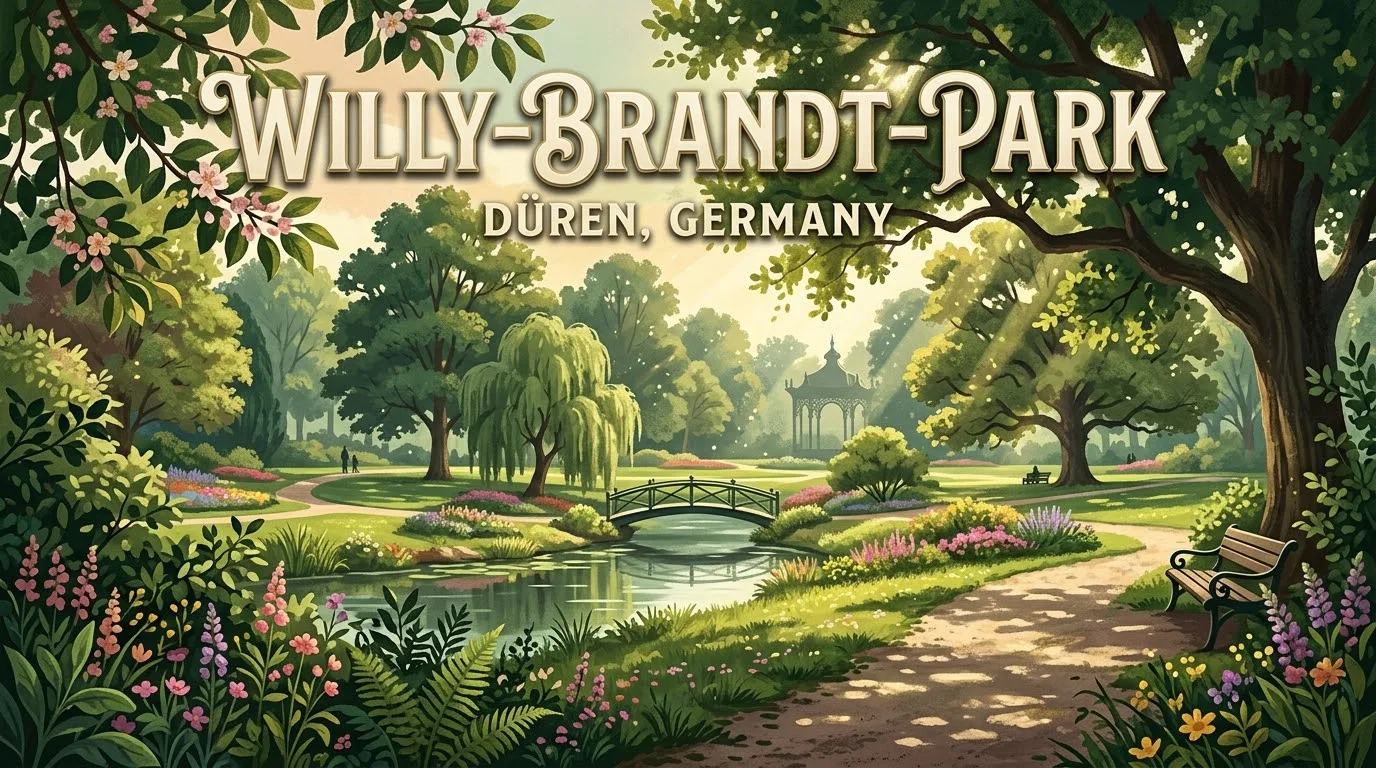
Right on the banks of the Rur, framed by Aachener Straße, Valencienner Straße and Tivolistraße, lies Willy-Brandt-Park, Düren's oldest and at the same time one of its largest public parks. Named after former German Chancellor Willy Brandt, the park covers around six hectares and offers a mix of wide lawns, mature trees, a large playground and direct access to the riverbank of the Rur, making it one of the most heavily used recreational spaces in the city. Over a century of history, numerous structural changes and two world wars have shaped the park without it ever losing its role as the green heart of the city. Anyone strolling through the winding paths of Willy-Brandt-Park today is moving through grounds originally laid out in the style of an English landscape garden, which still preserve many of their historic elements, from centuries-old trees to a protected sculpture.
History of Willy-Brandt-Park
The history of today's Willy-Brandt-Park begins in 1882, when the city of Düren purchased the entire roughly six-hectare site from the Ewaldus Guild for 64,000 marks. Cologne garden director Adolf Kowallek was commissioned to design the park, laying it out in the style of an English landscape garden with geometric elements. On 21 June 1896 the park was ceremonially opened under the name Stadtpark by Mayor August Klotz, already equipped at the time with tennis courts and a children's playground. Around 1898 the eastern, riverside section was incorporated into the grounds, creating the direct connection to the Rur that still defines the park today. In the years that followed, an adjoining municipal botanical garden with heated greenhouses was also established, cultivating around 1,000 plant species and varieties by around 1897/98, while around the turn of the century a river bathing facility on the eastern bank and a boat rental on the western bank made the park a popular leisure destination for the whole city. Both world wars left clear traces on the grounds: during the Second World War the former rose beds were temporarily replaced with vegetable plots to help secure the population's food supply, and the Rur remained one of the central front lines in the battle for Düren until 23 February 1945, causing considerable damage to the site. After the war the park was gradually restored, before being renamed Willy-Brandt-Park in May 1997 in honour of the former chancellor, commemorating his political work and his contribution to German postwar history.
Highlights of Willy-Brandt-Park
Among the most significant art-historical objects in Willy-Brandt-Park is the protected sculpture "Verteidigung einer Sabinerin" (Defence of a Sabine Woman) by sculptor Joseph Uphues, an impressive example of classicist sculpture that can be admired amid the park's greenery. Botanically, the park impresses above all with two imposing giant sequoias and a centuries-old cedar, among the oldest and largest tree specimens in the entire city, shaping the look of the park even from a distance. As a legacy of the former municipal nursery, the park is also home to a traditional Chinese pavilion, a gift from the partner city of Jinhua, which makes Düren's international town partnerships visible and adds a surprising architectural accent amid the local parkland. The historic rifle range of the Ewaldus Guild and the city's oldest tennis facility recall the grounds' original use, while the former Leopold Schoeller fine cloth factory on the edge of the park, a partially protected industrial building, bears witness to Düren's economic history. For families, the large, well-equipped playground is a central draw, while the Rurufer-Radweg cycle route, which runs directly through the park on its way from the Rur's source in Belgium to its mouth in the Netherlands, attracts cyclists from across the region. In summer the park regularly hosts events, including children's cultural festivals and celebrations of Rhenish dialect, making Willy-Brandt-Park a lively meeting point for families, clubs and neighbourhood initiatives. The wide, well-maintained lawns between the old groups of trees are ideal for a picnic or a relaxed afternoon of sunbathing on warm days, while shaded rows of benches along the main paths offer older visitors and parents with pushchairs a comfortable place to rest. Along the riverbank, visitors can also observe the Rur's varied birdlife, from ducks and coots to the occasional grey heron searching for food in the shallower stretches of water. Joggers often use the level main paths for their morning run, and in winter the old trees, with their bare, gnarled branches, lend the otherwise lively park a quiet atmosphere all its own.
Opening Hours, Tickets & How to Get to Willy-Brandt-Park
Willy-Brandt-Park is a public green space, freely accessible year-round and around the clock, with no admission charge. Its central location between Aachener Straße, Valencienner Straße and Tivolistraße makes the park reachable from Düren's city centre within a few minutes on foot, making a stroll after shopping or a museum visit an easy addition to any day out. From Düren's main railway station, the walk to the park takes only around ten to fifteen minutes, and several VRS bus lines also stop close by. Drivers will find sufficient parking in the surrounding streets and nearby multi-storey car parks in the city centre. Cyclists benefit from the direct connection to the Rurufer-Radweg, through which the park can easily be worked into a longer tour along the Rur. The paved main paths within the park are mostly level and therefore well suited to pushchairs and wheelchairs, although some of the more natural sections along the riverbank can become slippery in wet weather.
Attractions Near Willy-Brandt-Park
From Willy-Brandt-Park, the Rurufer with its onward walking and cycling paths can be reached directly, making it easy to combine a visit with a longer walk along the river. In the nearby city centre, the Annakirche with its striking tower and the Leopold-Hoesch-Museum await visitors interested in culture, both within comfortable walking distance of the park. Holzbendenpark with its popular duck pond also lies within a short drive and makes a good second stop on a day devoted to Düren's green spaces. Towards Niederau, the moated castle of Schloss Burgau with its Schlosspark and the extensive Burgauer Wald invite a nature-focused outing, conveniently linked to Willy-Brandt-Park by bicycle via the Rurufer-Radweg. Konrad-Adenauer-Park, with its sports and play facilities, is also within a short distance from here, rounding off a varied day exploring Düren's parks.
Where to stay in Düren, Germany
Compare current hotel prices and find the right place to stay.