St. Peter
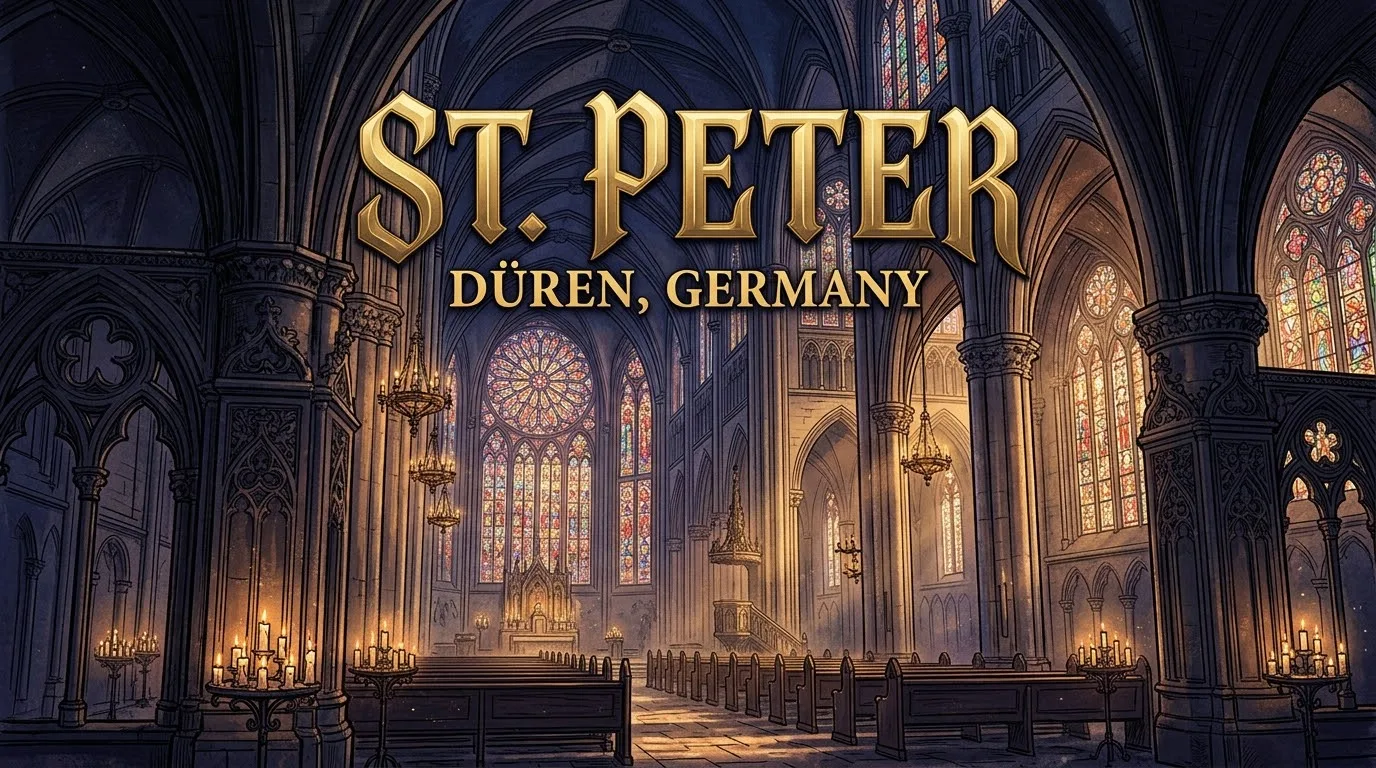
St. Peter in Birkesdorf ranks among the oldest and most significant parish churches in the Düren area, with a documented history dating back to 1308. The present neo-Gothic brick basilica, built between 1853 and 1855 to designs by the well-known Cologne architect Vincenz Statz, was repeatedly expanded and modernised over the following decades, most recently through a comprehensive remodelling in the 1960s under architect Alfons Leitl. Since 1 January 2026, St. Peter has served as the main church of the newly founded larger St. Franziskus/Düren parish, making it a central hub of church life in the Birkesdorf district. With its combination of historic neo-Gothic architecture and modern postwar elements, together with its valuable stained-glass windows, the church ranks among the architecturally most interesting sacred buildings in the north of Düren.
History of St. Peter
The history of the St. Peter parish in Birkesdorf reaches far back: as early as 1308, the church is documented in the so-called "Liber Valoris," making it one of the oldest recorded parishes in the Düren area. Originally, the parish belonged to the Jülich deanery within the Archdiocese of Cologne. In the course of the political and ecclesiastical reorganisations of the French period, the parish was assigned to the newly established Diocese of Aachen in 1804, later returned to the Archdiocese of Cologne, and was finally reattached to the Diocese of Aachen in 1930, where it has remained ever since — a reflection of the shifting political and ecclesiastical allegiances that shaped the Rhineland in the 19th and early 20th centuries. The present church was built between 1853 and 1855 to designs by the renowned Cologne architect Vincenz Statz: the groundbreaking took place on 14 September 1853, and the three-aisled, five-bay neo-Gothic basilica was consecrated on 26 September 1855. Due to strong population growth in Birkesdorf, Statz's son Franz Statz extended the church between 1911 and 1912 with a transept and a new choir. A fundamental modernisation took place between 1963 and 1967 under architect Alfons Leitl, during which the original 1853 tower was also replaced by a new bell tower in 1965. With the founding of the larger St. Franziskus/Düren parish, St. Peter took on the role of main church of this new pastoral unit on 1 January 2026, bringing together several formerly independent parishes in the Düren area.
Highlights of St. Peter
Architecturally, St. Peter impresses with its successful combination of different building eras: the neo-Gothic basic structure of the 1850s, with its characteristic rib vaults and richly decorated tracery windows, meets the clear, modern forms of the 1960s renovation, which also produced the distinctive new bell tower of 1965. This layering of different stylistic periods makes St. Peter a vivid example of the architectural development of Catholic parish churches in the Rhineland over more than a century. The stained-glass windows are especially valuable, created by two significant glass artists: Walther Hugo Brenner designed several windows in 1967, while the characteristic, abstract-modern stained glass by Ludwig Schaffrath dates from 1964/65 and ranks among the church's most artistically accomplished furnishings. Schaffrath, one of the most important German glass artists of the postwar era, also furnished other churches in Düren, such as St. Antonius in Grüngürtel, allowing interested visitors to draw an engaging comparison between the artist's various works across the city, each reflecting Schaffrath's distinctive approach to light and colour in a different architectural setting. Musically, St. Peter is enriched by a five-bell bronze chime, cast in 1979, lending the church a full, far-reaching sound. The church's status as a protected heritage monument further underscores its cultural and historical significance, which has become even more central to the city's church life since 2026, when it became the main church of the larger St. Franziskus/Düren parish. Taken together, these artistic and architectural layers make St. Peter one of the most rewarding churches in the Düren area for anyone tracing the evolution of ecclesiastical art and architecture across more than a hundred and fifty years.
Opening Hours, Tickets & How to Get to St. Peter
St. Peter is located on Nordstraße, the former Hauptstraße, in the Birkesdorf district at 52353 Düren. As the main church of the larger St. Franziskus/Düren parish, St. Peter is regularly open for services, including Sunday Masses, confession, and further liturgical celebrations such as rosary prayers and vespers. There are no fixed viewing hours independent of services in general; current dates and opening times can most reliably be found via the website of the St. Franziskus parish or through the parish office at Pfarrer-Rody-Straße 7, 52353 Düren. Admission to the church is free, so a visit during service times is easily possible. Getting to Birkesdorf from Düren's city centre is straightforward: by car, Nordstraße can be reached via the surrounding main roads within a few minutes, and several VRS bus lines also connect Birkesdorf with Düren's main railway station and city centre. Visitors arriving by car will find sufficient parking near the church. As Birkesdorf has its own well-developed infrastructure as an independent district, a visit to St. Peter combines well with a walk through Birkesdorf's historic village core, whose grown street pattern offers a noticeable contrast to the more densely built city centre of Düren.
Attractions Near St. Peter
The Birkesdorf district itself, with its established village core around Nordstraße, offers an interesting contrast to the more densely built Düren city centre and invites a quiet walk after visiting St. Peter. From there, Düren's city centre can be reached by car or bus within a few minutes, where several further significant churches await visitors: the Annakirche with the relic of Saint Anna, the Marienkirche on Hoeschplatz, and the Christuskirche, the city's most important Protestant church. The Leopold-Hoesch-Museum & Papiermuseum and Düren's town hall with Kaiser-Friedrich-Park are also located within the historic city centre and combine well with a visit to St. Peter. Those interested in the glass art of Ludwig Schaffrath can also draw a comparison with his work at St. Antonius in the Grüngürtel district. For a day trip beyond the city limits, the nearby Jülich Citadel is recommended, reachable by car in around 20 minutes.
Where to stay in Düren, Germany
Compare current hotel prices and find the right place to stay.