St. Antonius
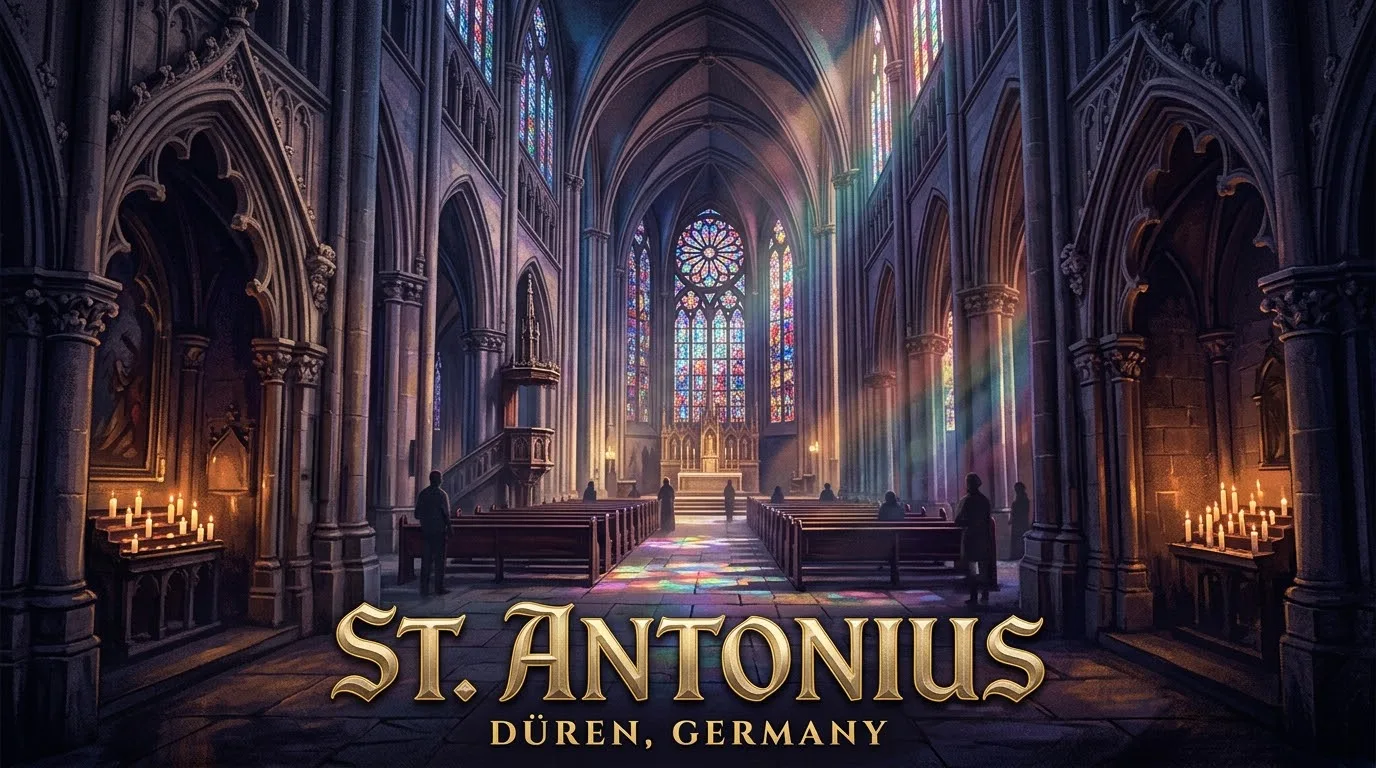
St. Antonius is the Catholic church of Düren's Grüngürtel district and ranks among the city's more recent, yet architecturally distinctive, sacred buildings. Named after Saint Anthony of Padua, the parish looks back on a nearly ninety-year history shaped by a remarkable new building in the 1970s: after the first church, consecrated in 1939, no longer met the needs of the growing congregation, an entirely new church was built between 1973 and 1975 to designs by the Aachen architect Matthias Kleuters. With its clear, almost square hall form and the striking stained-glass windows by artist Ludwig Schaffrath, today's St. Antonius church ranks among the architecturally most interesting examples of modern sacred architecture in the Düren district. As a subsidiary church of the St. Lukas parish, it remains an active centre of community life in Grüngürtel to this day.
History of St. Antonius
The history of St. Antonius begins in 1938, when the foundation stone for a first church was laid on 21 August in what was then still the young district of Grüngürtel. The design came from the Cologne architect Hans Peter Fischer, who planned a five-bay, two-aisled brick church that was solemnly consecrated as early as 16 July 1939. Initially run as a rectorate church, the congregation was elevated to an independent parish in 1952. During the Second World War, the church escaped direct bomb hits but suffered considerable damage from artillery fire during the fighting for Düren; the necessary repairs were completed by 1951. Over the following decades, the original building increasingly reached its limits as the district grew, leading the congregation to decide on an entirely new building. The first groundbreaking for the new church took place on 10 December 1973, followed by the laying of the foundation stone on 8 June 1974. Designed by the Aachen architect Matthias Kleuters, a modern sacred building rose within a short period of time and was solemnly consecrated on 13 September 1975 by the Aachen auxiliary bishop Josef Ludwig Buchkremer. Since the founding of the larger St. Lukas parish in 2010, St. Antonius has no longer been an independent parish church but a subsidiary church, though it remains an important spiritual focal point for the residents of Grüngürtel.
Highlights of St. Antonius
Architecturally, today's St. Antonius church impresses with its clear, almost square hall form and a flat wooden ceiling, following the modern formal language of the 1970s and forming a clear contrast with its brick predecessor. The free-standing bell tower, around 25 metres tall, complements the compact main building and gives the church grounds a clear vertical orientation, visible from a considerable distance across the Grüngürtel district. The outstanding artistic feature of the church, however, is its vividly coloured stained-glass windows, designed by the renowned glass artist Ludwig Schaffrath of Alsdorf. Schaffrath ranks among the most significant German glass artists of the postwar era and furnished numerous churches across the Rhineland and beyond with his characteristic, abstract-modern window compositions; his work in St. Antonius is among the church's most artistically valuable furnishings, bathing the interior in a shifting, atmospheric light depending on the time of day. The church's dedication to Saint Anthony of Padua, one of the most venerated saints of the Catholic Church, further underlines the spiritual significance of the site for the congregation. Compared with Düren's historic city-centre churches, St. Antonius serves as a telling example of how ecclesiastical building culture developed in the city's newer postwar districts: plainer in outward appearance, yet artistically ambitious in its furnishings. This combination of functional modernity and high-quality glass art makes St. Antonius a worthwhile destination for anyone interested in contemporary sacred architecture. Not least, the deliberate avoidance of elaborate historicist decoration shows how understanding of ecclesiastical space fundamentally changed within little more than a generation, moving from the plain brick architecture of the 1930s to the light-filled, colour-glass-defined modernity of the 1970s.
Opening Hours, Tickets & How to Get to St. Antonius
St. Antonius is located at Grüngürtel 41, 52351 Düren, and, compared with many other churches in Düren, offers reliable, regular opening hours for visitors: the church is open Monday to Friday from 10 a.m. to 6 p.m., Saturdays from 10 a.m. to 2 p.m., and Sundays from 10 a.m. to 12:30 p.m. Admission is free, and a visit outside service times is easily possible within these opening hours. For current service times and further information, it is worth checking the website of the St. Lukas parish or calling the parish office at Annaplatz 8. Getting to Grüngürtel from Düren's city centre is straightforward: by car, the church can be reached via the surrounding main roads within a few minutes, with ample parking available right on site. Travellers wishing to arrive by public transport can use several VRS bus lines connecting the Grüngürtel district with Düren's main railway station and city centre. As Grüngürtel lies somewhat outside the historic city core, a visit to St. Antonius is especially recommended for travellers who, alongside the classic city-centre attractions, also want to get to know Düren's more modern districts. The combination of a short journey, reliable opening hours, and free admission also makes St. Antonius an uncomplicated destination for a spontaneous stop along the way.
Attractions Near St. Antonius
The Grüngürtel district itself is, as its name suggests, characterised by numerous green spaces and parks, ideal for a relaxing walk after visiting St. Antonius. From there, it is also worth taking a trip into Düren's city centre, reachable by car or bus within a few minutes and home to three further significant sacred buildings: the Annakirche, the Marienkirche, and the Christuskirche. The Leopold-Hoesch-Museum & Papiermuseum and Düren's town hall with Kaiser-Friedrich-Park are also located within the historic city centre and combine well with a visit to St. Antonius. Those wishing to explore more of the region's modern postwar sacred architecture will also find St. Joachim in northern Düren and the Christuskirche interesting points of comparison. Finally, nature lovers can enjoy a trip to the nearby Eifel region, reachable from Grüngürtel by car in under an hour.
Where to stay in Düren, Germany
Compare current hotel prices and find the right place to stay.