Schlosspark Burgau
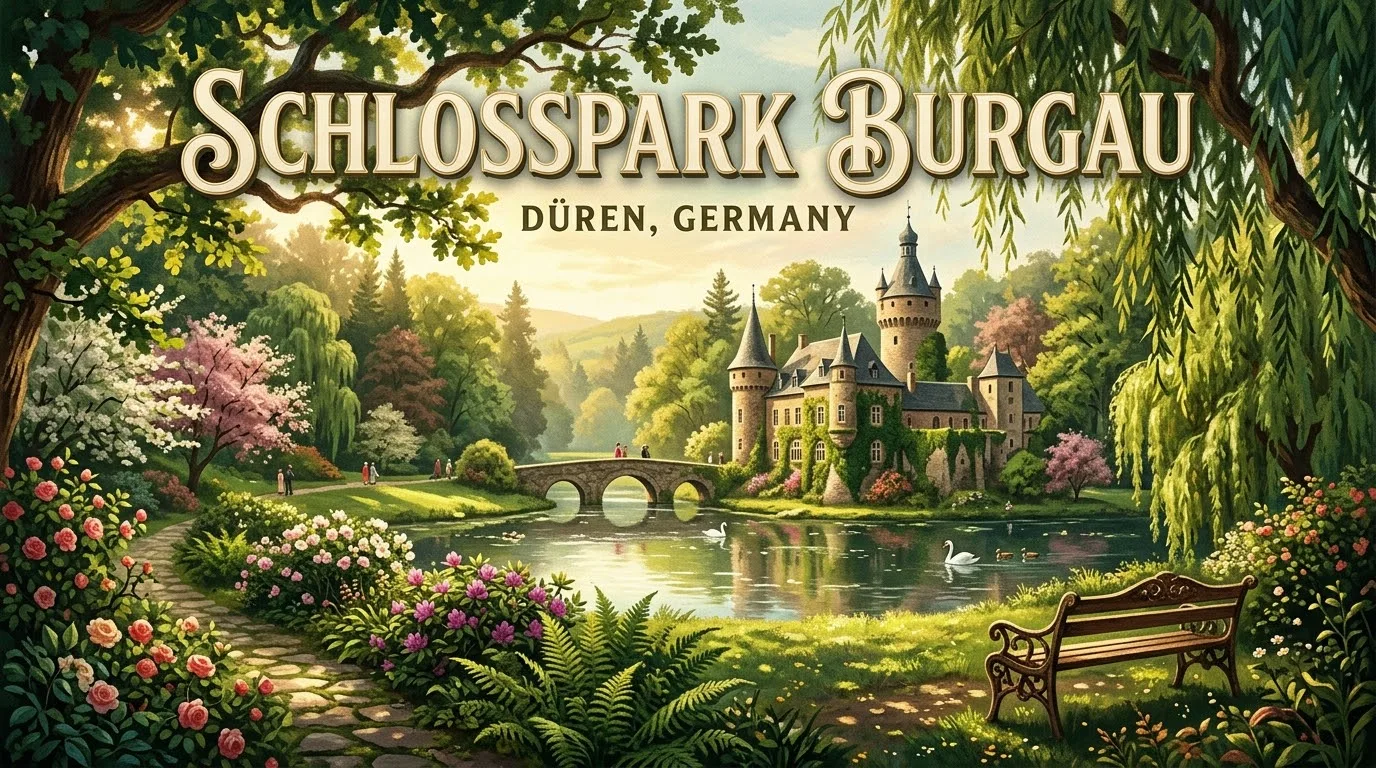
Walking from Düren's city centre towards the district of Niederau, visitors reach the Schlosspark Burgau within a few minutes, an expansive green space that wraps around the medieval moated castle of Schloss Burgau like a green cloak. The park itself is not a strictly symmetrical formal garden in the French style but rather a naturally grown landscape of old trees, meadows, the castle's moat and adjoining woodland that blends seamlessly into the larger Burgauer Wald forest. It is precisely this mix of a cared-for setting and natural wilderness that makes the Schlosspark Burgau one of the most popular destinations for families from Düren, casual walkers, and anyone looking for a place where history and nature meet directly. From many spots within the park, visitors enjoy particularly attractive views of the castle's distinctive towers and baroque main building, which rises on a small island roughly fifty metres in diameter at the centre of the moat.
History of Schlosspark Burgau
The history of the Schlosspark Burgau is inseparable from that of the castle itself, whose earliest structural traces date back to the 11th century and which was first documented in writing in 1313. For centuries the surrounding grounds served mainly practical purposes, functioning as farmland, pasture and a protective buffer zone around the moated stronghold, which passed to the von Elmpt family through inheritance in 1475. In 1551 the residential tower received its characteristic ornamental bay window with reliefs referencing weddings and classical literature, while in 1685 a new outer ward was built, expanding the grounds physically as well. The large baroque three-wing structure that still defines the castle's appearance today was completed in 1730, a development that also changed how the surrounding land was used, taking on an increasingly representative character. A particularly notable historical episode links Burgau to English history: in 1539, court painter Hans Holbein the Younger is said to have painted the portrait of Anne of Cleves here, intended to show King Henry VIII of England a prospective bride. After generations in the private hands of various noble families, the city of Düren acquired the entire estate, including the surrounding grounds, in 1917 for the then-considerable sum of 600,000 marks. In the decades that followed, the complex gradually fell into disrepair until an extensive restoration took place between 1974 and 1991, for which around €275,000 in donations were raised, supplemented by a 1981 city council resolution to allocate eight million Deutsche Mark for the rebuilding work. As part of this restoration, the surrounding parkland was also redesigned and opened to the public, transforming what had once been an enclosed noble residence into an open recreational space available to all residents of Düren.
Highlights of Schlosspark Burgau
The greatest appeal of the Schlosspark Burgau lies in its close combination of historic architecture and naturalistic parkland. The network of paths around the moat repeatedly opens up new perspectives on the castle, whose towers are reflected in the still water, especially striking early in the morning or during the golden hour before sunset. Mature trees, including impressive oaks and beeches, provide shade along the walking paths on hot summer days and make the park a popular destination for a quiet picnic on one of its meadows. The park's immediate proximity to the Burgauer Wald means that a walk through the Schlosspark can be extended seamlessly into a longer hike without needing to move the car or, in a narrower sense, leave the park's boundaries at all. Inside the castle itself, which can be visited separately, regular concerts, exhibitions covering around 450 square metres, and theatre performances take place, so on such evenings the park is further animated by visitors taking a stroll outdoors before or after the event. Since 1981 a café on the grounds has also invited guests to take a break with a view of the castle façade. For photographers, the park offers appealing motifs in every season: blossoming meadows and fresh greenery in spring, golden autumn foliage reflected in the moat, and occasional frost on the old treetops around the castle in winter. The Schlosspark Burgau is also extremely popular as a location for wedding photographs, since the romantic backdrop of the moated castle is ideally suited to such occasions, and civil wedding ceremonies can be held inside the castle itself.
Opening Hours, Tickets & How to Get to Schlosspark Burgau
As a publicly accessible green space, the Schlosspark Burgau can be visited year-round free of charge, though a visit during daylight hours is recommended in order to clearly follow the paths around the moat and through the adjoining wooded sections. The opening hours of the castle itself, should an indoor visit, exhibition or event be planned, vary according to the programme and should be checked in advance via the city of Düren's information offices or website, since the building is used for concerts, exhibitions and private celebrations among other things. Admission to the surrounding park, however, is always free regardless. Visitors coming from Düren's city centre can comfortably reach the Schlosspark Burgau on foot or by bicycle in around fifteen to twenty minutes, since the distance to the centre is only a few kilometres. By car, the grounds are easily reached via the Niederau district, where parking is available near the castle. Travellers using public transport can take VRS bus lines connecting Niederau with Düren's city centre, from where the park is only a short walk from the bus stop. There are no fixed opening hours for the park itself, since it is a freely accessible municipal green space with neither fences nor barriers, meaning a spontaneous visit is possible at virtually any time of day.
Attractions Near Schlosspark Burgau
Directly adjoining the Schlosspark is the extensive Burgauer Wald, which offers ideal options for longer outings with marked trails such as the roughly 6.8-kilometre "Große Runde durch den Wald von Schloss Burgau" loop and a 2.5-kilometre educational forest trail suited to families. Schloss Burgau itself, whose interior rooms and exhibition spaces can be visited separately, naturally forms the architectural centrepiece of the entire area and should not be missed when visiting the park. Towards Düren's city centre, the Rurufer with its walking and cycling paths along the river and Holzbendenpark with its popular duck pond are both within comfortable reach. The Annakirche, with its tower visible from afar, and the Leopold-Hoesch-Museum can also be reached from Burgau within a reasonable amount of time on foot, by bike, or by car, making it easy to combine a day of nature in the Schlosspark with cultural sightseeing in the city centre. Families with children may also enjoy a side trip to Konrad-Adenauer-Park or Willy-Brandt-Park, both equipped with their own play areas and reachable within a short drive from Niederau.
Where to stay in Düren, Germany
Compare current hotel prices and find the right place to stay.