Schloss Burgau
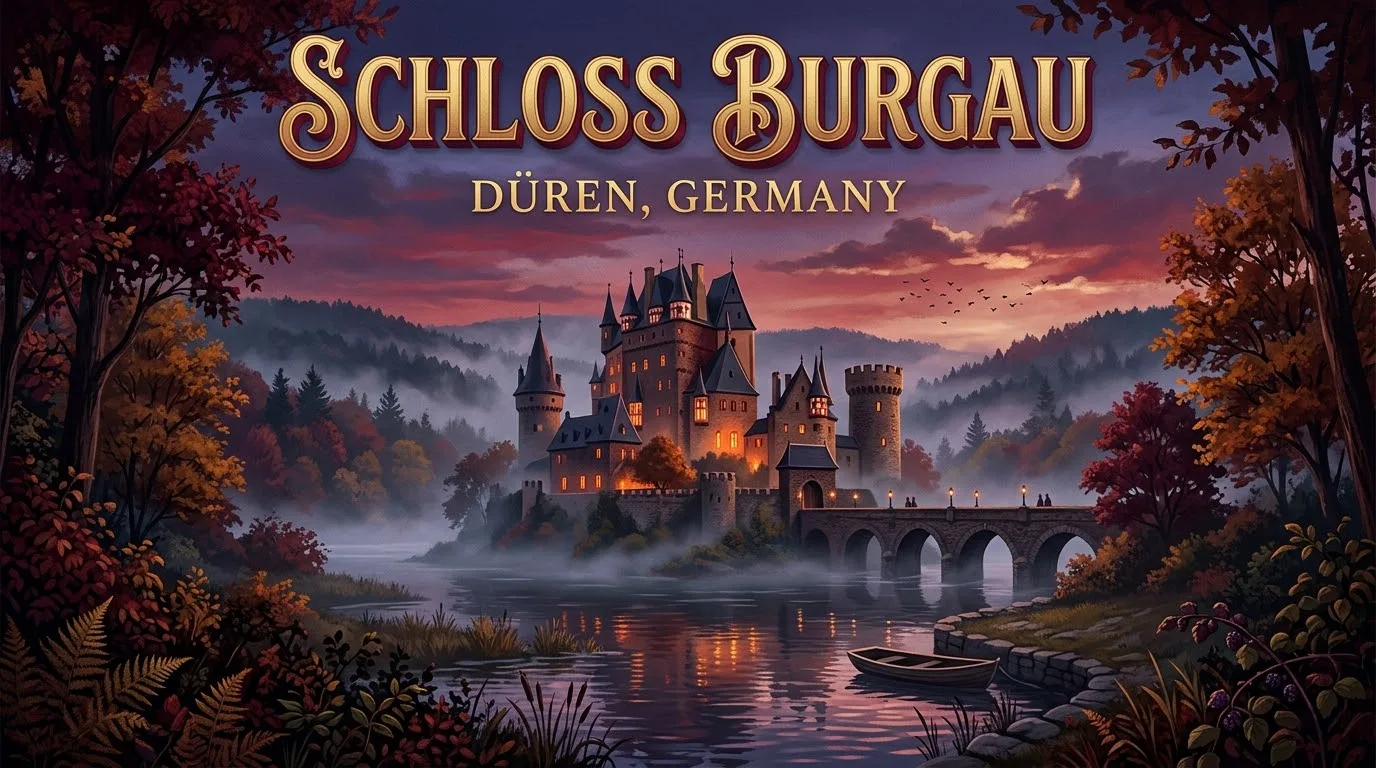
On the edge of Düren's Niederau district, surrounded by the quiet woodland of the Burgauer Wald, Schloss Burgau rises as one of the most impressive moated castles in the region. Walking along the old lime-tree avenue toward its pale walls and the water-encircled residential tower, visitors immediately sense why this site has drawn noble families, craftsmen, and today brides and grooms, concertgoers, and history enthusiasts alike for centuries. Schloss Burgau is not a museum in the classic sense but a living historic monument that combines exhibitions, theatre, weddings, and festivals under one roof. The blend of medieval masonry, Baroque expansion, and careful post-war reconstruction makes Schloss Burgau an essential destination for anyone wanting to experience Rhineland history away from the main tourist trails. Particularly striking is the contrast between the defensive character of the medieval foundations and the almost playful elegance of the later additions, which together give the building its rich, layered character today.
History of Schloss Burgau
The earliest traces of fortification on the grounds of Schloss Burgau date back to around 1100, when a motte, a timber-and-earth tower hill fortification, was raised on the site. The estate was first documented on 19 November 1313, making Schloss Burgau one of the most historically significant noble seats in the Düren area. Over the following centuries, Schloss Burgau changed hands several times: the earliest confirmed owners were the Lords von Auwe, followed by the families von Elmpt, von Binsfeld, Metternich, and finally von Keyserlingk. Each family left its own architectural imprint, so that Schloss Burgau today can be read almost like a layered record of different historical eras. A particularly notable historical episode occurred in 1539, when the renowned portrait painter Hans Holbein the Younger travelled to Düren on behalf of King Henry VIII of England to paint a portrait of Anne of Cleves – a vivid reminder of how closely this region around Schloss Burgau was once woven into the great power politics of Europe, even though the subsequent marriage between Anne and Henry VIII famously did not last. In 1551 Schloss Burgau received a richly relief-decorated bay window, which survives today as the Erkerzimmer, one of the most architecturally valuable rooms on the estate. Around 1730 the residential tower was remodelled in the Baroque style, while the three-winged outer bailey was built from 1685 onward, giving the overall ensemble the form still recognizable today. In 1917 Schloss Burgau passed into the ownership of the City of Düren, which has administered the property ever since. The darkest chapter in the long history of Schloss Burgau came in 1944, when the building suffered severe damage during the Second World War. It was only between 1975 and 1998 that Schloss Burgau was faithfully rebuilt through a comprehensive, multi-phase restoration, allowing today's visitors to experience a historic monument that, despite wartime destruction, has retained its original character.
Highlights of Schloss Burgau
The heart of Schloss Burgau is its medieval residential tower, with the characteristic water-moat layout that still conveys the fortress's defensive past. Inside, the bay-windowed Erkerzimmer added in 1551, with its ornate relief carvings, is architecturally outstanding and is regularly used by Düren's registry office for wedding ceremonies, a romantic detail that has made Schloss Burgau a popular wedding venue in the region. Visitors interested in exhibitions will find roughly 450 square metres of display space hosting rotating cultural and historical presentations that are updated regularly, covering both regional art and themes drawn from the castle's own history. The inner courtyard of the outer bailey and the so-called Winkelsaal are the central stages for concerts, theatre performances, and festivals held throughout the year, turning Schloss Burgau into a genuinely lively cultural venue rather than a static monument. Since the 1980s, the castle has also housed a theatre school that regularly stages productions in the historic rooms, creating an engaging contrast between contemporary stagecraft and centuries-old stonework. For a quieter break, the castle cafeteria, in operation since 1981, offers refreshments right next to the historic walls. Surrounding the residential tower, the expansive Burgauer Wald offers walking trails that pair perfectly with a castle visit for a peaceful stretch of nature. The combination of water moat, Baroque façade, and medieval core makes Schloss Burgau a photogenic destination in every season, with the reflection of the façade in the moat on calm days counting among the most photographed views in the entire region.
Opening Hours, Tickets & How to Get to Schloss Burgau
Schloss Burgau is managed by the City of Düren and is used primarily as an exhibition and events venue, which means access to the interior rooms is generally tied to specific exhibitions, concerts, theatre performances, or private events such as weddings. Visitors are advised to check the City of Düren's current events calendar or contact the Düren tourist information office, iPunkt, before planning a visit, since opening hours for exhibitions and special events vary by season and programme. The expansive outdoor grounds around Schloss Burgau, including the approach paths through the Burgauer Wald and the view of the water moat, remain freely accessible year-round and are well suited to a walk regardless of indoor opening hours. Admission fees typically apply only to specific exhibitions or events, while viewing the exterior and grounds remains free of charge. By car, Schloss Burgau is reached via the Niederau district of Düren, from where signposted paths lead directly to the castle; parking is available near the Burgauer Wald. By public transport, Schloss Burgau can be reached via the Rurtalbus network, whose bus lines connect Niederau with Düren's city centre and main railway station; from the nearest stop, a short walk through the forest leads to the castle. Travellers arriving by train should use Düren central station as their starting point and transfer there to the appropriate bus line toward Niederau.
Attractions Near Schloss Burgau
The surroundings of Schloss Burgau offer a rich selection of further destinations that pair naturally with a castle visit. Just a few kilometres away lies the Dürener Badesee with its fine sandy beach, an ideal spot for swimming and water sports during the summer months and a pleasant contrast to the historical calm of Schloss Burgau. Also within easy reach is the Echtzer See, another popular body of water for recreational activities in the Düren area. History enthusiasts should also plan a stop at Gut Weyern, a former noble estate with castle-like architecture that nicely complements the story of the region's landed aristocracy. Düren's city centre itself, with the pedestrian shopping street Wirtelstraße, the historic Kölnstraße, and numerous cafés, lies only a short drive away and makes for a fitting end to a day trip. The Rur river, with its natural riverside stretches, also invites walks near Schloss Burgau, tying the region together culturally and scenically into one connected excursion area in the heart of the Rhineland.
Where to stay in Düren, Germany
Compare current hotel prices and find the right place to stay.