Rurufer
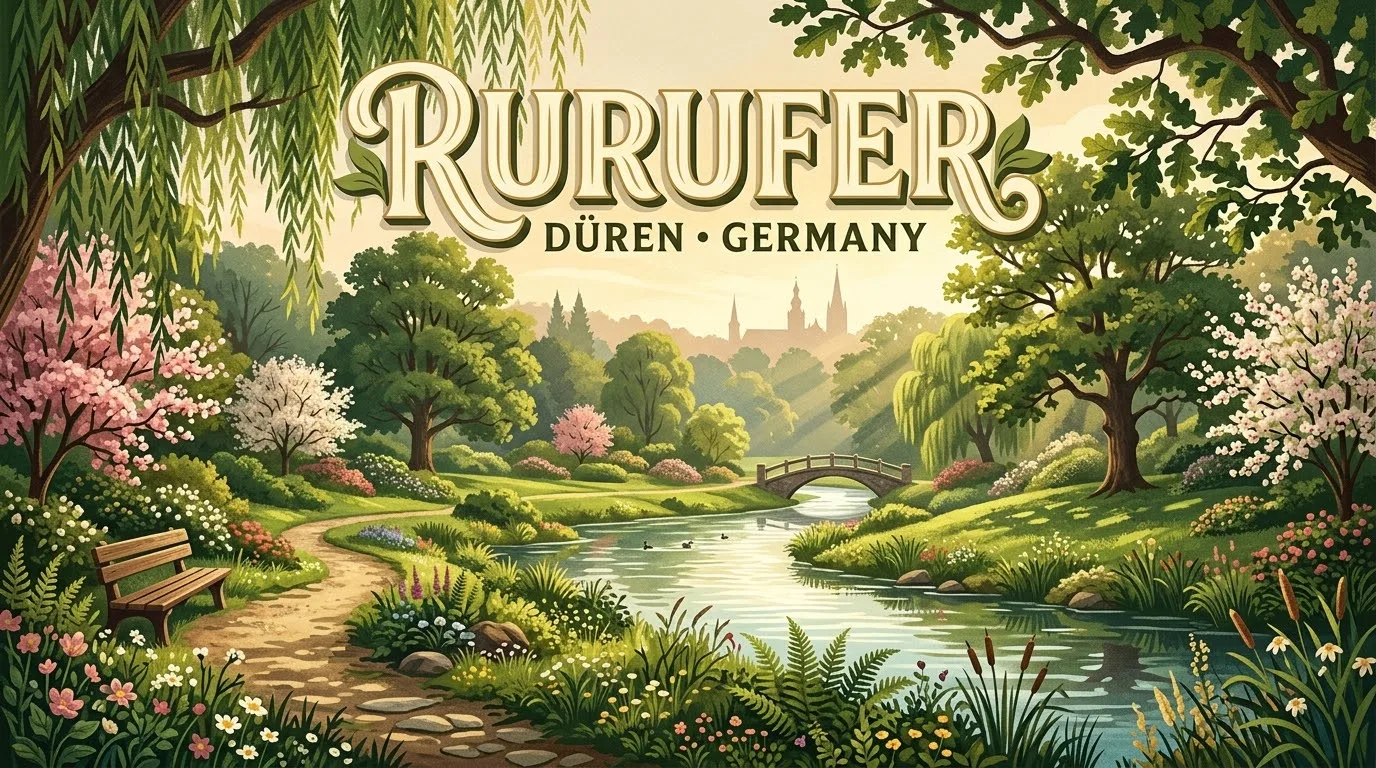
The Rur flows right through the heart of Düren, and it is this river that gave both the city and the wider region its name. Over the decades, a green ribbon of paths, meadows and small resting spots has grown up along its banks, known locally simply as the Rurufer. Anyone who strolls along the water, cycles past on two wheels, or just sits on a bench watching the ducks experiences a quieter side of the city than the one found a few hundred metres away in the pedestrian zone. The Rurufer is not a single, clearly bounded park but rather a chain of natural riverside sections that stretch from the southern districts far into the north, passing several bridges, weirs and former mill sites along the way. Precisely because it is so relaxed and easy to reach, a walk along the river is part of everyday life for many locals and one of the simplest ways for visitors to get to know Düren beyond its historic centre.
History of Rurufer
The history of the Rurufer is closely tied to the history of the city itself, since without the water power of the Rur, Düren would hardly have become the important paper-making city it is still known as today. As early as the Middle Ages, part of the river was diverted into an artificial mill channel, the Mühlenteich, to drive watermills that later supplied energy to paper mills and textile workshops. Workshops, warehouses and residential quarters grew up along the banks, so for centuries the river was more of a working artery than a place of leisure. That changed fundamentally after 16 November 1944, when an Allied air raid destroyed almost the entire city of Düren, reducing the riverside districts to rubble as well. During reconstruction in the following decades, the city deliberately kept parts of the Rur free of dense building and instead shaped them as public green space. Paved riverside paths, rows of trees and seating gradually appeared, turning the riverbank into a place of recreation rather than industry. In recent decades this transformation has been reinforced by the expansion of the Rurufer-Radweg cycle route, which today runs from Heimbach am Rursee all the way to the Dutch border, making Düren a central stop along the way. Running parallel to it, the Rurtalbahn regional train connects Düren with the Rur valley and the Eifel foothills, keeping the close relationship between river, railway and recreation visible to this day.
Highlights of Rurufer
The real appeal of the Rurufer lies in its variety. Those who want a relaxed walk will find shaded stretches beneath old willows and poplars, while more sporty visitors can move briskly between districts on the fully paved Rurufer-Radweg. At several points the river opens up into calm, gently meandering stretches where ducks, coots and, occasionally in winter, even swans can be spotted, while anglers pursue their hobby at designated spots. Particularly popular are the transitions to the larger green spaces along the river, for instance towards Josef-Vosen-Park in the Birkesdorf district or Willy-Brandt-Park, where the Rurufer blends seamlessly into more expansive parkland with additional play areas, benches and open meadows. In summer, many residents of Düren use the flat gravel banks and grassy strips by the water for a spontaneous picnic, while in autumn the colourful riverside trees provide some of the best photo opportunities in the city. History enthusiasts are also rewarded, since several sections still feature old weir structures and the former Mühlenteich mill channel, reminders of the water power once used by the city's paper and textile industries. For those wanting a longer outing, the Rurufer serves as a starting point for cycling tours along the official Rurufer-Radweg route, which leads south to the Rursee reservoir and far beyond the city limits towards the Netherlands. It is precisely this combination of short, family-friendly sections close to the centre and longer, more natural stretches further out that makes the Rurufer one of the most flexible leisure destinations in all of Düren, equally suited to a short after-work stroll or a multi-hour bike ride.
Opening Hours, Tickets & How to Get to Rurufer
Since the Rurufer is a publicly accessible green space rather than a commercial facility, there are no fixed opening hours and no admission fee – the paths along the river are open year-round, around the clock, although a visit during daylight hours is recommended for safety and orientation. The central sections in the city centre can be reached from Düren's main railway station within a few minutes on foot, since the station is separated from the riverbank only by the pedestrian zone and a handful of residential streets. Drivers will find parking in the city centre around the pedestrian zone as well as at several public car parks near the Arena Kreis Düren, from where the riverbank is within easy walking distance. For cyclists, the Rurufer is continuously connected to the well-signposted Rurufer-Radweg, which can easily be combined with public transport, for example by taking a bicycle along on the Rurtalbahn. The main paved paths are largely level and therefore well suited to pushchairs, wheelchairs and inline skaters, although some of the more natural sections further from the centre are unpaved and can become slippery when wet. Anyone wanting to explore the route at a leisurely pace should allow several hours, since the Rurufer stretches for many kilometres through various districts and offers new access points at virtually every bridge.
Attractions Near Rurufer
Several of Düren's most important attractions lie in the immediate vicinity of the Rurufer, making it easy to combine a riverside walk with further sightseeing. Just a few minutes' walk from the city centre stands the striking Annakirche with its tower visible from afar, while the Papiermuseum Düren vividly documents the close historical connection between the river and the paper industry. Towards Niederau, the Rurufer leads near the idyllic moated castle Schloss Burgau and its surrounding Burgauer Wald, which is ideal for an extended hike. In the city centre itself, Holzbendenpark with its duck pond and the Arena Kreis Düren event venue invite further stops along the way. The Stadtmuseum Düren and the historic old town with its pedestrian zone are also within easy reach from the riverbank, allowing visitors to easily fill an entire day with a mix of nature, culture and city history.
Where to stay in Düren, Germany
Compare current hotel prices and find the right place to stay.