Leopold-Hoesch-Museum
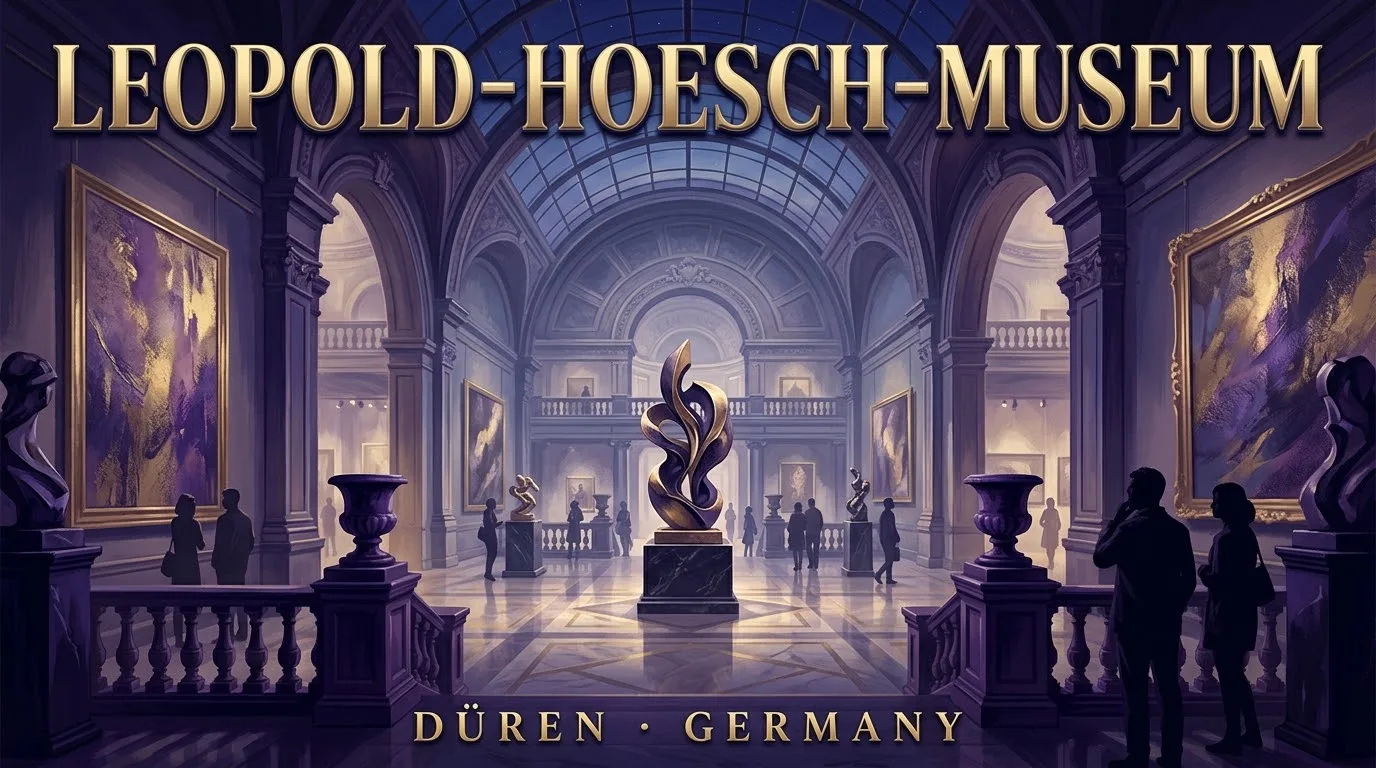
The Leopold-Hoesch-Museum is one of the most important art museums in the Rhineland and, together with the adjoining Papiermuseum Düren, forms the cultural heart of the city of Düren in North Rhine-Westphalia. Located directly at Hoeschplatz 1 in the city center, the museum houses an impressive collection of modern and contemporary art ranging from German Expressionists such as Emil Nolde, Wassily Kandinsky, Max Beckmann and Ernst Ludwig Kirchner to international positions in contemporary art. The magnificent Neo-Baroque museum building from 1905, with its striking staircase rotunda and the two monumental bronze figures by Karl Krauß flanking the entrance, was complemented in 2010 by a modern extension designed by the renowned architect Peter Kulka. With roughly 3,000 square meters of exhibition space, the museum ranks among the larger art museums in the region and attracts art lovers from across North Rhine-Westphalia and beyond every year. The museum takes its name from the industrialist Leopold Hoesch, whose son Wilhelm Hoesch made the founding of the museum possible in 1899 through a generous donation. Anyone visiting Düren should make time for the Leopold-Hoesch-Museum, as it uniquely combines Rhenish industrial history, art history and contemporary cultural life.
History of Leopold-Hoesch-Museum
The history of the Leopold-Hoesch-Museum began in 1899, when Wilhelm Hoesch, son of the Düren industrialist Leopold Hoesch, donated 300,000 Mark to the city of Düren for the construction of a museum in memory of his late father. With this generous gift, the city commissioned architect Georg Frentzen to design a representative building. Built in the Neo-Baroque style with richly ornamented sandstone façades and an imposing staircase rotunda, the museum was ceremonially inaugurated on November 8, 1905. Two monumental bronze sculptures by sculptor Karl Krauß, titled "Studium" and "Phantasie," still flank the main entrance today, reflecting the building's original ambition as both an educational institution and a repository of collections. During its first decades, the Leopold-Hoesch-Museum functioned as a mixed museum, displaying not only artworks but also antiquities, coins and cultural-historical objects alongside its art collection. A deep rupture in the museum's history came with the air raid on Düren of November 16, 1944, during which the city was almost completely destroyed. The museum building sustained severe damage, yet parts of it survived better than many neighboring structures, allowing for reconstruction in a simplified form that was completed by 1952. In the postwar period, the museum's collecting policy shifted increasingly toward classical modernism and German Expressionism, bringing significant works by artists such as Emil Nolde, Wassily Kandinsky, Max Beckmann and Ernst Ludwig Kirchner into the collection. From the 1980s onward, then-director Dorothea Eimert established a new thematic focus: paper art. Under her leadership, Düren became established as a significant international center for artistic work made from and with paper through the international PaperArt biennial, held between 1986 and 2005. Between 2007 and 2009, the historic building underwent extensive renovation and was extended with a modern wing designed by architect Peter Kulka, which opened in June 2010 and expanded the exhibition space to roughly 3,000 square meters. Since then, the Leopold-Hoesch-Museum has combined historic architecture and contemporary design into an ensemble that is itself regarded as an urban highlight of downtown Düren.
Highlights of Leopold-Hoesch-Museum
Among the greatest draws at the Leopold-Hoesch-Museum is its collection of German Expressionist art, which includes works by Emil Nolde, Wassily Kandinsky, Max Beckmann and Ernst Ludwig Kirchner and forms one of the focal points of the permanent presentation. Visitors can trace the development of classical modernism in Germany through high-caliber original works on display. Another hallmark of the museum is its intensive engagement with paper art, a focus expanded internationally since the 1980s under director Dorothea Eimert, which made Düren a recognized name in the international art world through the PaperArt biennial. Among the museum's permanently installed works is the striking ceiling painting "The Conference of the Birds" by Ulrich Rückriem in the historic dome of the original building, widely regarded as one of the most photogenic spots in the entire museum. Equally worth seeing is the light installation "Lichtraum" by Otto Piene, one of the co-founders of the ZERO art movement, which impressively stages the interplay of light, space and perception. Architecturally, the extension opened in 2010 by Peter Kulka is itself a highlight: the clean, reduced lines of the new wing enter into a compelling dialogue with the ornate Neo-Baroque façade of Georg Frentzen's original building, creating generous, light-filled exhibition halls for changing special exhibitions. The museum regularly shows internationally curated temporary exhibitions on contemporary art, photography and paper art that complement the permanent collection and offer repeat visitors something new to discover. For families and school groups, the museum offers educational programs, guided tours and workshops that provide a playful introduction to modern art. The entrance façade itself also counts among the highlights: the two monumental bronze figures "Studium" and "Phantasie" by Karl Krauß flank the main entrance and are a popular photo spot for visitors strolling across Hoeschplatz. The museum is especially atmospheric during special events such as the "Lange Nacht der Museen" (Long Night of Museums), when the house, together with the neighboring Papiermuseum Düren, stays open into the late evening hours and offers a varied program of guided tours, music and artist talks.
Opening Hours, Tickets & How to Get to Leopold-Hoesch-Museum
The Leopold-Hoesch-Museum is open Tuesday to Sunday from 10:00 a.m. to 5:00 p.m., with extended hours until 7:00 p.m. on Thursdays. The museum is closed on Mondays as well as on certain public holidays, including New Year's Day, Carnival days, Easter Monday, Whit Monday and Christmas. Admission for adults costs 6.00 euros, while the reduced rate for students aged 18 and over, apprentices, people with disabilities and supporting members is 3.00 euros. Children and teenagers under 18, school classes, refugees and members of the museum's association are admitted free of charge. On the first Thursday of every month, admission is free for all visitors, making it an excellent opportunity for a spontaneous short visit. Visitors wishing to see both the Leopold-Hoesch-Museum and the neighboring Papiermuseum Düren can purchase a combination ticket for 8.00 euros (reduced: 4.00 euros), valid for same-day admission to both institutions. The museum is centrally located at Hoeschplatz 1, 52349 Düren, just a few minutes' walk from Düren train station, which is served regularly by regional trains from Cologne and Aachen. From the station, the museum can be reached on foot in about ten to fifteen minutes through the city center, and several city bus lines also stop nearby. Drivers will find a paid parking lot directly in front of the museum at Hoeschplatz, while free parking is available about a ten-minute walk away at Annakirmesplatz. For visitors with mobility impairments, the city of Düren provides a downloadable barrier-free city map that also covers accessibility at the museum building. It is advisable to check the current opening hours on the official website before visiting, since these can vary around public holidays and during the installation or dismantling of special exhibitions.
Attractions Near Leopold-Hoesch-Museum
Directly within the same building complex at Hoeschplatz is the Papiermuseum Düren, which illustrates the region's more than 600-year-old tradition of paper manufacturing in an interactive way and combines perfectly with a visit to the Leopold-Hoesch-Museum. Just a few minutes' walk away lies the Stadtmuseum Düren on Arnoldsweilerstraße, which traces the city's history chronologically from its beginnings to the present day and makes an excellent complement to the art-historical focus of the Leopold-Hoesch-Museum. Visitors interested in Düren's more recent and turbulent history should also pay a visit to Rathaus Düren, whose striking 1950s architecture documents the city's reconstruction after its near-total destruction during the Second World War. The remnants of the medieval city fortifications are also easy to reach from downtown Düren: the Dicker Turm, a surviving watchtower from the former city wall, and the nearby Mona-Lisa-Turm both convey an impression of the historic fortification system that once encircled the old town. Between museum visits, a stroll through Düren's pedestrian city center, with its many cafés and shops, makes for a pleasant break. The central location of the Leopold-Hoesch-Museum at Hoeschplatz makes it an ideal starting point for exploring Düren's most important cultural and historical attractions on foot within a single day.
Where to stay in Düren, Germany
Compare current hotel prices and find the right place to stay.