Kaiserplatz
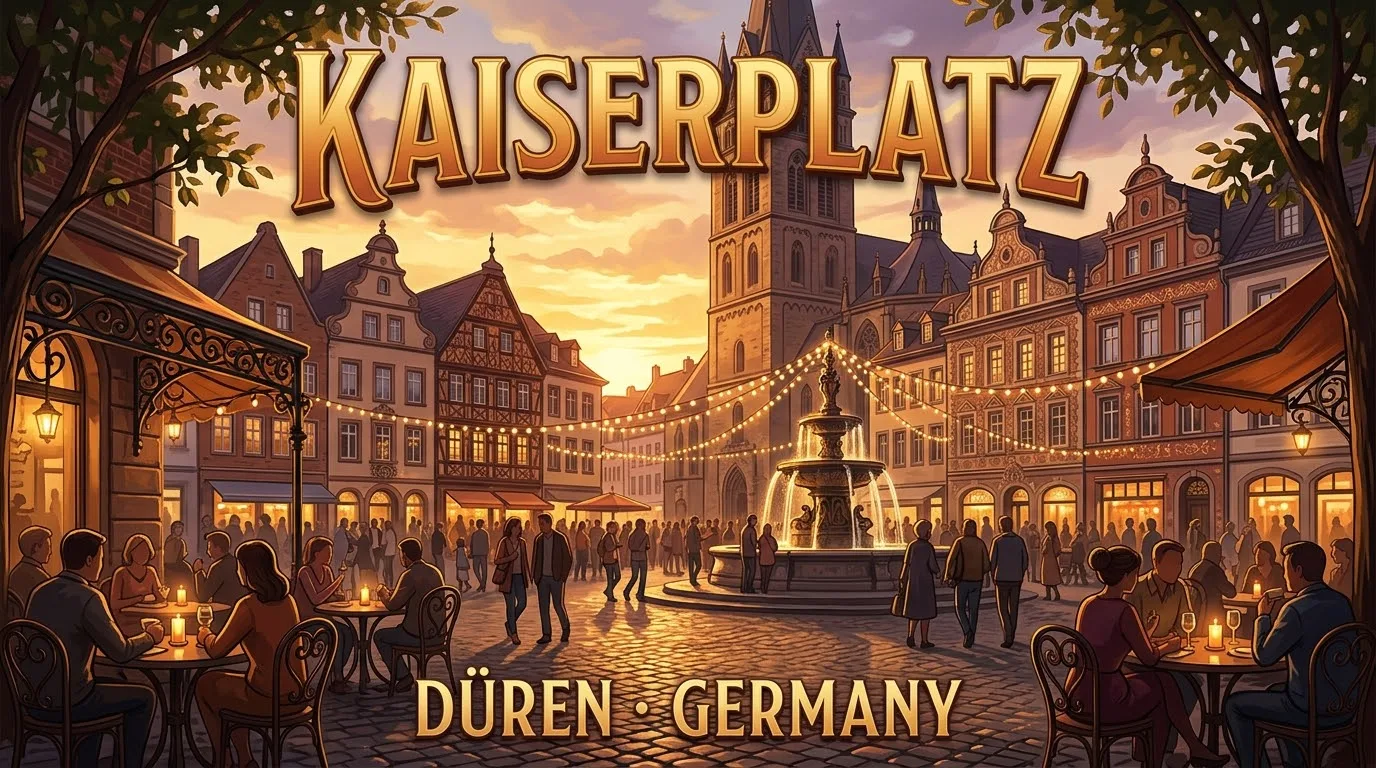
Kaiserplatz is Düren's political and transportation center, home to the town hall opened in 1959, one of the most defining buildings of the post-war city. Originally used as a cattle market, the square received its current name only in 1889, when the city council decided to rename it in honor of Kaiser Wilhelm I, to whom a monument had already been erected here in 1891. This imperial monument, however, fell victim to the devastating air raid of November 16, 1944, which destroyed almost the entire inner city of Düren. Today, Kaiserplatz is not only the seat of the city administration but also the region's central bus hub and the site of the Flammenengel, a significant memorial commemorating the city's destruction. This combination of administration, transport, remembrance, and city life makes Kaiserplatz one of Düren's most multifaceted squares.
History of Kaiserplatz
Today's Kaiserplatz originally bore the name Viehmarkt and served as the center of the city's livestock trade. The site also housed a meat hall, in whose upper floor Reformed Christians established a prayer house starting in 1610. On July 12, 1649, the Reformed congregation acquired the building and erected the so-called Predigthaus, a small church that it owned until 1844. On May 7, 1889, the city council decided to rename the Viehmarkt as Kaiserplatz, and as early as 1886 the city had leased the site for 99 years in order to erect a monument to Kaiser Wilhelm I, which was ceremonially unveiled on March 22, 1891. On December 22, 1892, the Evangelical congregation finally officially donated the square to the city. This decades-long development from a simple cattle market to a representative square named after the Kaiser reflects the growing prosperity and self-confidence of Düren in the late nineteenth century.
The imperial monument did not survive the Second World War: it was completely destroyed in the air raid of November 16, 1944, like almost every other building in Düren's city center. After the war, the city decided to build the new town hall not at the original location on the Marktplatz but on the northern side of Kaiserplatz. The new building opened in early 1959 and remains the seat of Düren's city administration today; in 1986 it was granted protected heritage status. Directly beside the town hall steps, the Flammenengel by sculptor Adolf Wamper was unveiled in 1962, a memorial commemorating the destruction of 1944. In the 1990s, and again between 2020 and 2022, Kaiserplatz was comprehensively redesigned to meet the changing demands on a modern, multifunctional city square.
Highlights of Kaiserplatz
The architectural highlight of Kaiserplatz is the town hall, opened in 1959, whose most striking feature is a coat of arms made from 25,000 mosaic stones of Milanese glass above the clock tower - an impressive example of the design ambitions of post-war West German architecture. The building complex comprises roughly 41,000 cubic meters of space and about 200 office rooms, and was designed by architect Denis Boniver of Mettmann, who won a 1953/54 competition against 74 competitors. Directly at the town hall steps stands the Flammenengel by Adolf Wamper, whose expressive bronze figure has commemorated the city's destruction since 1962 and forms a striking contrast to the sober architecture of the town hall. The square itself serves as a central transfer point for numerous regional bus lines, keeping it busy throughout the day, while also regularly hosting markets and concerts. The most recent redesign, between 2020 and 2022, gave Kaiserplatz a more spacious, greener appearance with improved quality for lingering, without compromising its function as a transport hub. For those interested in architecture, the square thus offers a rare glimpse into three different eras of urban design: the Wilhelmine period of the original imperial monument, the functional reconstruction of the 1950s, and contemporary twenty-first-century urban planning.
Opening Hours, Tickets & How to Get to Kaiserplatz
Kaiserplatz is a public square and therefore freely and permanently accessible, free of charge; there are no fixed opening hours. Only the town hall building itself follows the usual office hours of the city administration on weekdays, while the square itself can be visited around the clock, independent of those hours. Kaiserplatz is especially lively on market or event days, while in the evening hours it offers a quieter atmosphere shaped by the lighting of the town hall and the Flammenengel. Thanks to its function as the central bus hub, Kaiserplatz is one of the most easily reached places in Düren by public transport; practically every regional bus line stops here. Hauptbahnhof Düren is also within walking distance, making arrival by train straightforward as well. Drivers should note that through traffic across the square itself is restricted; parking, however, is available in the surrounding parking garages and streets of the city center. Since Kaiserplatz lies centrally between the Marktplatz, the Annakirche, and Hoeschplatz, it makes an ideal starting point for a walking tour of Düren's entire city center.
Attractions Near Kaiserplatz
From Kaiserplatz, almost all of Düren's central sights can be reached within a few minutes' walk. Just a short stroll away lies the historic Marktplatz with the Mariensäule, re-erected in 1957, where market days have been held for more than 650 years. Also within walking distance is the Annakirche with the surrounding squares of Annaplatz and Ahrweilerplatz, whose Gothic south portal survived the wartime destruction. Culture enthusiasts should visit Hoeschplatz with the Leopold-Hoesch-Museum and the neighboring Papiermuseum, while history enthusiasts will find further impressive testimonies to the city's past at the Bismarckdenkmal in Theodor-Heuss-Park and at the surviving remains of the medieval city wall, for instance along Wallstraße. The Mahnmal für die Opfer des Nationalsozialismus on nearby Rückmüller-Platz can also be easily worked into a walking tour tracing Düren's eventful history from the imperial era through the destruction of the Second World War to its modern reconstruction. Visitors who want to combine several sights in a single day will find Kaiserplatz an ideal central starting point, from which both the historic squares and the museums of the city can be comfortably reached on foot.
Where to stay in Düren, Germany
Compare current hotel prices and find the right place to stay.