Flammenengel
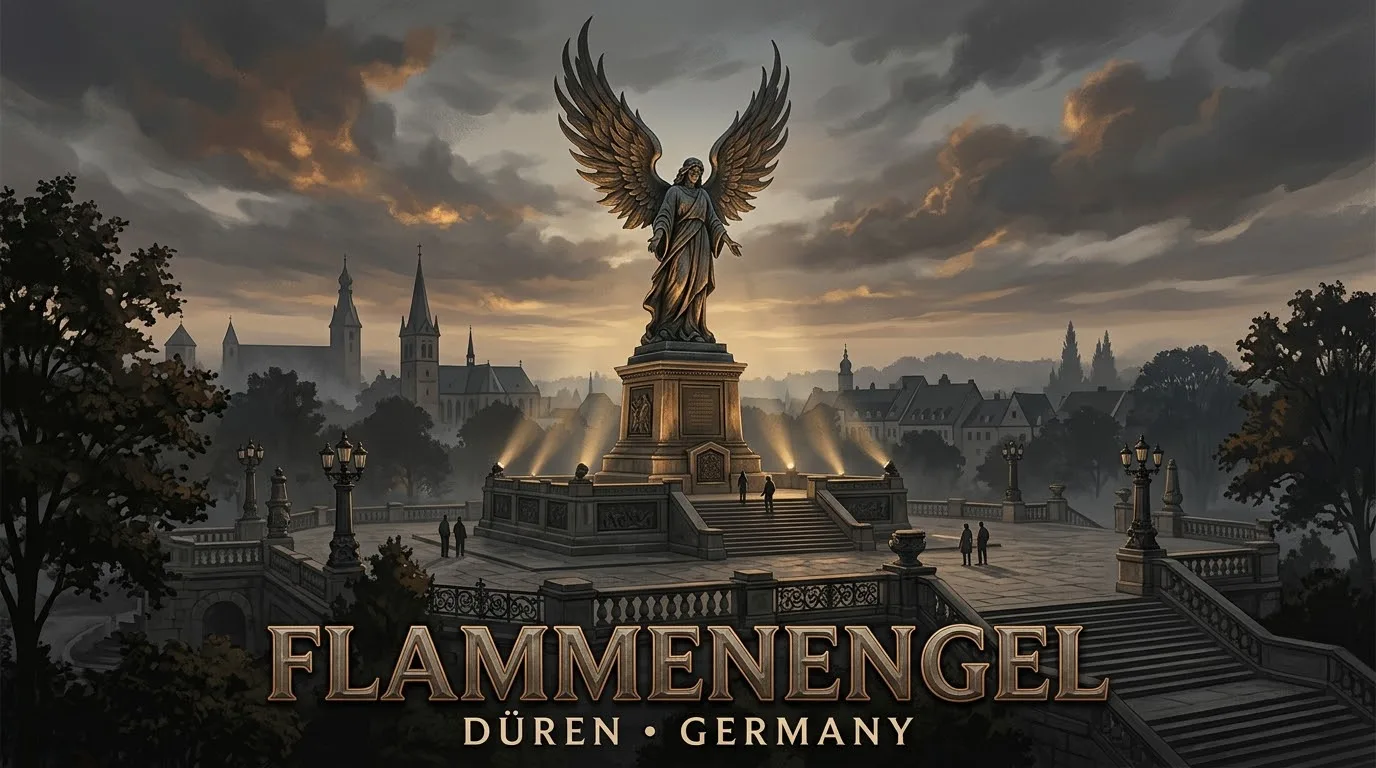
The Flammenengel is one of Düren's most striking memorials, standing directly beside the steps of the town hall on Kaiserplatz, right in the heart of the city. The bronze sculpture by Adolf Wamper, dedicated in 1962, commemorates the Royal Air Force air raid of November 16, 1944, which destroyed almost the entire inner city of Düren within 21 minutes, as well as the dead of both World Wars. Unlike many classical war memorials, the Flammenengel avoids triumphant gestures and instead presents an expressive figure shaped by grief and admonition. It is therefore one of the city's most important sites of remembrance and continues to be used today for commemorative events, such as on Volkstrauertag or the anniversary of the air raid, as a central location of Düren's culture of memory. Anyone walking through the city center almost inevitably passes this striking sculpture on Kaiserplatz, immediately sensing how closely the city's history and its culture of remembrance are intertwined at this spot.
History of Flammenengel
The square where the Flammenengel now stands once carried a completely different meaning. Kaiserplatz was originally known as the Viehmarkt, or cattle market, before the city council decided to rename it on May 7, 1889. As early as 1886, the city had leased the site for 99 years and erected a monument to Kaiser Wilhelm I, which was ceremonially unveiled on March 22, 1891. This imperial monument, however, fell victim to the same air raid that destroyed almost the entire inner city of Düren on November 16, 1944, wiping out roughly 99 percent of all buildings. After the war, the new town hall was built on the northern side of the square, opening in early 1959 and remaining the seat of the city administration to this day.
In the course of reconstruction and the reckoning with the horrors of war, the city decided to erect a memorial explicitly dedicated to the destruction and its victims, rather than another monument to a ruler. Sculptor Adolf Wamper was commissioned for this work, and in 1962 the Flammenengel was unveiled directly next to the steps leading up to the new town hall. The placement was deliberate: everyone entering or leaving the town hall encounters the memorial and is reminded of the devastation of November 16, 1944, as well as of the fallen and victims of both World Wars. Since then, the Flammenengel has been a fixed part of Düren's culture of remembrance and is regularly included in wreath-laying ceremonies and commemorative speeches on official occasions.
Highlights of Flammenengel
The central highlight is undoubtedly the expressive bronze figure itself, whose flame-like, upward-reaching forms express grief and pain while simultaneously delivering an admonishing gesture toward future generations. Adolf Wamper, one of the better-known sculptors of post-war West German art, created with the Flammenengel a work that deliberately breaks away from the classicist war memorials of the nineteenth century in favor of a modern, more abstract visual language. Its location directly at the town hall steps ensures that the memorial is woven into the everyday life of the city administration and its visitors, rather than standing in some remote corner. The sculpture is particularly striking in the evening hours, when the lighting on Kaiserplatz accentuates its contours and heightens its dramatic effect. The surrounding Kaiserplatz itself is also worth seeing: it serves as the region's central bus hub, regularly hosts markets and concerts, and was comprehensively redesigned again between 2020 and 2022. The combination of modern town hall architecture, lively square life, and the quiet memorial of the Flammenengel makes this one of the most striking places in Düren, where history, remembrance, and present-day city life meet directly.
For first-time visitors to Düren, the Flammenengel therefore offers a compact yet profound introduction to the city's recent history, one that pairs naturally with a subsequent stroll around the rest of Kaiserplatz.
Opening Hours, Tickets & How to Get to Flammenengel
The Flammenengel stands in the public space of Kaiserplatz and is therefore freely accessible at all times, free of charge. There are no opening hours and no admission fee, since it is an outdoor memorial that can be visited around the clock. A daytime visit is recommended to appreciate the details of the bronze sculpture, while the evening hours with artificial lighting offer a particularly atmospheric perspective. Kaiserplatz lies right in the center of Düren and is therefore one of the easiest destinations to reach in the city. Because the square functions as a central transport hub for numerous regional bus lines, getting there by public transport is especially convenient; almost every bus line from the surrounding Düren area stops nearby. Düren's main railway station, Hauptbahnhof Düren, is also just a few minutes' walk away, making arrival by train an easy option as well. Drivers will find sufficient parking in the surrounding car parks and parking areas of the city center, though it should be noted that through traffic on Kaiserplatz itself is restricted. Visitors exploring the city center on foot can also comfortably reach the square from the nearby Marktplatz or from the Annakirche.
Attractions Near Flammenengel
Kaiserplatz with the Flammenengel lies right in the center of Düren and therefore makes an ideal starting point for a walking tour of the city. Directly on the square rises the town hall, opened in 1959, with its striking coat of arms above the clock made from 25,000 mosaic stones of Milanese glass. Just a few steps away lies the historic Marktplatz, where market days have been held for more than 650 years and which is also home to the Mariensäule, re-erected in 1957 as another post-war memorial. The Annakirche, rebuilt after the war by architect Rudolf Schwarz, together with the surrounding squares of Annaplatz and Ahrweilerplatz, is also within comfortable walking distance. Culture enthusiasts should also visit Hoeschplatz with the Leopold-Hoesch-Museum and the neighboring Papiermuseum. Those interested in the period before Düren's destruction will also find further impressive testimonies to the city's history at the Bismarckdenkmal in Theodor-Heuss-Park and at the surviving remains of the medieval city wall, for instance along Wallstraße.
Where to stay in Düren, Germany
Compare current hotel prices and find the right place to stay.