Dicker Turm
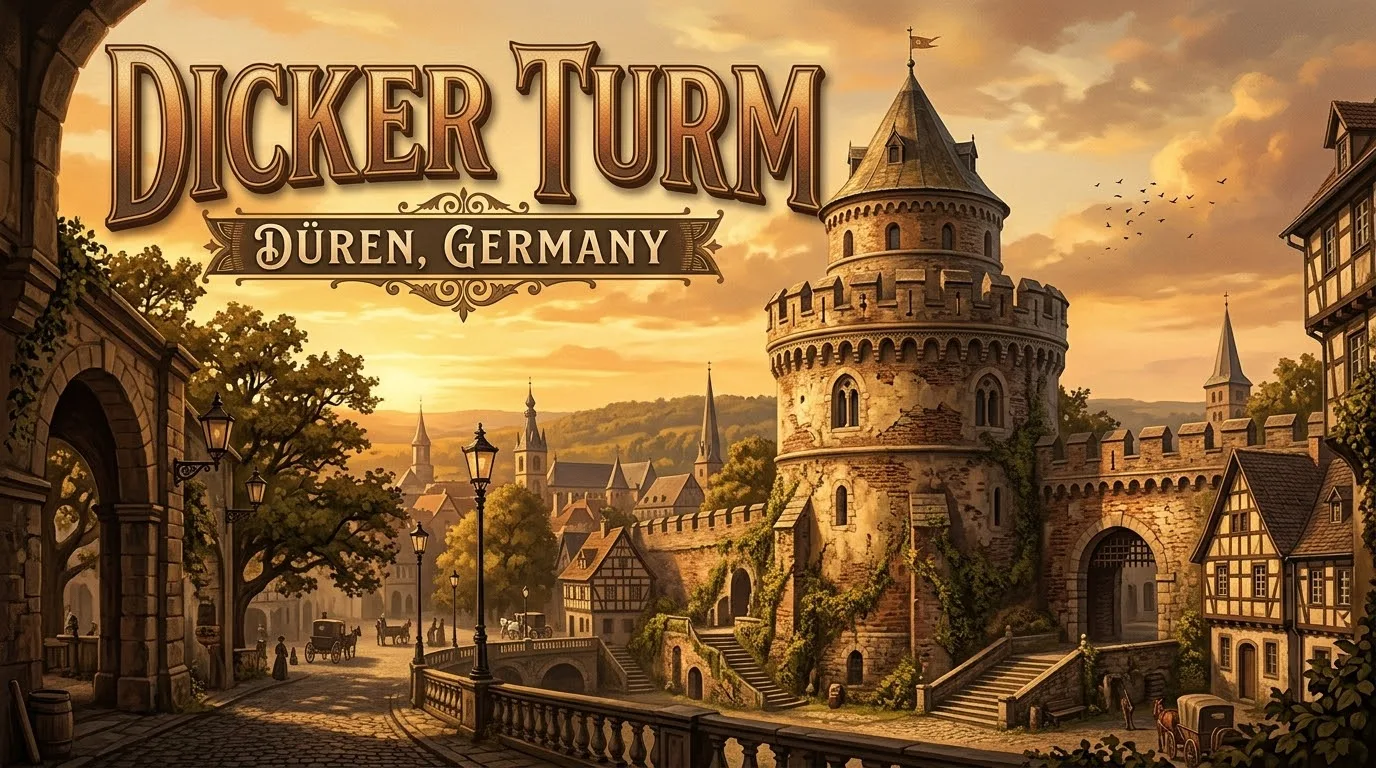
At the corner of Stürtzstraße and Altenteich, right on the grounds of the Stiftisches Gymnasium Düren, stands a massive round brick tower that counts among the very few structures to have survived the devastating air raid of November 16, 1944: the Dicker Turm. As one of the last surviving watchtowers of Düren's medieval city fortifications, it is today not only a protected historic monument but also a symbol of local identity, so closely tied to the neighboring school that it even appears on the school's coat of arms. Anyone walking through Düren's city center with an interest in the town's turbulent history of destruction and reconstruction should make time for this compact yet impressive landmark.
History of Dicker Turm
The Dicker Turm was built in 1493 as part of what was then the still fully intact city fortifications of Düren, designed to protect the town against attackers and besiegers for centuries to come. Constructed as a round bastion tower of brick, it originally featured a pointed conical roof that further emphasized its silhouette and made it recognizable from a distance as a prominent defensive position. Its location on the grounds of what later became the Stiftisches Gymnasium, founded in 1513, is no coincidence, since the school was deliberately established right next to the fortifications that shaped the town's appearance, and the tower remains so closely associated with the school to this day that it even forms part of its emblem. As the city wall gradually lost its military purpose in the early modern period, the tower initially survived as a structural relic, but increasingly faded into the background as the town was reshaped during the 19th and early 20th centuries. During the Second World War, and especially during and after the severe air raid of November 16, 1944, which reduced Düren's entire old town to rubble, the Dicker Turm was also significantly damaged. In the decades that followed, the interior of the tower was filled with rubble and soil, a pragmatic but widespread postwar solution used to provisionally stabilize structures at risk of collapse. In the long run, however, this measure proved problematic: the internal pressure of the fill material began to put stress on the historic masonry from within, eventually making an extensive and technically demanding restoration necessary in the 1990s, during which the fill was removed and the tower's structural stability was fundamentally secured. Since then, the Dicker Turm has been listed under entry number 1/035a in Düren's official heritage register and enjoys special protection as one of the town's oldest surviving structures.
Highlights of Dicker Turm
What makes the Dicker Turm distinctive is its almost completely enclosed, massive round shape, which clearly sets it apart from more slender, representative watchtowers and still makes its purely defensive, practical origin obvious today. Visitors walking around the school grounds can view the sturdy brick masonry dating from around 1493 up close and get a real sense of just how formidable Düren's medieval city wall must once have been. Particularly appealing is its direct spatial connection to the neighboring Grönjansturm, another semi-circular bastion tower built in the early 16th century with a diameter of roughly eight meters, whose partially preserved vaulted basement and upper floor can likewise be found on the gymnasium grounds. Running between the two towers is a roughly 84-meter-long, 3.5-meter-high stretch of the original city wall, protected under entry number 1/035b, which gives visitors a rare, continuous impression of the scale and height of the historic fortifications. It is precisely this combination of tower, neighboring tower, and surviving wall section that makes the area around the Stiftisches Gymnasium one of the most authentic places to imagine Düren's former defensive strength, far more vividly than a single, isolated tower could convey on its own. Because the tower sits on the grounds of an active school, its historic character is set in an unusual but appealing contrast with the lively, everyday life of the school right in the middle of town.
Opening Hours, Tickets & How to Get to Dicker Turm
The Dicker Turm is located on the grounds of the Stiftisches Gymnasium at Altenteich 14, 52349 Düren, at the corner with Stürtzstraße. Since this is an active school campus, the tower itself is generally not open for interior visits or free access; however, it can be viewed and photographed from outside at any time, free of charge, particularly along the publicly accessible streets and footpaths surrounding the school grounds. No admission fee applies, since there are no regular museum-style opening hours; visitors interested in an interior visit or an expert-led tour are best advised to contact the city's visitor services or local guides in advance, as the Dicker Turm is regularly included in guided walks covering Düren's history. Getting there is straightforward, as the tower lies only a few minutes' walk from Düren's city center: from Düren's main train station on the Cologne-Aachen rail line, it takes about ten minutes to walk through the city center to Altenteich. Several Rurtalbus bus lines stop nearby, and drivers will find public parking options in the surrounding area, from which the school grounds are easily reached on foot.
Attractions Near Dicker Turm
Right next to the Dicker Turm, also on the grounds of the Stiftisches Gymnasium, it is worth taking a look at the Grönjansturm and the well-preserved stretch of wall between the two towers, which together form the most impressive continuous remnant of Düren's medieval city fortifications. Just a few minutes' walk away is the modern Rathaus Düren on Kaiserplatz, whose clean postwar architecture offers a striking contrast to the centuries-old watchtowers. The Leopold-Hoesch-Museum and the directly adjoining Papiermuseum Düren, which brings the town's papermaking tradition to life through interactive exhibits, are also within easy walking distance. The Stadtmuseum Düren on Arnoldsweilerstraße rounds out the visit with a chronological exhibition on the town's history, including the destruction of 1944 that also damaged the Dicker Turm. Visitors wishing to continue exploring the city's cultural scene will find the Komm-Kulturzentrum and the Stadtbücherei Düren, two further stops with historic building fabric, both of which fit naturally into an extended walk through Düren's history-rich center.
Where to stay in Düren, Germany
Compare current hotel prices and find the right place to stay.