Christuskirche
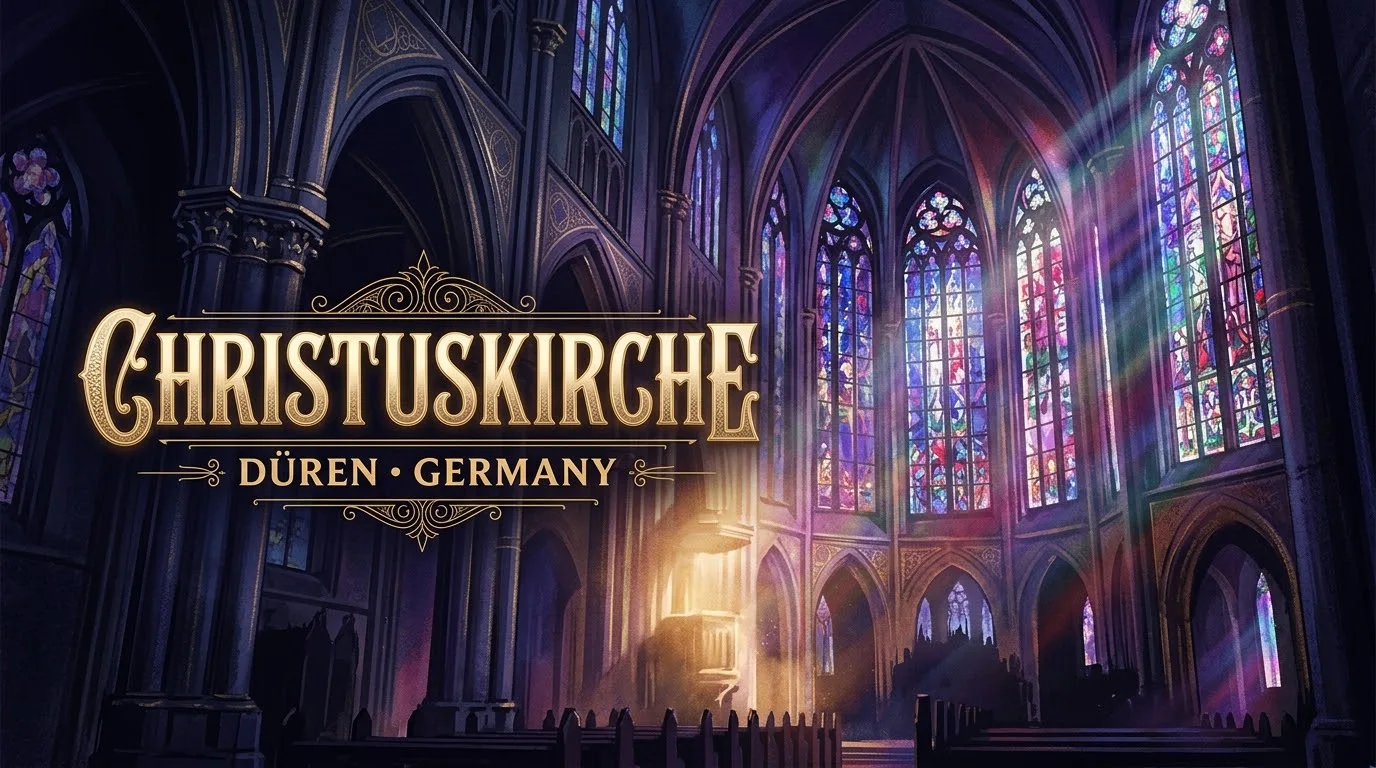
The Christuskirche is the most important Protestant church in Düren and is regarded as one of the most remarkable examples of postwar ecclesiastical architecture in the Rhineland. The building was erected in the 1950s on Schenkelstraße after its predecessor, the Auferstehungskirche built between 1841 and 1844, was completely destroyed during the air raid on Düren on 16 November 1944. Designed by the renowned Düsseldorf architects Helmut Hentrich and Hubert Petschnigg, the Christuskirche makes a distinctive mark on Düren's skyline with its striking cross-shaped plan and its once-tallest free-standing church tower in Germany. As the main church of the Protestant congregation of Düren within the Jülich church district, it remains a lively centre of Protestant community life to this day and is also a protected architectural monument that draws architecture enthusiasts from across the region.
History of Christuskirche
The history of the Protestant congregation in Düren and its main church dates back to the first half of the 19th century, when the so-called Auferstehungskirche was built between 1841 and 1844, serving for more than a century as the spiritual centre of Düren's Protestant community. This historic building was completely destroyed during the devastating air raid on Düren on 16 November 1944, which reduced large parts of the city centre to rubble. In the years following the war, the congregation faced the task of constructing an entirely new church. On 30 January 1952, an architectural competition selected the design of the Düsseldorf architects Helmut Hentrich and Hubert Petschnigg, who would later gain international recognition for buildings such as the Thyssen-Haus high-rise in Düsseldorf. The foundation stone for the new Christuskirche was laid on 26 April 1953, and just one year later, on 4 April 1954, the church was solemnly consecrated — an unusually rapid pace of construction for the time, reflecting the postwar society's determination to rebuild. With its free-standing tower, which at the time of its completion was considered the tallest free-standing church tower in Germany, the Christuskirche made a deliberately confident architectural statement from the very beginning. Since its construction, the building has been protected as a heritage monument and is listed in Düren's register of architectural monuments under number 1/111, underscoring its special cultural and historical significance.
Highlights of Christuskirche
The architectural centrepiece of the Christuskirche is its unusual floor plan in the shape of an obtuse-angled cross, in which the communion table was deliberately placed at the intersection of the cross's arms, making it the visual and liturgical focal point of the entire church space. The floor slopes gently towards this central point, drawing the congregation visually towards the altar area and creating a sense of community and closeness that was groundbreaking for Protestant church architecture of the 1950s. This clear geometric concept makes the Christuskirche a textbook example of modern Protestant sacred architecture of the German postwar period. Another highlight is the impressive organ, built in 1967 by the long-established organ-building firm G. F. Steinmeyer & Co. and thoroughly restored in 2002: with 65 stops spread across four manuals and pedal, it ranks among the largest and most versatile church organs in the entire Rhineland in terms of sound, and is regularly used for concerts and special services. The church's bells also deserve special attention: the four bells were cast by the renowned bell and art foundry Rincker in Sinn, Hesse, one of the oldest bell foundries still operating in Germany, lending the church a full, far-reaching sound. The slender, free-standing bell tower, which at the time of its construction was considered the tallest free-standing church tower in Germany, remains a widely visible landmark in Düren's skyline to this day and reflects the confident spirit of reconstruction of the 1950s. Together with the clear, unadorned interior and the bright, light-filled architecture, the Christuskirche conveys a timeless modernity that clearly sets it apart from many of the region's more traditional church buildings.
Opening Hours, Tickets & How to Get to Christuskirche
The Christuskirche is located on Schenkelstraße in the centre of Düren and serves as the main church of the Protestant congregation of Düren within the Jülich church district. As an active parish church, its opening hours are primarily tied to regular services as well as occasional concerts and cultural events; outside these times, access may be limited. Current service times, organ concert dates, and contact details are available via the website of the Protestant congregation of Düren or through the parish office at Philippstraße 4, 52349 Düren. Admission to the Christuskirche is free, as is customary for most parish churches in the Rhineland; for special concert events, separate tickets may occasionally be required, about which the congregation provides specific information. The Christuskirche is centrally located in Düren's city centre and is therefore excellent to reach on foot, for instance from the nearby Düren main railway station on the Cologne–Aachen line, which is only about a ten-minute walk away. Visitors arriving by car will find several public parking options nearby, while those travelling by public transport benefit from the numerous bus and rail connections linking Düren with surrounding towns such as Cologne, Aachen, and Jülich. Thanks to its central location, a visit to the Christuskirche can easily be combined with a walk through Düren's historic city centre and visits to other nearby attractions.
Attractions Near Christuskirche
Numerous other attractions in Düren's city centre lie in the immediate vicinity of the Christuskirche, making it easy to combine a visit with a walk through the old town. Just a few minutes' walk away is the Annakirche, the city's important Catholic pilgrimage church housing the relic of Saint Anna, whose modern postwar architecture offers an interesting comparison with the Christuskirche. Also within walking distance is the Leopold-Hoesch-Museum & Papiermuseum, which gives art lovers an insight into modern art and the region's paper-making history. Düren's town hall, with the adjoining Kaiser-Friedrich-Park, invites visitors to a relaxing break amid greenery, while the historic Marienkirche, with its impressive architecture, makes for another worthwhile stop. Those wishing to delve deeper into the city's history will find further information at the Stadtmuseum Düren about the region's eventful past, which was particularly shaped by the destruction of the Second World War. For a day trip beyond the city limits, the nearby Jülich Citadel, one of the best-preserved Renaissance fortifications in Europe, is also well worth a visit and can be reached by car in around 20 minutes.
Where to stay in Düren, Germany
Compare current hotel prices and find the right place to stay.