Annaplatz
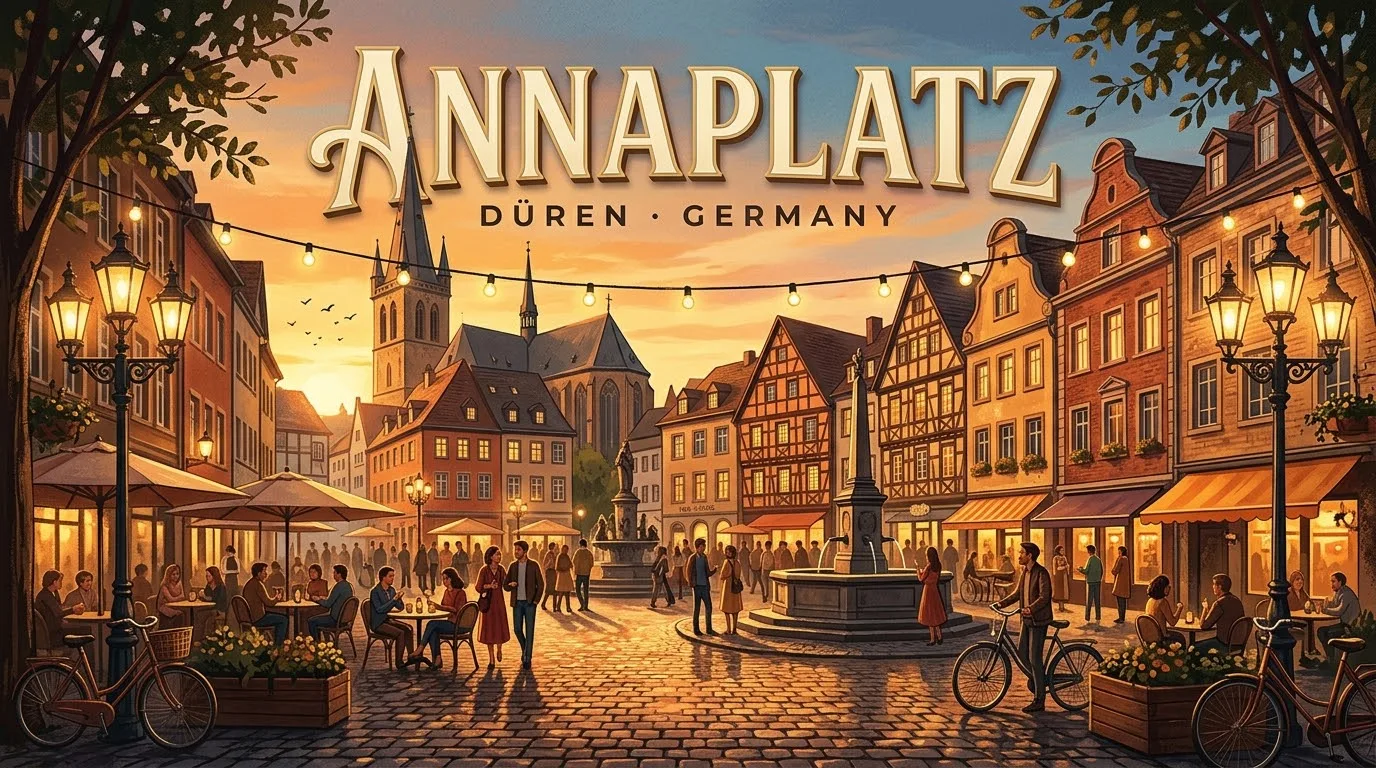
Annaplatz lies in the center of Düren, directly south of the Annakirche, and is one of the city's most historically rich squares. Together with the adjoining Ahrweilerplatz to the west, it encircles the Annakirche, the central church of Düren's St. Lukas parish, forming the spiritual heart of the city center. The square sits between Oberstraße and the street Höfchen and today is designed as a traffic-calmed zone that invites visitors to linger. The history of the site reaches back to the era of Düren's medieval fortifications and is inseparably linked to the history of the Annakirche itself, which received its present name after the arrival of a relic shrine containing the head of St. Anne from Mainz in 1501. Visiting Annaplatz means experiencing not just a lively inner-city square but a place with more than 500 years of continuous religious and civic significance.
History of Annaplatz
Annaplatz developed within Düren's medieval city fortifications and for centuries was closely tied to the city's religious life. The church that gives the square its name was originally called Martinskirche but was renamed Annakirche after the transfer of the Annahaupt, an important relic, from Mainz in 1501. As early as around 1550, the square is mentioned in historical documents as "an deme platze gnat zo Sent Annen," attesting to the early establishment of its present name. Historically, two separate cemetery areas existed around the church, the so-called German Cemetery and the Latin Cemetery, reflecting the different use by German- and Latin-speaking parish members. The southern part of the square was also home to important educational institutions: from 1358 to 1636 a Latin school stood here, later succeeded until 1774 by the Jesuit grammar school; after that, the Stiftisches Gymnasium used the premises until 1826. This centuries-old dual structure of church building and educational institutions still makes Annaplatz a place where religious, pedagogical, and civic history directly overlap today.
The Annakirche itself was completely destroyed in the air raid of November 16, 1944; the senior pastor, Johann Fröls, and other clergy died in the attack. Only the early Gothic south portal and parts of the north wall survived the bombardment. It was not until 1948 that a provisional chapel was created amid the ruins, before extensive archaeological excavations beginning in 1951 documented the site's centuries-old building history - uncovering a total of five successive church buildings dating back to around the year 700. Between 1954 and 1956, architect Rudolf Schwarz built today's Annakirche using historic stones and architectural elements from the destroyed predecessor building; the foundation stone was laid on January 16, 1955, and the church was consecrated on July 7, 1956. The bell tower, initially completed only at the foundation level due to financial constraints, was not finished until 1963/64 and, at around 50 meters, reaches only about half the height of its roughly 100-meter-tall predecessor.
Highlights of Annaplatz
The central highlight of Annaplatz is undoubtedly the adjoining Annakirche with its surviving early Gothic south portal, one of the few architectural elements that survived the destruction of 1944 and thus provides a direct link to the medieval church. The new building erected by Rudolf Schwarz in the 1950s is considered an important example of post-war German sacred architecture, skillfully combining historic fragments with a contemporary visual language. On the western side of the square stand the Papst-Johannes-Haus and the St. Anna parish center, which keep religious life around the square active to this day. The southern side of Annaplatz is shaped by a Brauhaus and other restaurants, which make the square a popular meeting point for locals and tourists alike. Especially during Düren's annual city festival, the city's partner towns present themselves here, briefly turning Annaplatz into a stage for international encounters. Visitors planning a trip around this time of year should check the exact dates of the city festival in Düren's official events calendar so as not to miss this special gathering on Annaplatz. The combination of ecclesiastical history, an archaeologically documented past reaching back to around the year 700, and a lively dining scene makes Annaplatz one of the most multifaceted places in Düren's city center.
Opening Hours, Tickets & How to Get to Annaplatz
Annaplatz is a public, freely accessible square and can therefore be visited free of charge at any time; there are no fixed opening hours for the square itself. The adjoining Annakirche follows the usual opening hours of Catholic parish churches and can generally be visited during the day, though service times should be taken into account. The surrounding restaurants on the southern edge of the square have their own opening hours, generally following standard dining establishment hours. Annaplatz lies in the center of Düren, just a few minutes' walk from the Marktplatz and Kaiserplatz, making it very easy to reach on foot. Travelers arriving by train reach Hauptbahnhof Düren and can reach Annaplatz from there with a short walk through the city center. Numerous regional bus lines stop near Kaiserplatz, from which Annaplatz is also easily reached on foot. Drivers will find ample parking in the city center's parking garages; Annaplatz itself, as a traffic-calmed zone, is not intended for through traffic.
Attractions Near Annaplatz
Directly adjoining Annaplatz is Ahrweilerplatz, which together with it encircles the Annakirche and, with its numerous restaurants and the summer open-air concert series "Airweiler," is a popular destination for an evening out. Just a few minutes' walk away lies the historic Marktplatz with the Mariensäule, re-erected in 1957, as well as Kaiserplatz with the town hall and the Flammenengel, a memorial commemorating the destruction of Düren in 1944. Culture enthusiasts should also visit Hoeschplatz with the Leopold-Hoesch-Museum and the adjoining Papiermuseum. Those interested in the period before Düren's destruction will also find further impressive testimonies to the city's history at the Bismarckdenkmal in Theodor-Heuss-Park and at the surviving remains of the medieval city wall, for instance along Wallstraße. All of these destinations lie within comfortable walking distance of Annaplatz, making it easy to plan an extended tour of Düren's historic city center. Heading into 2026 and 2027, Annaplatz is likely to remain a fixture of any tour of Düren, especially since it combines so well with a stroll across the neighboring Ahrweilerplatz.
Where to stay in Düren, Germany
Compare current hotel prices and find the right place to stay.