Annakirche
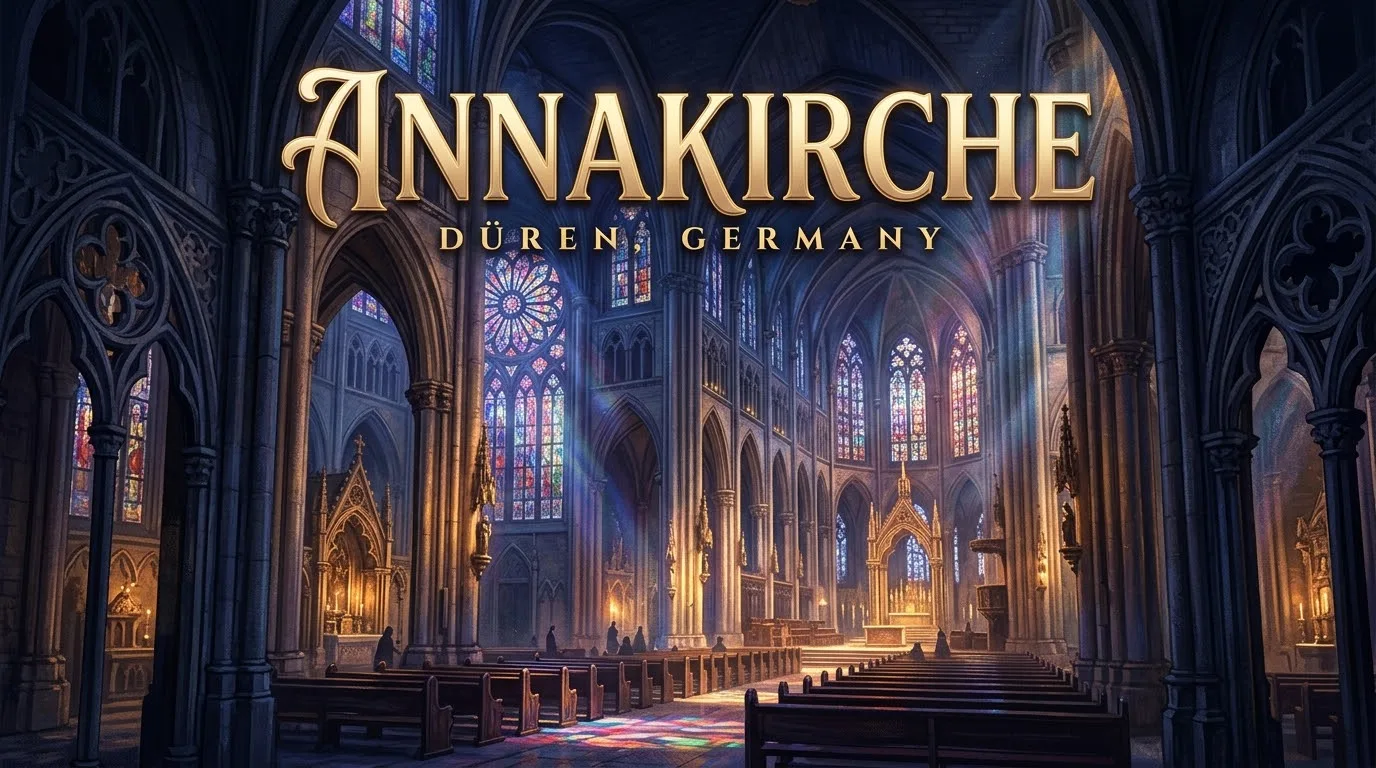
The Annakirche is one of the most important sacred buildings in the Rhineland and stands as one of Germany's most striking examples of postwar ecclesiastical reconstruction. Officially named St. Anna, the church serves as the parish church of the St. Lukas parish in Düren. For more than five centuries, one of the Rhineland's most significant relics, the head of Saint Anna, has rested here, making the Annakirche a popular pilgrimage site to this day. The present building, erected after the devastation of the Second World War, combines an almost archaic formal language with modern architecture and ranks among the principal works of architect Rudolf Schwarz. Visitors to the Annakirche enter not only a living place of worship but also a monument to twentieth-century German architectural history, one that deliberately leaves the scars of destruction visible while radiating hope and renewal.
History of Annakirche
The history of the Annakirche stretches back to around the year 700, when a small, single-nave chapel was first built on this very site. Over the following centuries the building was repeatedly expanded and rebuilt: in the 8th century a larger three-nave basilica was constructed, in the 10th century a Romanesque pillar basilica followed, and towards the end of the 13th and during the 14th century a late-Gothic, three-nave hall church with cross-rib vaulting eventually rose, shaping the townscape of Düren until the middle of the 20th century. Since 1501 the church has venerated the head of Saint Anna as a relic, which was brought to Düren from Mainz and turned the town into one of the most important pilgrimage destinations in the Rhineland. As early as 1510, around 20,000 pilgrims are said to have visited the Annakirche annually to venerate the relic. This centuries-old Gothic church was almost completely destroyed during the devastating air raid on Düren on 16 November 1944; only the south portal and parts of the north wall survived. After the war, it was decided to build an entirely new church on the historic site, designed by the renowned Cologne architect Rudolf Schwarz, one of the most influential church builders of German postwar modernism. Between 1954 and 1956 the present-day Annakirche was constructed, partly using stones salvaged from the ruins of its Gothic predecessor — a deliberate link between destruction and new beginnings.
Highlights of Annakirche
Architecturally, the Annakirche impresses with its clear, almost archaic formal language, through which Rudolf Schwarz countered the destruction of war with a new, deliberately reduced monumentality. The bright, hall-like interior consistently draws the eye towards the chancel and creates an atmosphere of stillness and contemplation, markedly different from the lavish interiors of Gothic churches. Among the most art-historically valuable furnishings are the Renaissance choir stalls, dated to 1562/1563, making them one of the few objects rescued from the medieval predecessor building. Also of particular artistic significance are the relief works by the renowned sculptor Ewald Mataré, who contributed to the interiors of numerous postwar churches across the Rhineland and whose pieces lend the Annakirche an additional layer of artistic depth. Musically, the church reaches another highlight with its organ built in 2010 by the Swiss organ-building firm Metzler Orgelbau: the instrument has 45 stops and ranks among the most significant church organs in the region in terms of sound, regularly used for concerts. The bell tower also carries a carillon renewed in 1964 with 49 bells, whose chimes can be heard far beyond Annaplatz, lending the old town of Düren a distinctive soundscape. The central spiritual highlight, however, remains the relic of Saint Anna, which is still venerated today in its own shrine and draws numerous pilgrims and worshippers each year, particularly around the Annafest in summer. The combination of medieval relic veneration, Renaissance artworks, and resolutely modern postwar architecture makes the Annakirche one of the most multifaceted sacred buildings in the entire Rhineland.
Opening Hours, Tickets & How to Get to Annakirche
The Annakirche, located at Annaplatz 8, 52349 Düren, is open to visitors throughout the day and invites quiet moments of reflection or prayer; there are generally no separate fixed opening hours apart from services, though access may be temporarily restricted during liturgical celebrations. Admission to the church is free of charge, so a visit is possible at any time without a ticket or prior booking. For current service times, guided tours, or information about special events such as the Annafest, it is worth checking the website of the St. Lukas parish or calling the parish office. The Annakirche is centrally located in Düren's old town and is therefore very easy to reach on foot; from Düren's main railway station, which lies on the Cologne–Aachen railway line, it is only about a ten- to fifteen-minute walk to Annaplatz. The church is also easily reached by car, with ample parking available in the surrounding streets and multi-storey car parks of the city centre. Travellers arriving by public transport can make use of several VRS bus lines that stop in the immediate vicinity of the old town. Düren itself is conveniently located between Cologne and Aachen and is well connected via the A4 motorway and regional rail services, making a visit to the Annakirche an ideal addition to a day trip through Düren's city centre.
Attractions Near Annakirche
The area around the Annakirche is well suited to exploring on foot. Just a few minutes' walk away is the Leopold-Hoesch-Museum & Papiermuseum, which combines modern art with the region's industrial paper-making history and ranks among the most worthwhile museums in the Düren district. Also nearby is Düren's town hall, with the adjoining Kaiser-Friedrich-Park, a green oasis in the heart of the city that is ideal for a break after visiting the church. Architecture enthusiasts should also pay a visit to the Christuskirche, the city's most important Protestant church, which lies only a few minutes from the Annakirche and offers an interesting contrast to Catholic sacred architecture. Visitors wishing to experience the annual Annakirmes, one of the largest folk festivals in North Rhine-Westphalia, will find it traditionally held in late summer around Annaplatz and the surrounding streets, drawing visitors from across the region. The historic Marienkirche, with its striking architecture, is also within walking distance and makes for a worthwhile combined visit with the Annakirche. Beyond the city centre, Düren also makes a good base for a day trip to the nearby Jülich Citadel or into the Eifel region, both reachable within a few minutes or around half an hour by car, making them excellent additions to a city trip to Düren.
Where to stay in Düren, Germany
Compare current hotel prices and find the right place to stay.