Wochenmarkt auf dem Apostelnkloster
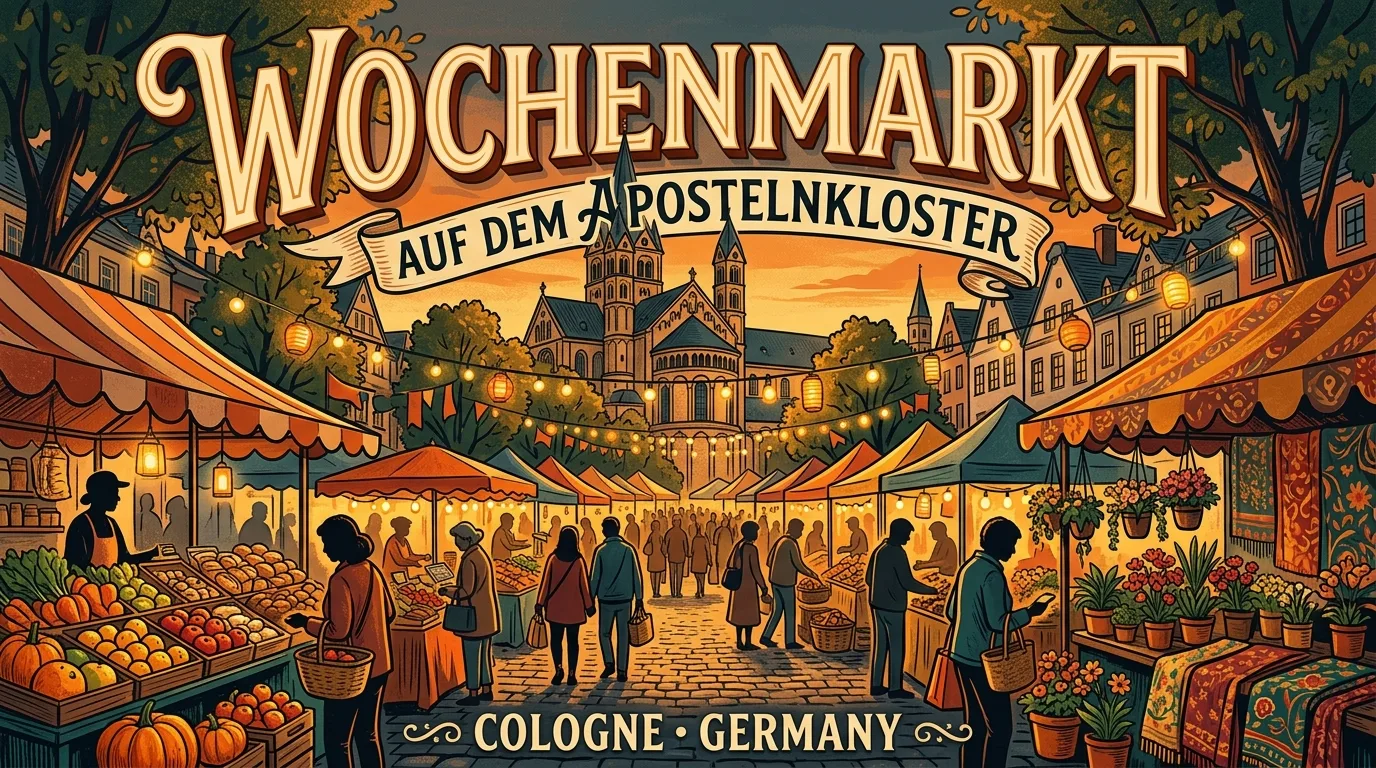
Between the Romanesque columns of St. Aposteln church and the brick-red façades of Cologne's city center lies Apostelnkloster square, home for decades to one of the city's most traditional neighborhood markets: the Wochenmarkt auf dem Apostelnkloster. Twice a week, on Tuesdays and Fridays, this normally quiet square in the Altstadt-Nord district transforms into a colorful open-air marketplace where vendors from the Rhineland and surrounding countryside sell fresh vegetables, fruit, meat, fish, cheese, baked goods and flowers. For residents of the city center and for office workers from the surrounding streets, the Wochenmarkt auf dem Apostelnkloster is a regular stop on the way to work or during a lunch break. This article explains how the Wochenmarkt auf dem Apostelnkloster came to be, what sets it apart from Cologne's other markets, and how to easily combine a visit with a walk through the old town. Because it receives almost no tourist promotion, the Wochenmarkt auf dem Apostelnkloster remains something of an insider tip among locals who prefer shopping away from the busiest tourist routes. Few visitors realize that this small square has been hosting market days continuously for longer than most of Cologne's famous landmarks have existed in their current form.
History of Wochenmarkt auf dem Apostelnkloster
The square Apostelnkloster takes its name from the former monastery attached to the collegiate church of St. Aposteln, one of Cologne's twelve great Romanesque churches, whose foundations date back to around the year 1000. Even in medieval times, the areas surrounding Cologne's collegiate churches often served as trading grounds, where merchants set up stalls just outside the monastery gates, and following this tradition the city of Cologne eventually established a regular weekly market on today's Apostelnkloster square. In its current form, with fixed stall assignments organized by the city's market office, the Wochenmarkt auf dem Apostelnkloster has existed for many decades as one of roughly two dozen weekly markets the city of Cologne operates across its various neighborhoods, known locally as Veedel. Unlike the large markets built around Christmas tourism, the Wochenmarkt auf dem Apostelnkloster has always remained primarily a neighborhood market, serving the people who live and work in Cologne's city center. Over the years, the range of goods has adapted to changing shopping habits: alongside the classic fruit and vegetable stalls, organic produce stands, Mediterranean specialties and street-food vendors have also become established on the square, without the market losing its original character as a genuine source for everyday groceries.
Highlights of Wochenmarkt auf dem Apostelnkloster
What makes the Wochenmarkt auf dem Apostelnkloster special is the combination of a compact footprint and consistently high-quality stalls. Because the square in front of St. Aposteln church is relatively small, only a carefully selected group of vendors sets up here, some of whom have been trading at Cologne's weekly markets for generations. Regular offerings include seasonal fruit and vegetables from the Köln-Bonn basin and the Vorgebirge region, fresh fish from the North Sea, poultry and artisanal sausages, and cheese stalls carrying a wide selection of German and French varieties. Particularly popular with the lunchtime crowd from nearby offices are the stalls selling ready-to-eat food, from fried fish to filled bread rolls and, in winter, warm soups. The market's proximity to the Romanesque St. Aposteln church also gives it a distinctive backdrop: the pale sandstone of the church towers makes an appealing contrast with the colorful awnings and displays of the stalls. Visitors who arrive early can watch vendors setting up their goods while the bells of St. Aposteln mark the hour, a small moment of everyday urban life right in the middle of Cologne's otherwise tourist-heavy center. Regular customers also value the direct exchange with producers, something that is barely possible anymore at larger supermarkets. For anyone looking for an authentic glimpse into daily life in Cologne's city center, the Wochenmarkt auf dem Apostelnkloster is a worthwhile addition to the city's better-known sights.
Opening Hours, Tickets & How to Get to Wochenmarkt auf dem Apostelnkloster
According to the city of Cologne, the Wochenmarkt auf dem Apostelnkloster regularly operates on two days a week: Tuesdays from about 7am to 1pm and Fridays from about 7am to 2pm. As with most weekly markets in Cologne, there is no admission fee; visitors only pay for the goods they buy directly at the stalls, and many vendors now accept card payments as well. Arriving early guarantees the widest selection, while shopping shortly before closing time often means discounted prices on remaining stock. The market sits centrally in Cologne's Altstadt-Nord district and is therefore very easy to reach by public transport: several Stadtbahn lines, including lines 1, 3, 4, 7, 9 and 16, stop at nearby stations such as Neumarkt or Appellhofplatz, from where Apostelnkloster square is just a few minutes' walk. The market is also easily reached by bicycle via the Ringe boulevards and the city center streets, with bike racks available nearby. Drivers should use one of the parking garages around Neumarkt or Cäcilienstraße, since the square itself is closed to through traffic during market hours.
Attractions Near Wochenmarkt auf dem Apostelnkloster
Right on the market square stands the Romanesque church of St. Aposteln, one of Cologne's twelve great Romanesque churches and architecturally notable for its striking trefoil choir on the building's eastern end - stepping inside after shopping at the market is almost always worthwhile. Just a few minutes' walk away is Neumarkt, one of the largest squares in Cologne's city center, with numerous shops, cafés and its own Stadtbahn stop. From there, the well-known shopping street Schildergasse leads directly toward Cologne Cathedral and Hohe Straße, making it easy to combine a market visit with a stroll through the city center. Heading west, it's a short walk to Rudolfplatz with the Hahnentor, one of the last surviving gates of Cologne's medieval city wall, and the start of the Ringe boulevards. The lively Agnesviertel district, with its cafés, second-hand shops and the square around Agneskirche, is also within walking distance and makes a good continuation of a city walk. Culture lovers can also visit the nearby Käthe Kollwitz Museum or the Minoritenkirche, both only a few minutes from Apostelnkloster square. The Hohenzollernring, with its bars and cinemas, is likewise reachable on foot within just a few minutes.
Where to stay in Cologne, Germany
Compare current hotel prices and find the right place to stay.