Ulrepforte
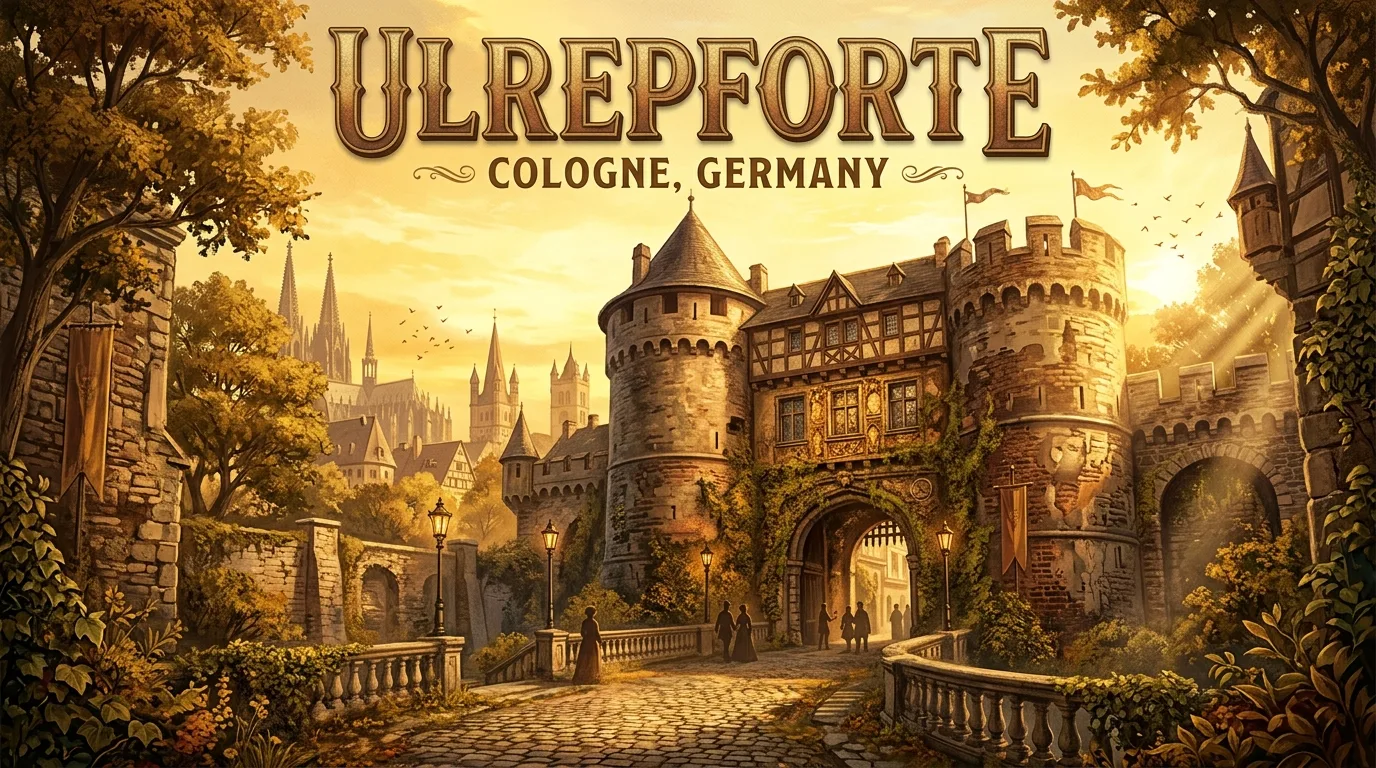
On the edge between Cologne's lively Altstadt-Süd district and the Sachsenring stands an unassuming yet historically significant structure: the Ulrepforte. Visitors stepping off the tram at the stop of the same name find themselves almost immediately in front of one of the last surviving testimonies to Cologne's medieval city fortifications. Unlike the city's more famous gate towers, the Ulrepforte appears almost modest at first glance - yet a closer look reveals massive wall remnants, a distinctive tower, and a history reaching back to the 13th century, telling one of the most dramatic episodes in Cologne's urban history. The Ulrepforte is thus far more than an architectural relic: it is a stone witness to siege, defense, and civic determination that still stands today in the middle of modern Cologne.
History of Ulrepforte
The roots of the Ulrepforte go back to the great medieval fortification campaign of Cologne. Starting around 1180, the city began building a massive city wall roughly 9.5 kilometers long, which at the time formed the largest city fortification north of the Alps. Between 1220 and 1250, twelve large gate towers and numerous smaller gates were built along this ring, among them the Ulrepforte. The Ulrepforte was first documented in 1245 in the records of the parish of St. Severin, making it one of the earliest documented components of the city wall. With a passage width of only around four meters, it was the narrowest of the gates facing south and west, and likely served more as a pedestrian and minor traffic gate than as a main entrance for heavy carts.
Architecturally, the Ulrepforte originally consisted of two semicircular, inward-open flanking towers, between which rose a multi-story gate structure. This design was characteristic of the smaller gates of Cologne's city wall and differed markedly from the imposing twin-towered main gates. Arguably the most memorable event in the history of the Ulrepforte took place on the night of October 14 to 15, 1268. During a feud, enemy troops attempted to undermine the city wall at this location by digging a tunnel beneath it, hoping to breach the defensive line. The citizens of Cologne, led by the patrician Matthias Overstolz, noticed the attack in time and were able to repel the intruders in a fierce night battle. This "Battle at the Ulrepforte" became a symbol of the defensive resolve and resilience of medieval civic Cologne and remains part of local memory culture to this day.
As the military significance of the city wall declined in the late Middle Ages, the function of the Ulrepforte changed as well. Around 1450, the gate was walled up and repurposed: the so-called Carthusian Windmill was built, with a roughly 23.5-meter-tall mill tower added to the north side, which from then on defined the silhouette of the structure. During the 19th and early 20th centuries, the entire complex gradually lost significance, fell into obscurity, and was threatened by decay. It was only from 1955 onward that the Ulrepforte was faithfully restored as part of extensive renovation works and saved from final ruin, allowing it to remain admired today as one of the few surviving testimonies of Cologne's former city fortifications.
Highlights of Ulrepforte
The most striking highlight of the Ulrepforte is undoubtedly its dual nature as a medieval defensive structure and later windmill, which can be read directly in its unusual architecture: massive, partly Romanesque-looking wall remnants of the original gate tower merge with the distinctive mill tower into a unique structure found nowhere else in Cologne in this form. For those interested in architecture and history, this structural break offers a vivid insight into how medieval defensive architecture was functionally repurposed and adapted over the centuries rather than simply demolished.
Another central highlight is the memory of the legendary Battle at the Ulrepforte of 1268. A commemorative relief from 1360, artistically depicting the dramatic events of that night, recalls the successful defensive fight of Cologne's citizens against the invading attackers; the original of this historic relief is now housed in the Cologne City Museum, while at the Ulrepforte itself the memory of the event is kept alive. For visitors interested in Cologne's medieval military history, this site is thus an authentic setting of real historical events rather than merely an abstract monument.
Since its restoration in the mid-20th century, the Ulrepforte has also taken on a new, distinctly Cologne-style function: it serves as the clubhouse of the Rote Funken, one of the most traditional and oldest carnival societies in Cologne, which holds its meetings and social activities here. This makes the Ulrepforte not merely a silent historical relic, but a place where Cologne's traditions and club life continue to be actively carried forward - a fusion of centuries-old history and lively contemporary culture typical of the city. Its direct proximity to the Ulrepforte tram stop also makes the structure a frequently noticed element of the cityscape, passed daily by commuters and strollers alike.
Opening Hours, Tickets & How to Get to Ulrepforte
The Ulrepforte is located on the street Sachsenring in Cologne's Altstadt-Süd district, directly at the tram stop of the same name. Since it is an outdoor structure in public street space, the Ulrepforte can be viewed from the outside free of charge at any time - there are no fixed opening hours and no admission fee for viewing the historic facade and commemorative plaques. The interior of the building is now used by the Rote Funken carnival society as a clubhouse and is not permanently open to the public; interior visits are generally only possible during club events, carnival occasions, or by special arrangement.
Getting to the Ulrepforte by public transport is particularly convenient, as Cologne's tram lines 15 and 16 stop directly at the Ulrepforte stop right next to the structure. From Cologne's main train station, the Ulrepforte can thus be reached comfortably in just a few minutes. The building is also quickly reachable on foot from the lively Severinstraße and Chlodwigplatz, as it lies on the southern edge of Altstadt-Süd. Parking is available on the surrounding residential streets, though travel by bus and tram is generally more advisable given the central inner-city location.
Attractions Near Ulrepforte
From the Ulrepforte, Cologne's Altstadt-Süd with its many other historic traces of the medieval city wall can be excellently explored. Just a few minutes' walk away lies the lively Severinstraße with its shops, cafes, and the Severinstorburg, another impressive remnant of the old city fortifications that once marked the southern entrance into the historic old town. Also nearby is Chlodwigplatz, a central traffic hub and popular meeting point in the Severinsviertel, and one of the traditional strongholds of Cologne's street carnival.
Walking further from the Ulrepforte toward the Rhine, visitors quickly reach the Rheinauhafen quarter with its striking Kranhäuser and the Chocolate Museum, which presents the history of chocolate in an engaging and family-friendly way. The Vringstreff and the colorful, alternative Severinsviertel with its many owner-run shops and pubs also invite a leisurely stroll. For those interested in cultural history, a detour to the nearby church of St. Severin is also worthwhile - one of Cologne's twelve Romanesque churches, whose history is closely tied to the city's early Christian settlement.
Where to stay in Cologne, Germany
Compare current hotel prices and find the right place to stay.