Stapelhaus
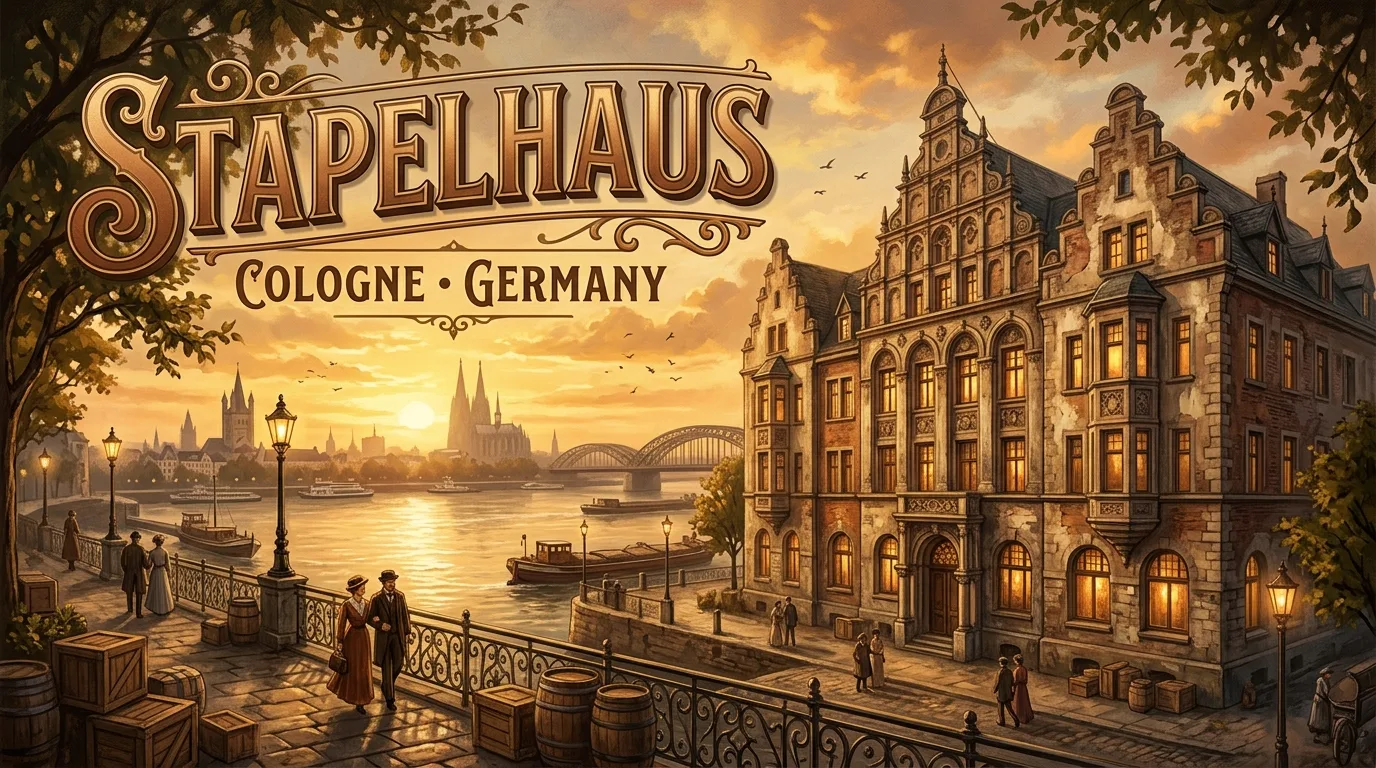
Directly on Frankenwerft, right in front of the Romanesque church of Groß St. Martin and within sight of the Fischmarkt, stands a building whose name says it all: the Stapelhaus. With its slender, delicate stair tower, which stands out clearly from the surrounding facades of the old town, it is one of the most distinctive structures along Cologne's Rhine riverfront. Anyone sailing past Cologne on the Rhine, or strolling along the opposite riverbank in Deutz, often spots the Stapelhaus from afar - a stone symbol that Cologne was, for centuries, one of the most important trading hubs on the Rhine. Behind today's facade lies a turbulent history of medieval fish trading, civic trading privileges, destruction, and reconstruction, making the Stapelhaus a fascinating testament to Cologne's economic history.
History of Stapelhaus
The origins of the Stapelhaus reach far back into the High Middle Ages. On the site of today's building on Frankenwerft, directly in front of the church of Groß St. Martin at the Fischmarkt, a fish trading house serving the sea fish trade already existed in this early period. Cologne was at the time one of the most important hubs for sea fish such as herring and dried cod throughout the Rhineland, as the city's location on the Rhine made it a central pivot for the movement of goods between the North Sea and the Upper Rhine. Decisive for the significance of this site was Cologne's staple right, which came into effect in 1259: this medieval trading privilege obliged all passing merchants to offer their goods for sale in Cologne for a certain period before they were allowed to continue transporting them. Inside the Stapelhaus itself, the landed fish were washed, salted, and marked with Cologne's official brand mark - the three crowns - to certify their origin and quality.
The first known trading house on this site was rebuilt in 1425 and from then on served as the central hub for the city's fish trade. Between 1558 and 1561, a fundamental late-Gothic renovation took place, during which the Stapelhaus was expanded into a fortified building with an impressive side length of around 46 meters - a scale that underscores the economic importance of this trading site on the Rhine. The building received its present, unmistakable appearance with its characteristic slender stair tower only around the turn of the 19th to the 20th century: between 1900 and 1901, Cologne's city building officer Friedrich Carl Heimann had the Stapelhaus rebuilt and added this striking tower, which gave the structure its still-iconic silhouette on the riverfront.
Like so many historic buildings in Cologne's old town, the Stapelhaus was also severely hit during the Second World War: in 1942 and again in 1944/45, the building was largely destroyed by incendiary bombs. It was not until the 1960s that a simplified reconstruction took place, featuring a characteristic hipped roof that retained the original footprint of the historic predecessor building, even though the detailing turned out simpler than in the prewar structure. This reconstruction shapes the Stapelhaus's appearance to this day and makes it one of many examples of Cologne's pragmatic postwar rebuilding after the destruction of the war.
Highlights of Stapelhaus
The most striking highlight of the Stapelhaus is undoubtedly its slender, elegantly designed stair tower, which gives the building its unmistakable silhouette and clearly distinguishes it from all the other historic structures along Frankenwerft. This tower, added around 1900, is considered by many Cologne residents to be one of the unofficial symbols of the city's trading history and is a popular photo subject for visitors strolling along the riverbank or passing by on one of the many sightseeing boats on Frankenwerft.
Another highlight is the Stapelhaus's immediate proximity to the Romanesque church of Groß St. Martin, whose distinctive four towers, together with the Stapelhaus and the colorful gabled houses of the Fischmarkt, form one of the most photographed cityscapes in Cologne. This composition of church, trading building, and riverfront tells, within a very small space, the entire story of medieval Cologne as both a spiritual and economic center. History enthusiasts also appreciate imagining that, for centuries, fish traders from all over Europe landed their goods right at this spot, washing them and marking them with Cologne's brand mark - a vivid picture of medieval everyday life that can only be sensed today at this now much quieter location.
The building's current use is also an interesting aspect of the Stapelhaus's story: the Kreishandwerkerschaft Köln (the regional chamber of trades) is the current owner of the building, which between 1988 and 2013 also housed the Bundesverband Bildender Künstler (Federal Association of Visual Artists), making it a center of artistic life in Cologne for decades. The fourth floor of the building today houses the Colonia Forum business club, which continues the site's long trading tradition in a modern form. This continuity of trade, culture, and commerce spanning more than 500 years makes the Stapelhaus an unusually lively historic building that is not merely viewed but actively used to this day.
Opening Hours, Tickets & How to Get to Stapelhaus
The Stapelhaus is located on Frankenwerft, directly on the Rhine riverfront in Cologne's Altstadt-Nord, right in front of the church of Groß St. Martin and within sight of the Fischmarkt. As the building is in private and commercial use, interior visits are not available to tourists; however, the facade and the characteristic stair tower can be viewed and photographed from the outside free of charge at any time, as the building sits in freely accessible public street space along the riverfront.
Getting to the Stapelhaus is straightforward from virtually any point in Cologne's old town, as it sits in the heart of Altstadt-Nord directly on the Rhine. From the main train station and Cologne Cathedral, the Stapelhaus can be reached with a leisurely walk of about 10 to 15 minutes through the historic old town. The site is also well connected by public transport, for instance via the Heumarkt tram stop, from which the riverfront is just a few minutes away. For visitors exploring Cologne by sightseeing boat, the landing stage on Frankenwerft also serves as an ideal starting point, placing the Stapelhaus directly within reach.
Attractions Near Stapelhaus
The Stapelhaus's location directly on the Rhine riverfront makes it an ideal starting point for exploring the historic old town of Cologne. In its immediate vicinity stands the Romanesque church of Groß St. Martin with its widely visible four towers, one of Cologne's twelve great Romanesque churches and one of the main works of medieval sacred architecture on the Rhine. Just a few steps away stretches the Fischmarkt with its colorful, tightly packed gabled houses, one of the most photographed squares in Cologne's old town and an inviting spot to linger at one of its many cafes and restaurants.
Walking further from the Stapelhaus toward the cathedral, visitors soon reach the Hohenzollern Bridge with its famous love locks, as well as Cologne's main train station with the imposing cathedral right beside it. Heading south along the Rhine leads to the Rheinauhafen with its striking Kranhäuser, the Chocolate Museum, and further remnants of the medieval city wall such as the Bayenturm. Museum Ludwig and the Philharmonie are also within walking distance of the Stapelhaus, rounding off a culturally rich stroll along Cologne's Rhine riverfront.
Where to stay in Cologne, Germany
Compare current hotel prices and find the right place to stay.