Stadtgarten
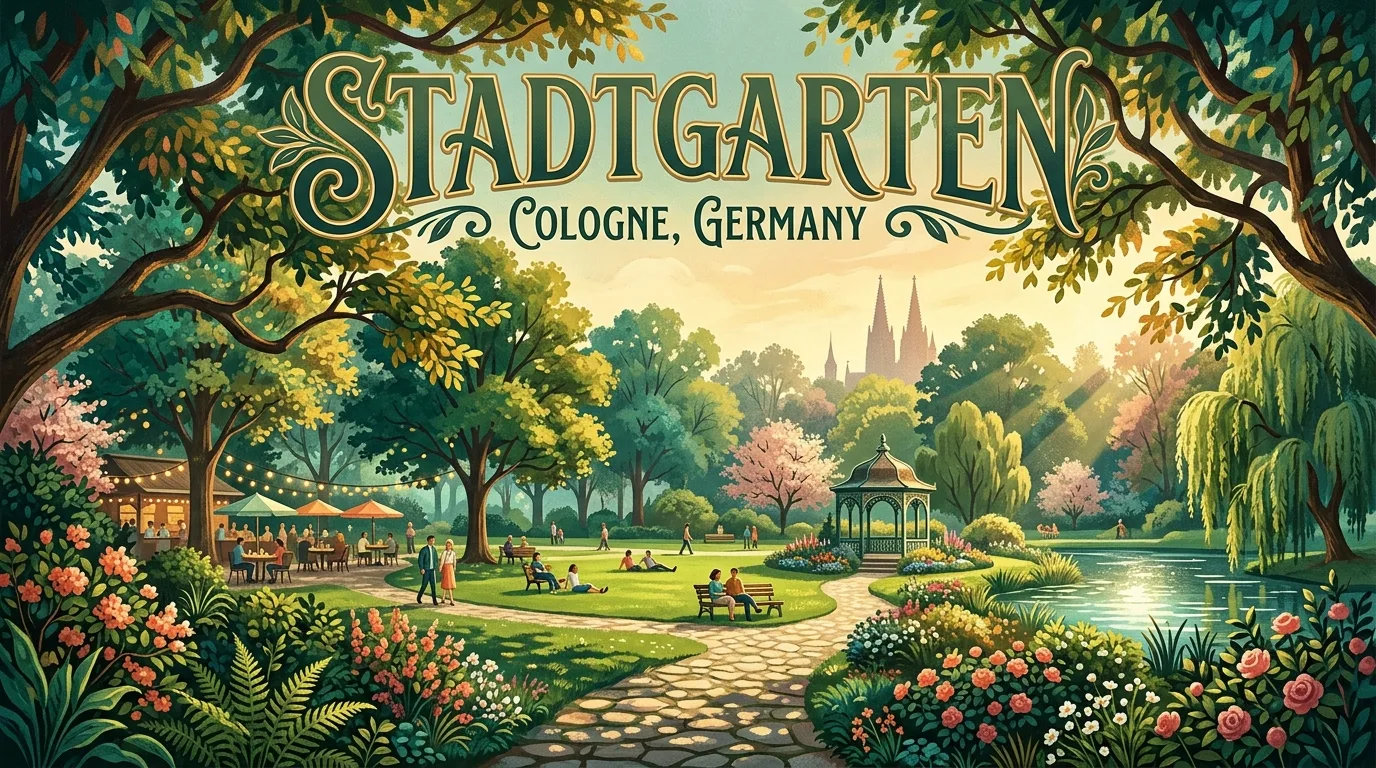
Stadtgarten in Cologne is one of the city's oldest surviving green spaces, located in the heart of Neustadt-Nord, directly adjoining the lively Belgisches Viertel. Spanning just over 6 hectares, the park combines historic garden design with one of the Rhineland's best-known music venues, the Stadtgarten concert house. Bounded by Venloer Straße, Gladbacher Straße, and Spichernstraße, the park has served for nearly 200 years as a calm green counterpoint to dense city life, while also functioning as a meeting point for jazz enthusiasts, families, students, and residents of the Belgisches Viertel alike. Visitors looking to experience Cologne beyond the classic tourist trail will find in Stadtgarten a blend of botanical tradition, cultural programming, and everyday urban life rarely found packed so densely into one place.
History of Stadtgarten
The roots of Stadtgarten date back to 1827 and 1828, when it was laid out just outside the city's historic walls as an ornamental garden with an attached municipal tree nursery. The original design was overseen by garden director Jakob Greiß. In 1857, the park received a significant botanical boost when exotic tree species were transferred here from the old Botanical Garden, which had to close due to new railway construction. A fundamental redesign took place between 1888 and 1890, after the railway line was relocated further west, freeing up additional land. This new layout was entrusted to Adolf Kowallek, a student of the renowned Berlin landscape architect Johann Heinrich Gustav Meyer. During this transformation, the original area of roughly 11 hectares was reduced to today's approximately 6 hectares, as parts of the grounds were given up for the expanding Neustadt district. The garden restaurant was rebuilt in 1898, and the characteristic Gärtnerhaus (gardener's house) was constructed around the same time. Both the historic garden layout and several of its buildings are now protected as heritage monuments, making Stadtgarten one of the best-documented inner-city parks in Cologne. Despite two world wars and extensive urban restructuring throughout Neustadt-Nord, Stadtgarten has remained a stable, continuously used green space in the heart of the city for almost two centuries. Both world wars left visible traces on the tree population and the historic buildings, yet the park's fundamental character as a calm, civic recreation space between residential blocks and the city center endured across the decades and was carefully preserved through later restoration efforts.
Highlights of Stadtgarten
Botanically, the tree population of Stadtgarten is particularly appealing, comprising around 50 different tree and shrub species, including numerous exotic varieties introduced in the 19th century. Biotope surveys have also recorded roughly 80 different plant species within the park, including unusual inner-city wild plants such as wood sorrel and bloody dock, giving the park a small but notable degree of ecological diversity. The cultural centerpiece of the grounds, however, is the Stadtgarten concert house, founded in 1986, which combines a large concert hall, the JAKI live club, a café-restaurant, and a garden and beer-garden area. With more than 400 events per year focused primarily on jazz and contemporary improvised music, Stadtgarten ranks among the most important venues for this genre in all of Germany. Since 2006, part of the park has also transformed annually into a popular Christmas market that deliberately sets itself apart from the bustle of Cologne's city center, offering a more alternative, neighborhood-driven atmosphere. Sound sculptures scattered throughout the park pick up on the site's musical theme even during the day, creating a connection between garden artistry and contemporary art installation. Shady old tree canopies, broad lawns for lounging, and quiet seating corners also make Stadtgarten a favorite retreat for students from nearby colleges and residents of the Belgisches Viertel, who come here to relax between lectures or after work. Numerous paths wind between the old trees toward small clearings that fill with picnic blankets, frisbee players, and readers especially on sunny weekends, while the proximity to the music scene gives the park a culturally charged yet thoroughly unpretentious atmosphere that draws both young and old alike.
Opening Hours, Tickets & How to Get to Stadtgarten
The park itself, as a public municipal green space, is freely accessible year-round with no fixed closing times and no admission fee. The situation differs for the Stadtgarten concert house: concerts, club nights at JAKI, and special events generally require a ticket, which can be purchased through the venue's official website; current dates, prices, and programs can be found at stadtgarten.de. The concert house's address, which also serves as a convenient landmark for the park, is Venloer Straße 40, 50672 Köln. Getting there by public transport is remarkably easy, since Stadtgarten lies right next to the city center: several tram and Stadtbahn lines stop just a few minutes' walk away, for instance at Friesenplatz or Piusstraße, from where the park is reached via Venloer Straße or Spichernstraße. The park is also just a few minutes on foot or by bike from Cologne's inner ring road or the Belgisches Viertel. Car parking in the densely populated surrounding area is limited and usually metered, so arriving by train or bicycle is especially recommended.
Attractions Near Stadtgarten
Directly adjacent lies the Belgisches Viertel, one of Cologne's trendiest nightlife and shopping districts, packed with boutiques, cafés, bars, and restaurants around Brüsseler Platz. Just a few minutes' walk away is Rudolfplatz, home to the striking Hahnentorburg, another remnant of Cologne's medieval city fortifications, as well as the bustling Hohenzollernring with its clubs and theaters. Heading toward the city center, visitors quickly reach Friesenplatz and from there the pedestrian zones around Breite Straße and Schildergasse, among Cologne's most important shopping streets. Cologne Cathedral and the historic old town are also within comfortable walking distance and combine well with a relaxed stroll through Stadtgarten. Especially in the evening hours, when the first notes of a jazz concert drift outside from the concert house, Stadtgarten takes on a particularly atmospheric quality that clearly sets it apart from the purely functional green spaces found in other parts of Cologne. Culture enthusiasts can also plan a detour to the Museum of Applied Arts or to the many small galleries scattered throughout the Belgisches Viertel, making a visit to Stadtgarten an ideal piece of a varied day combining nature, culture, and city life.
Where to stay in Cologne, Germany
Compare current hotel prices and find the right place to stay.